

Suffolk Misc - Miscellaneous References to Suffolk from Around the World - Part 6


Order of contents on this page: (Click on the links below)
Fauna & Flora:
Suffolk as a Scientific Name:
Fauna:
Flora:
suffolciensis - Wasps Species
Claude Morley (1874-1951) was an English entomologist who was born in Blackheath near Halesworth. He came to Ipswich in 1892, before moving to Monk Soham, where he lived for the rest of his life. A founder member of the Suffolk Naturalists’ Society, his collection of material from 1898 - 1951 forms the core of Ipswich Museum ’s British insect collection, with an estimated 150,000 specimens. He became a Fellow of the Entomological Society of London in 1896. He specialised in Hymenoptera & Diptera but also worked on Coleoptera, Hemiptera & Ichneumonidae. His major legacy is the five volume Ichneumons of Great Britain (1903-1914). He wrote many articles for the Entomologist magazine, & was on the editorial staff from 1909.
Morley used the suffix suffolciensis nine times to describe species that he discovered in Suffolk. Confusingly, however, some of these describe the same insect & there are now only three recognised species. Only one of these is now an accepted name, the other two having since been reclassified as being synonymous with other known species.
All three are in the order Hymenoptera, which comprises wasps, bees, ants & sawflies, of which over 130,000 species have been recognised worldwide. The name derives from the Ancient Greek ‘hymen’ meaning membrane & ‘pteron’ meaning wing, hence ‘membrane winged’. Within the Hymenoptera, all three are species of parasitic wasp in the superfamily Ichneumonoidea; which contains more than 58,000 species worldwide. One of the three is in the family Ichneumonidae, (commonly called ichneumon wasps), whilst the other two are in the family Braconidae.

Apanteles suffolciensis:
This species is listed under the following names:
Apanteles suffolciensis
Choeras suffolciensis
Hypomicrogaster suffolciensis
Microgaster suffolciensis
Hygroplitis suffolciensis
These all seem to be the same species, however. Morley first described the species in 1902 in the Entomologist magazine 38:4-5, under the title A new species of Microgaster. The species has now been reclassified & is known as Apanteles (Choeras) dorsalis, which is in the family Braconidae.

Glyphicnemis suffolciensis:
Also listed under the name Stylocryptus suffolciensis.
Morley first described this species in 1907 in Ichneumonologia Britannica. ii. The Ichneumons of Great Britain. Cryptinae. This species is now classified as Glyphicnemis atrata in the family Ichneumonidae.
Dyscritulus suffolciensis:
Also called Dyscritus suffolciensis, & sometimes known as the “Suffolk Wasp”, this is the only species with the suffolciensis suffix that is still an accepted species name. It belongs to the family Braconidae. In 1933, Morley described this species in the Entomologists 66:201-203 Notes on Braconidae XIV: Alysiides.

Antaeon suffolciensis:
Another wasp species, this one not named by Morley, was described in 1908 by the entymologist A J Chitty and given the name Antaeon suffolciensis. This one was from another parasitic wasp family, the Dryinidae. It was later noted that this species had already been described by the naturalist Johan Wilhelm Dalman in 1823 and given the name Antaeon brachycerum, thus the name given by Chitty is no longer recognised.
All images shown larger than actual size. All Photos in this section reproduced by kind permission of Colchester & Ipswich Museum Service
suffolciensis and suffolkensis – As used in the Names of Extinct Species
The suffix suffolciensis has also been used in naming a number of extinct aquatic species found as fossils in the chalk and crag deposits of Suffolk, England. The suffix suffolkensis has been used once in relation to England, but is more often used for extinct species found in Suffolk, Virginia.
Borsonia suffolciensis:
This name was given to a fossil marine gastropod mollusc (sea snail) of the family Borsoniidae. It was found in the Red Crag of Suffolk by Frederic William Harmer of Norwich, one of the pioneers in the field geology of East Anglia. It is described in The Pliocene Mollusca (1915). The name Borsonia was given in 1839 by Luigi Bellardi, the Italian malacologist (one who studies molluscs), in honour of Stefano Borson (1758-1832), the professor of mineralogy and geology at the Royal School of Mines at Moutiers, France.
Echinocyamus suffolciensis and Fibularia suffolciensis:
This particular fossil is found in the Crag beds of Suffolk and was described by Professor Edward Forbes in his Monograph of the Echinodermata of the British Tertiaries (1852). The majority of fossil finds are derived from the older Coralline Crag (see Suffolk Crag section on the Suffolk, England page). The phylum Echinodermata comprises the starfish, brittlestars, sea urchins and sea cucumbers. Echinocyamus suffolciensis was a type of sea urchin probably related to the modern Sea Pea or Green Urchin. It belonged to the class Echinoid.
In Echinoids, the skeleton is almost always made up of tightly interlocking plates that form a rigid structure or ‘test’ in contrast with the more flexible skeletal arrangements of starfish, brittle stars, and sea cucumbers. The order Clypeasteroida and family Fibulariidae constitute the complete classification of the genus Echinocyamus. In all, the Echinocyamus suffolciensis possessed an oval rigid skeleton consisting of calcium carbonate plates arranged in a fivefold radial pattern. The skeleton or ‘test’ was flattened and covered by short movable spines which would have in turn been covered with very small hairs (cilia). Its anus was on the underside behind its mouth. It probably grew no more than a centimetre. The animal thrived in the North Sea Basin burying itself in coarse sandy marine sediments deposited during a warm climate during the Pliocene and early Pleistocene epochs, feeding on detritus and foraminifera.
Echinocyamus suffolcieusis is recorded as a fossil, but this is probably an accidental mis-spelling of the above species, replacing ‘n’ by ‘u’ in the suffix.
Fibularia suffolciensis is an earlier name given to Echinocyamus suffolciensis. It is described by Henry Thomas De La Beche in his A geographical manual (1832) under “Radiaria” fossils found in East Anglian Crag. In Lamarck’s classification (1801-12), “Radiaria” is a class of animals that was divided into the orders Mollia and Echinoderma. This species name was superseded in 1852 by Forbes in his treatise mentioned above.
The name Echinocyamus was given in 1774 in a treatise by the Dutch physician, Murk van Phelsum (1732-79). The name in Latin is descriptive: “echino-” means ‘prickly’ or ‘spiny’, and “cyamus” is the Latin name for the ‘Egyptian flat bean’. In 1816 the renowned French naturalist Jean-Baptiste Lamarck (1744-1829) in his “Histoire Naturelle des Animaux” creates a new genus Fibularia in which he placed three species, one of which is obviously Echinocyamus. Since Echinocyamus was an earlier name than Fibularia, in the scientific world it should have taken precedence, but such was Lamarck’s reputation that Fibularia continued to be used for various species, such as Fibularia suffolciensis. Although a compromise was reached in 1846, some scientists refused to accept the decision and kept using whichever name they personally preferred. This caused confusion, but the dispute rumbled on until 1954 when the International Commission on Zoological Nomenclature made a definitive ruling: Echinocyamus was to apply to species “of a low type with internal radiating walls” (we would say ‘flat ones’), and Fibularia was to apply to species “of a high type without internal radiating walls” (we would say ‘round ones’).
Membranipora suffolciensis:
This fossil was described by Reginald Marr Brydone in his Further notes on new or imperfectly known Chalk Polyzoa (1936). Polyzoa is the old name for the modern phylum Bryozoa, more commonly known as “moss animals”. These are typically aquatic invertebrate animals of less than a millimetre in length. They are filter feeders that sieve food particles out of the water using a retractable ring of tentacles lined with cilia, known as a lophophore. Membranipora suffolciensis belonged to the widely distributed Membraniporidae family, of the Cheilostomata order in the Gymnolaemata class of the phylum. These animals were composed of calcium carbonate and formed large colonies that lived under seawater inhabiting the surfaces of rocks, kelps and seaweeds. This type species was found in the chalk deposits of Suffolk and differed in detail from others of its genus. The name of this lace-like Bryozoan was given in 1830 by the French zoologist and anatomist Henri de Blainville (1777-1850) and is self-explanatory, since the Latin equivalent is much the same in most European languages: a membrane that allows the passage of water though the pore (pora).
Melanogrammus suffolkensis:
This is the name given to fossil otoliths found at Sutton and Gedgrave, Suffolk, England, in the Coralline Crag, and were named after the county. They were laid down in the Early to Middle Pliocene epoch, between 5.3 and 3.6 million years ago.
Otoliths are commonly referred to as “earstones” or “fish ear bones”. They are hard, calcium carbonate structures located directly behind the brain of fish. Otoliths help with balance, orientation, and sound detection. They have a very distinct shape, which is characteristic of the species of fish. That is, different fish species have differently shaped otoliths, thus biologists can determine the species of fish from this one individual structure.
Melanogrammus suffolkensis was first described by Ernst Hermann Koken (1860-1912), a German palaeontologist and professor of geology at the University of Tübingen in 1891 (“Neue Untersuchungen an tertiaren Fischotolithen, Part II”. Zeit. Deutsch. Geol. Gesell., 1891). It was more recently described in “The Otoliths from the Miocene of the North Sea Basin” by Werner Schwarzhans, 2010.
Koken originally named this fossil species Otolithus vulgaris var. suffolkensis and placed it in the genus Merlangus, the fish commonly known in English as the whiting. He soon realised that it should be in the genus Melanogrammus (the haddock) which is in the same family, Gadidae. The original name is still sometimes seen as a synonym for this fossil. The name Melanogrammus comes from the ancient Greek ‘black’ (melaina) ‘line’ (grammē), referring to the black lateral line running along its white side, a name given by the American ichthyologist Theodore N Gill in 1862.
Callianassa suffolkensis:
Callianassa is a genus of mud shrimp, in the family Callianassidae of the order Decapoda (crustaceans). The genus was described and named by William Elford Leach (1791-1836) in 1814 (“Crustaceology.” Brewster’s Edinburgh Encyclopedia. London, 1814). Leach was an English zoologist and marine biologist employed in the Natural History Department of the British Museum, where he had responsibility for the zoological collections. He named it after one of the fifty Nereides (nymphs of the sea) in Greek mythology: Callianassa, which means “the lovely queen”.
The fossil species Callianassa suffolkensis was named by Mary J. Rathbun in 1935 (“Fossil Crustacea of the Atlantic and Gulf Coastal Plain.” Geological Society of America, Special Paper (2), 1935). One specimen (a holotype, i.e. a single physical example of an organism) was found in the Yorktown Formation, three miles northeast of the Borough of Suffolk, Virginia, hence its species name.
Mary J. Rathbun (1860-1943) was an American zoologist who specialised in crustaceans. She worked at the Smithsonian Institution from 1884 until her death. In 1935 she published the first comprehensive paper on the fossil crustaceans, principally decapods, of the Atlantic Gulf Coastal Plain of Eastern North America. In this landmark paper she describes or mentions all of the fossil decapods. All but one were listed as occurring in deposits of the Yorktown Formation which at that time was regarded as Miocene. However, later stratigraphy studies of southeastern Virginia have revised this dating, and a number of species, including Callianassa suffolkensis, are now regarded as Upper Pliocene, dating from 3.6 to 2.6 million years ago.
The Yorktown Formation is composed primarily of silty sand with marine shell fragments and was originally many hundreds of feet thick, deposited in a shallow, tropical sea 5.3 to 2.6 million years ago when eastern Virginia was submerged. During a subsequent glacial period when the sea level fell and exposed Yorktown sediments on the surface, the upper portion of the Yorktown Formation was removed by subsequent erosion, which has cut deep channels into its surface, exposing levels of strata that contain these fossils.
Cytheromorpha suffolkensis:
Ostracods are a class of the Crustacea more commonly known as seed shrimp. They are small crustaceans, typically around 1 mm in size, with their bodies flattened, round and protected by a bivalve-like, calcareous ‘shell’. Seed shrimp eat dead plant matter lying on or inside the upper layer of the sea floor. The name comes from the Greek “óstrakon” meaning ‘shell’. Ostracods are found in marine, freshwater, and wet-terrestrial habitats worldwide. Roughly 13,000 extant species in four orders have been described, but four times as many species are known only as fossils. As such, ostracods are by far the most common arthropods in the fossil record.
The oldest generic names given to ostracods are Cypris and Cythere by the Danish naturalist Otto Friedrich Müller in 1776 and 1785. These are also names of the Greek islands known in English as Cyprus and Cythera; both names are alternative names given to the Goddess of Love, better known as Aphrodite, who according to the myths emerged from the sea foam from the severed genitals of the god Uranus, nearby either one of these islands. Otto Müller (1730-84) was one of the first to study micro-organisms, and established the classification of several groups of animals all unknown to Linnaeus. Müller obviously saw a relationship between the shape of these tiny sea creatures and the sea foam of the myth. These two names are now commonly used as prefixes in ostracod nomenclature.
Cytheromorpha is a genus of the family Loxoconchidae in the order Podocopa, described by the Finnish naturalist Nikolaj Hirschmann in 1909. As noted above, the prefix is used with the Greek word “morphē”, meaning ‘shape’. In 1977 Joseph E Hazel of the U.S. Geological Survey recorded a new species found in the Yorktown Formation at Suffolk, Virginia, which he named Cytheromorpha suffolkensis. However, this was not described to a sufficiently high enough standard to be accepted. In 1983 full reference was provided on a similar fossil found at Lee Creek Mine, near Aurora, North Carolina (“Age and correlation of the Yorktown (Pliocene) and Croatan (Pliocene and Pleistocene) formations at the Lee Creek Mine.” Smithsonian Contributions to Paleobiology, Vol. 53, 1983 (Hazel)). This Cytheromorpha suffolkensis was found in the Yorktown Formation strata with an age range from 5.3 to 3.6 million years ago, and is a holotype, although it is accepted that others probably do exist in the same Formation elsewhere in Suffolk, Virginia.
Eontia incile suffolkensis:
Thomas Say (1787-1834) was an American naturalist. He helped found the Academy of Natural Sciences of Philadelphia in 1812, and accompanied Major Stephen Long as zoologist on his expeditions to the interior of North America, from which he gave the first descriptions of the many animals encountered. Thomas Say carried on his monumental work describing insects and molluscs of North America, and he is widely considered to be the father of descriptive entomology in the United States. In 1822 he gave the name Noetia ponderosa to an ark clam found along the Atlantic coast of North America. The ark clam is the common name for a family of small to large-sized saltwater clams or marine bivalve molluscs. The species have a large flat area between the umbones which, in an undamaged shell, resembles a deck of a wooden boat such as Noah’s Ark was thought to have been. Say gave the Latin name for Noah to this species (arca Noe = Noah’s ark), and the family name became Noetiidae. They are differentiated from the other ark clams by the presence of striations on the hinge ligament and on the placement of this ligament. They usually grow to around 6 cm in length, with a maximum of 10 cm.
In 1824 Say recorded a fossil clam which he named Noetia incile; the species suffix is Latin for “trench”, alluding to the deep grooves on the shell. These were noted to be the primary bivalves found in the sedimentary strata representing the intertidal sand flats and shallow, muddy areas that became the Alum Bluff Formation in the Florida Panhandle. In 1937 Francis Stearns MacNeil (1909–1983) of the U.S. Geological Survey proposed that the Noetia genus should be further subdivided into two groups (“Species and Genera of Tertiary Noetinae” U.S. Department of Interior Geological Survey Professional Paper, Issue 189, 1937). He showed that the genera usually referred to as Noetinae were two distinct groups relative to their geographic positions in the Pacific and Atlantic Oceans, and he outlined the morphologic differences that distinguished the two. The Atlantic Group comprised three genera and a sub-genus. MacNeil named this new sub-genus Eontia, an anagram of Noetia, and Noetia incile became Eontia incile.
MacNeil noted that occurring with the typical specimens of Eontia incile in the upper part of the Yorktown Formation around Suffolk, Virginia, was a quite distinct form that could be distinguished by several different morphologic characteristics. He surmised that the two stocks became separated by noticeable changes in the type of deposits that indicated a colder regime in one area to the other, and that this resulted in the two stocks developing independently. He named this different species Eontia incile suffolkensis. The type locality was found at Rock Wharf, near Smithfield in Isle of Wight County, with other occurrences one mile east of Chuckatuck, Suffolk, Virginia. The age range is between 3.6 to 2.6 million years ago.
Urosalpinx suffolkensis:
Urosalpinx is a genus within the family Muricidae. The name was given by Thomas Say (see Eontia incile suffolkensis, above) in 1822, combining the Greek words “uro-” = tail, and “salpinx” = an ancient Greek trumpet which it resembles. Most species of muricids are carnivorous, active predators that feed on other gastropods, bivalves, and barnacles. This particular genus is commonly known as oyster-drills or drill snails. Access to the soft parts of their prey is typically obtained by boring a small hole through the shell by means of a softening secretion and the scraping action of the radula (a rasp-like structure of tiny teeth used like a drill) that carves the hole. Once the hole is made, the snail will draw in and digest the soft meat of the prey.
The fossil drill snail Urosalpinx suffolkensis was described by the American geologist Gardner in 1943. Julia Anna Gardner (1882-1960) worked for the United States Geological Survey for 32 years from 1920, and was known worldwide for her work in stratigraphy and mollusc palaeontology. The fossil was first recorded in “Mollusca from the Miocene and Lower Pliocene of Virginia and North Carolina, Part 1, Pelecypoda” U.S. Department of Interior Geological Survey Professional Paper, Issue 199, 1943 (Gardner).
The shell is described as heavy with an aperture approximately half the total height, whorls convex, about six of them. It has a height of 31.0 mm and a diameter of 15.8 mm. The type specimen was found in the Yorktown Formation at a locality one mile northeast of Suffolk, Virginia, hence the species suffix. It has also been found in different strata formations at various locations in North Carolina.
Uzita suffolkensis:
Uzita is a name given to a fossil sea snail. The modern equivalent is Nassarius, a genus name coined by the French zoologist André Duméril in 1805. The common name is a mud snail (USA), or dog whelk (UK). These are small to medium-sized predatory sea snails, in the family Muricidae (the rock snails), found mostly in sandy or muddy, shallow water, often intertidal. Nassarius is derived from the Latin “nassa”, which is a wicker basket with a narrow neck for catching fish.
Uzita was recorded in 1853 in “The Genera of recent mollusca, Vol 1” (1853) H & A Adams. Arthur (1820-78) and Henry Adams (1813–77) were English brothers, and together they wrote “The Genera of recent mollusca: arranged according to their organisation” (three volumes, 1858). Uzita was the name of a 16th century chiefdom and its town near the mouth of the Little Manatee River on the south side of Tampa Bay, Florida, where the fauna were first identified. The brothers gave this name to Nassariids from the tropical western Atlantic Ocean because they considered them to differ slightly from those found elsewhere. However, Uzita was not accepted as the genus name for existing taxons, the earlier Nassarius being preferred, but it has been retained for the extinct taxon because of their abundance in the Tertiary fauna of the Atlantic Coastal Plain.Uzita suffolkensis was first referred to in 1926 by Julia Gardner (see Urosalpinx suffolkensis, above) in “The Molluscan Fauna of the Alum Bluff Group of Florida, Part VI, Pteropoda, Opisthobranchia and Ctenobranchia”, U.S. Department of Interior Geological Survey Professional Paper, Issue 142, 1926. This was with reference to a find in the Yorktown Formation near Suffolk, Virginia, hence the species name. This was the first use of this suffix relating to Suffolk, Virginia. However, the detail given was not then sufficient to have this new species accepted by the scientific community, so Gardner had to provide additional information at a later date. This was produced in “Mollusca from the Miocene and Lower Pliocene of Virginia and North Carolina, Part 1, Pelecypoda” U.S. Department of Interior Geological Survey Professional Paper, Issue 199, 1943 (Gardner). The description provides greater detail of the specimen shell which has a height of 10.4 mm and a diameter of 5.2 mm, and is stated as remarkable for its low and very flat spirals. It is found at locations in the Yorktown Formation within 1½ miles of Suffolk, and also in the same Formation at Swift Creek in Edgecombe County in North Carolina. The age range has since been adjusted to the Middle and Later Pliocene.
Calliostoma suffolkense:
Calliostoma suffolkense is a name given to a fossil sea snail. Calliostoma is a genus of marine gastropod molluscs within the family Calliostomatidae. They are small to medium-sized sea snails with gills, an operculum and a pearly inside. An ‘operculum’ means a ‘cover’ or ‘lid’, a structure attached to the muscular foot that serves as a door, trapping moisture in when the tide goes out to protect the gastropod from drying up. The name Calliostoma was given by the British naturalist William Swainson (1789-1855) in 1840. This is derived from the Greek words kallos (beautiful) and stoma (mouth), referring to the aperture of the shell. Swainson applied the name to a section of the genus Trochus, a name given in 1558 to a miscellaneous assortment of univalves, which was one of the first families listed by Carl Linnaeus in his classification of life in 1758.
The distribution of this genus is worldwide, found mainly on hard substrata rather than sandy bottoms. These snails are found in shallow waters and along the slopes of the continental shelves. The genus Calliostoma is known in fossil records from the Upper Cretaceous onwards. There are at least 575 species in this genus, so they are very common and extremely diverse.
The fossil species Calliostoma suffolkense was named by Axel Ollson in 1916 (“New Miocene Fossils.” Bulletin of American Palaeontology, Volume 27, 1916). The type specimen was found in the Yorktown Formation at Chuckatuck, in the Borough of Suffolk, Virginia, hence its species name. The Yorktown fauna of Virginia and North Carolina is unusually rich in Calliostoma species which are found in the fossiliferous deposits that underlie much of the Virginian Coastal Plain, and date to 4.5 to 2.5 million years before the present.
Axel Adolf Ollson (1889-1976) was an American born in New York State who wrote extensively on the Cenozoic Mollusca.
Suffolk as used in Virus Names
The classification of viruses shares many features of zoological nomenclature, particularly in the taxon structure, although it differs from other taxonomic codes on several points because of the peculiar nature of viruses, not least because of the importance of identification in view of their capability to transmit diseases. Viruses are infectious parasites consisting of nucleic acid (RNA or DNA, which is the first classification in their taxonomic tree) enclosed in a protein coat (called a capsid). In some cases a membranous envelope may cover the capsid. Viruses are further classified based on the presence or absence of this envelope. Non-enveloped viruses are more virulent and can survive harsh conditions, including resistance to heat, acids and drying. A minor point is that names of orders and families are italicised, unlike in the International Code of Zoological Nomenclature; names of virus strains (by which they are commonly known) are not italicised.
Mycobacteriumphage Suffolk:
A bacteriophage (usually shortened to phage) is a virus that infects and replicates within a bacterium. The term is derived from “bacteria” and the Greek word “phagein” which means ‘to devour’. Bacteriophages are composed of proteins that encapsulate a DNA or RNA genome (an organism’s complete set of DNA or RNA, i.e. basically the code for life).
Mycobacteriumphages are viruses that infect bacteria of the family Mycobacteriaceae. A bacteriumphage found to infect Mycobacterium smegmatis in 1947 was the first documented example of a mycobacteriophage. The Greek prefix “myco-” means ‘fungus’, alluding to the way mycobacteria have been observed to grow in a mould-like fashion on the surface of liquids when cultured. More than 4,200 mycobacteriumphages have since been isolated from various sources, and the genetic make-up of about 600 has been completely sequenced.
Mycobacteriumphage Suffolk is a species in the family Siphoviridae. This is a family of double-stranded DNA viruses in the order Caudovirales (also known as the ‘tailed bacteriophages’). The characteristic structural features of this family are a non-enveloped head and non-contractile tail. This virus was found as part of a science program at Oregon State University in 2010 in Corvallis, Oregon, USA. It was taken from the surface soil of a drying mud puddle in front of the University Beef Barn. The puddle was covered with a glossy sheen and the material was very damp and sticky. The phage was isolated from its host Mycobacterium smegmatis, and its genome sequenced in 2011. The name ‘Suffolk’ was given by its founder, Michelle Janik, because of her association with the Suffolk Sheep breed. As she states on her website: “Raising a small flock of registered Suffolk Sheep and competing in livestock judging gave me a greater appreciation for Oregon agriculture, and fueled my passion for food animal veterinary medicine”.
Influenza A/equine/2/ Suffolk 89 (H3N8):
Influenza A virus causes influenza in birds and some mammals, and it is a genus in the Orthomyxoviridae family of viruses. The Orthomyxoviruses (name derived from Greek words: “orthos” for ‘straight’, because of its shape; “myxa” for ‘mucus’) are a family of RNA viruses. No separate species are currently recognised in the genus Influenza A and the genus is comprised of a cluster of strains. In the viral taxonomy they are known as “negative-sense, single-stranded, segmented RNA” viruses which are categorised into several subtypes based on the type of two proteins on the surface of the viral envelope, labeled according to an H number (for the type of hemagglutinin) and an N number (for the type of neuraminidase). Different influenza viruses encode for different hemagglutinin and neuraminidase proteins. The H3N8 virus designates an Influenza A subtype that has a type 3 hemagglutinin (H) protein and a type 8 neuraminidase (N) protein. Each virus subtype has mutated into a variety of strains with differing pathogenic profiles. Variants are named according to the host species in which the strain is endemic, in this case it is “equine influenza”, subtype 2.
Equine influenza had been sporadically reported from AD 330, but it was a widespread outbreak in North America in 1872 that brought it to the attention of the scientific community as a matter for study. The virus is extremely contagious and has a short incubation period of one to five days. The disease has a nearly 100% infection rate in an unvaccinated horse population with no prior exposure to the virus. Mortality today is low and only found in foals and horses that are already seriously ill or not adequately rested. Nevertheless, periodic outbreaks in populations that are partially immune is a persistent problem in parts of Europe and North America, and indicates that as the virus spreads, it undergoes mutation and its structure changes.
In 1963, the H3N8 subtype created an epidemic of equine influenza in Miami and subsequently spread throughout North America and Europe. Vaccines were developed and following a mandatory vaccination policy in 1980, equine influenza was not experienced in the UK and Ireland until 1989 when both countries suffered an outbreak in horses that had been vaccinated. Genetic analysis of one of the viruses isolated at the Dept of Infectious Diseases at the Animal Health Trust in Newmarket, Suffolk, proved to be a significantly different strain from previous epidemics. Further analysis indicated that in the late 1980s, there was an acceleration of evolution of the H3N8 virus that had diverged into two separate lineages: an “American” lineage and a “European” lineage. This new strain was given the name A/equine/2/ Suffolk 89, indicating the place and date of isolation.
Mivirus Suffolkense (former names: Chuviridae Suffolk mivirus and Mononegavirales Suffolk Virus):
In the viral taxonomy, the category “RNA virus” includes the “negative-sense, single-stranded, segmented RNA” viruses which includes the Order Mononegavirales. This name means exactly what the preceding description says, and is derived from the Greek “monos” which means ‘single’; the Latin “negare” which means ‘negative’; and the taxonomic suffix “-virales”, denoting a viral order. The order currently includes five virus families which embrace numerous related viruses that are commonly known, e.g. Ebola virus, measles virus, mumps virus, and rabies virus. All of these viruses cause significant diseases in humans.
In the last few years there has been concern in the New York State Department of Health and local health departments of an increase in the number of tick-borne diseases that they seemed to be treating. Patients treated with antibiotics in the early stage of an infection usually recover rapidly and completely, but if untreated, a number of health problems may arise. It was noted that these tick-borne diseases are most frequently found on Long Island and in the lower Hudson Valley region. The full range of microbes that are found on ticks has not yet been fully explored, so as part of a viral surveillance and discovery project in arthropods, adult ticks were collected in Heckscher State Park in Suffolk County, Long Island, in April 2013.
Analysis was conducted at the Center for Infection and Immunity at Columbia University, New York, and new viruses were discovered, among them was one that was given the scientific name of Suffolk Virus by researchers Rafal Tokarz and W Ian Lipkin. The genetic analysis of Suffolk Virus, sequenced in June 2015, showed that it was a tick-borne virus related to Mononegavirales. It was given a taxonomic identifier but could not be placed in an existing family, so Suffolk Virus was originally placed as an “unclassified Mononegavirales”. Further analyses revealed that it belonged to a whole new family of circular RNA viruses identified in 2015 in the Order Mononegavirales. This family was given the name Chuviridae, named after the ancient Kingdom of Chu in southern China where the virus was first isolated. The primary host for the Suffolk Virus is the deer tick (Ixodes scapularis). The exact relationship of a number of viruses took a few more years to work out and a new arrangement was proposed in October 2018 and ratified in February 2019 by the International Committee on Taxonomy of Viruses (ICTV). The Suffolk Virus was renamed Suffolk mivirus. The genus name Mivirus derives from Mi, the ancestral name of King Zhuang of the Chinese State of Chu (reigned 613-591 BC), along with the suffix - virus. This was at first the only genus in the family Chuviridae which was in the order Jingchuvirales, this latter being closely related to the order Mononegavirales.
In 2020 it was decided to thoroughly revise the order Jingchuvirales and four new families were created of which Chuviridae was one. In this family there were 13 genera, Mivirus being one of them. There were 14 species placed in this genus, including Suffolk mivirus. However, it had been decided in December 2019 that “Species names are printed in italics and have the first letter of the first word capitalised. Other words are not capitalised unless they are proper nouns or parts of proper nouns.” To avoid the use of a proper noun, the Suffolk mivirus was renamed Mivirus Suffolkense. These changes were publicised in August 2020 (National Center for Biotechnology Information, Bethesda, Maryland). Thus Suffolk Virus lost its previous nomenclature to that now shown above.
Scrapie - Suffolk Strain:
Scrapie is a fatal, degenerative disease affecting the central nervous system of sheep and goats, and it is the prototype of a group of diseases described as “transmissible spongiform encephalopathy” (TSE) which affect man and some animal species, notably BSE (Mad Cow Disease). The name ‘scrapie’ is derived from one of the signs of the condition, where affected animals will compulsively scrape off their fleeces against rocks, trees, or fences. The disease apparently causes an intense itching sensation in the animals, trembling, excessive thirst, emaciation, weakness, finally paralysis and death.
Scrapie has been endemic in British sheep, particularly the Suffolk breed, since first recorded in 1732. It was recognised as an infectious disease in 1936. The extremely long incubation period of two to five years was noted as long ago as 1913. The first case of scrapie in the United States was diagnosed in 1947 in a Michigan flock of Suffolks. The owner had imported sheep of British origin through Canada. The disease is not found in Australia, New Zealand and South Africa where strict quarantine regulations exist to prevent its spread. There is no scientific evidence to indicate that scrapie poses a risk to human health.
Between 1920 and 1950, scrapie became a major problem in the British Suffolk breed, causing considerable financial loss in some flocks. Concern about the disease in the 1930s led to research that showed the Cheviot and Suffolk breeds are more susceptible to scrapie than other breeds. Further research showed that there are different strains of scrapie, distinguishable by their disease characteristics, and the Suffolk strain, known as SUF81, was first isolated in 1981 and described definitively in 1988 (AG Dickinson & JD Foster). Hence the name in this case derives directly from the breed of sheep (see Suffolk Sheep section, below) and only indirectly from the county name.
The study of scrapie has been complicated by the fact that an infectious agent causing it has never been isolated. The agent responsible must be smaller than the smallest known virus. There are two main theories on the nature of the scrapie agent: (1) the agent is a prion, an exclusively host-coded protein that is modified after infection; or (2) the agent is a virus with unusual characteristics. At present, prions are suspected to be the culprit. These are self-propagating misfolded proteins which are responsible for a number of diseases that affect the brain and other neural tissue. It is not known what causes the normal prion protein to misfold. The word prion, first coined in 1982, derives from the initial letters of ‘proteinaceous infectious particle’. However, in 2011 ‘Spiroplasma’ DNA was found in the eyes of scrapie affected sheep. ‘Spiroplasma’ is a tiny wall-less bacterium and this supports the hypothesis that a virus may be involved in the pathogenesis of this disease. Exhaustive research into the transmission of this disease has concluded that the principal or sole component of the infectious agent is the misfolding of the normal prion protein which transforms it into a ‘disease-associated infectious aggregate’ (the abnormal prion protein is designated PrPSc) (reference to the Manual of Diagnostic Tests and Vaccines for Terrestrial Animals, June 2022).
Suffolk Punch
“His color is bright chestnut - like a tongue of fire against black field furrows, against green corn blades, against yellow wheat, against blue horizons. Never is he any other color.”
Marguerite Henry (1902-97)
The Suffolk Punch, also sometimes known as the Suffolk Sorrel, or simply the Suffolk, is a breed of English heavy or draft horse.

The breed can be traced bac k to the early sixteenth century & is thought to have been a cross between the Norfolk Trotter & Norfolk Cob; later cross breeding also involving the English Thoroughbred. This produced the forerunner of the Suffolk Punch, known as the Suffolk Cob. The first description of the Suffolk Punch occurs in William Camden’s Britannia of 1586, which makes it the oldest breed of horse recognisable in the same form today.
By the 1760s, the breed had reached a genetic bottleneck, with all but one stallion having died out. The one remaining stallion, from which all other Suffolks derive today, was foaled in 1768 & owned by Thomas Crisp of Ufford near Woodbridge. Never named, this stallion was known simply as “horse 404”, but has become known today as “Crisp’s Horse”.
The Suffolk is always chestnut in colour (or “chesnut” as it is commonly written). There are seven different shades recognised, however; bright, red, golden, yellow, light, dark and dull dark. White markings are rare, but can occur on the face or lower legs. The Suffolk generally stands between 16 & 17.2 hands tall & can weigh 2,200 lbs or more.
Although shorter than other breeds of draught horse such as the Shire & Clydesdale (in the Suffolk dialect “punch” means stocky or short), the Suffolk is more massively built, with a powerful neck, well muscled shoulders & a wide back . The legs are short but strong, with no feathering on the fetlocks; the latter feature being a distinct advantage on the thick clay soils of East Anglia. The Suffolk is renowned for its early maturity, longevity, good temperament, stamina & tractive power. They are also regarded as economical; needing less feed than other horses of comparable size. Traditionally, the Suffolk Punch was used for farm work as well as pulling brewer’s drays, omnibuses &, during wartime, heavy artillery.
The Suffolk Horse Society was founded in 1877 & published its first stud book in 1880. The first official exports (to Canada) took place in 1865, with the first exports to the USA taking place in 1880. More exports took place over the next few years, with the American Suffolk Horse Association being formed in 1907. During the early twentieth century, Suffolks were exported to many European countries, as well as several other parts of the world including Australia, New Zealand & Argentina.

The Suffolk Punch remained a popular work horse in Britain until the Second World War, when the increase in motorised farm vehicles coincided with the reduction in the use of horse power. From that time the numbers of Suffolks decreased, until in 1966 only nine foals were born. In the USA the American Suffolk Horse Association was revived in 1961, having become inactive some years earlier. In the 1970s & 80s the American Society allowed cross breeding with the Belgian Draught Horse, although only the fillies from these crosses were allowed to be registered with the Association. There are now estimated to be around 1,200 Suffolks in the USA.
Since 2001, horses with American bloodlines have not been permitted to be registered with the British Suffolk Horse Society, & consequently the breed is considered the rarest in Britain. Although numbers are on the increase, the Rare Breed Survival Trust lists the Suffolk Punch’s survival status as critical. Suffolk Punch numbers are now in the low hundreds.
The Suffolk Horse Museum is located in the Shire Hall on Market Hill in Woodbridge. The museum documents the history of the Punch in more than 50 paintings & many old photographs, as well as displaying exhibits on the work done by the horses & the craft of the blacksmith & harness maker. The museum is open from April to the end of September on Tuesday, Thursday & Saturday afternoons.

Based on 200 acres of land on the Suffolk coast acquired from HM Hollesley Bay Prison, The Suffolk Punch Trust was formed in 2002. Suffolks had been bred on this land since at least the late eighteenth century, & when the Prison Service took over in 1938 they agreed to retain the st ud farm. When the prison decided that it was no longer feasible to carry on, the Trust came into being. As well as a breeding centre, the Trust has a visitor & educational heritage centre, & is open to the public from late March until the end of October. It keeps two stallions & around twenty mares & foals at any one time, as well as a collection of local breeds such as Suffolk sheep & Red Poll cattle.
Since 1972 , the Suffolk Punch has been the central image on the badge of Ipswich Town Football Club; designed by the then Treasurer of the Supporters Club, John Gammage.
See also The Suffolk Punch - A Poem by Henry Birtles on the Suffolk Misc. page
Suffolk Sheep
The Suffolk
The Suffolk is a breed of English polled (hornless), black faced sheep that has been in existence since at least the late eighteenth century. The first record of the use of the name Suffolk appeared in 1797 when Arthur Young, in his General view of Agriculture in the County of Suffolk, sta ted that:
"These ought to be called the Suffolk breed, the mutton has superior texture, flavour, quantity and colour of gravy"
Originally produced by crossing Southdown rams with Norfolk Horned ewes, the Suffolk was recognised as a pure breed in 1810 & was first exhibited at the Suffolk Show in 1859. In 1886 the English Suffolk Society was formed, with the first flock book being produced in the following year.
The breed’s popularity soon spread across the British Isles.
The Suffolk is a short fleeced breed, primarily bred for its meat. The average weight of a ram is between 250 & 350 lb, whilst a ewe typically weighs between 180 & 250 lb. The fleece is usually in the range of 2 to 3.5 inches in length. Suffolks are renowned as good breeders & are widely regarded as the leading terminal sire on a variety of breeds of ewes to produce top quality lamb.
Suffolks were first exported to Australia in the 1880s (but not registered until 1904), the USA & Canada in 1888, South Africa 1896 and New Zealand in 1913. Today the breed is found throughout the world.
The Suffolk Sheep Society is now based in Ballymena, Northern Ireland.
(See also Scrapie - Suffolk Strain in the Suffolk as used in Virus Names section on the Misc. page)
The South Suffolk
In 1929, New Zealand breeder George Gould developed the breed known as the South Suffolk, by further crossing between the Suffolk & the Southdown. The main objective of this was to combine the lean carcase of the Suffolk with the finely-textured meat of the Southdown. It was recognised as a breed in 1940 & was first exported to Australia in 1946. It is now found throughout Australia. The South Suffolk is generally slightly smaller than the Suffolk, with rams weighing between 200 & 300 lb & ewes between 150 & 220 lb. The Australian South Suffolk Breeders Society was established in 1958, but amalgamated with the Australian Society of Breeders of British Sheep in 1972.
The White Suffolk
The White Suffolk is a breed developed in Australia in the 1970s with experimentation conducted by Professor E. Roberts of the University of New South Wales. The aim of this experimentation was to produce a breed with the stature & characteristics of the Suffolk, but with a white head, legs & body. The reason for this was to reduce the risk of contamination of the wool by dark fibres. This was achieved by crossing the Suffolk with white breeds; mainly the Poll Dorset. The Australian White Suffolk Association was established in 1985.
Suffolk Pigs

The Black Suffolk, also known as the Small Black, is a now extinct breed of pig. Originating in the nineteenth century, its exact origins are unclear, although it is possible that it was created by crossing the Essex Pig with foreign breeds; the short upturned snout & pricked ears, together with its size, are suggestive of some contribution from imported Chinese pigs.
Another theory is that the Suffolk Pig predates the Essex & that the latter was created from a cross between the Suffolk & the Yorkshire White Pig.
Although the Suffolk matured early, it was said to have a delicate constitution & too great a percentage of fat, so by the beginning of the twentieth century its popularity was on the wane. The Small Black seems to have died out after being cross bred with the breed known as the Devon Pig to produce the Large Black; a breed also indigenous to Suffolk. The Large Black Pig Society was formed in Ipswich in 1898. It produced the Herd Book of Large Black Pigs in 1899. In it the large black pigs of Devon and Cornwall were combined under one name with the remnants of the smaller Black Essex, Black Suffolk or Small Black, and other black East Anglian breeds whose numbers had fallen below sustainable levels. This date is accepted as the year of extinction for the breed.
The Suffolk White Pig was well documented in early 19th century agricultural literature. It is described as a pig that “stands high, is narrow in the back, and the forehead is rather broad; the ears stand pretty well; the hair is short with many bristles. The weight when fully grown is from 16 to 19 stone.” (from “Treatise in the Breeding and Management of Live Stock” by Michael Parkinson, 1810 (Cadell and Davies)). Similar descriptions follow and the breed was still being recorded in 1842 by the Encyclopedia Britannica. It finally became absorbed with the Small White (in America known as the Small Yorkshire) well before the end of the century. However, the popularity of the Middle White led to the rapid decline of the Small White breed and that was declared extinct in 1912. The breed survived in the United States for a few more years (see next paragraph).
The American Suffolk is believed to have been developed from a Small (Yorkshire) White imported to the United States in 1855 by John Wentworth of Illinois. It was called the American Suffolk because of its similarity to the English Suffolk White, and it was accepted as a distinct breed by the National Swine Breeders’ Convention at Indianapolis in 1872. A full, detailed description of the breed was compiled; this can be briefly summarised as having a small head, very short snout, dished face, upright small ears, short thick neck, a good length of body, pinkish skin and soft fine hair. It matured early and gave excellent meat.
The American Suffolk pig in a breed comparison was essentially a Small Yorkshire, although there were finer distinctions in the dish and size of the face. Otherwise the two breeds were to all intents and purposes the same. The Small (Yorkshire) White was developed in England in the early 19th century by cross-breeding the traditional Old Yorkshire with imported Chinese pigs, from which it inherited the dished face. This characteristic also distinguished the American Suffolk from the English Suffolk White.
The distribution of the American Suffolk pig was mainly in the Mississippi Valley, small herds being kept in Michigan, Iowa, Illinois, and Indiana, numbering between one and two thousand pigs in total. There were a few hundred registered in Canada. The American Suffolk breed never had much development in that country and, although an association was organised on its behalf, the American Suffolk was not recognised in the 1904 list of accredited swine-record associations of the United States Department of Agriculture. Like the English Suffolk White, the breed was absorbed by the Small Yorkshire. The American Suffolk was no longer recorded by the US Department of Agriculture in its “Breeds of Swine” publication of 1917, which also states that “the Small Yorkshire is but slightly bred today either in England or America”.
Suffolk Dun & Red Poll Cattle

The now extinct Suffolk Dun cattle are thought to have derived from stock imported from Holland during the late sixteenth & early seventeenth centuries. The Suffolk Dun were a large breed of dairy cattle with a high milk yield. Predominantly dun coloured, they were later crossed with the beef breed known as the Norfolk Red (also now extinct) to produce what was originally called the Norfolk and Suffolk Red Polled cattle; a name that was adopted in 1863. The breed became known as the Red Polled in 1883, then the Red Poll in 1888. The Norfolk cattle had been a horned b reed, but this has been bred out, resulting in the hornless Red Poll of today. The increased popularity of the dual beef/dairy purpose Red Poll resulted in the Suffolk Dun dying out in the latter part of the nineteenth century.
The Red Poll was introduced into Australia in the 1860s & New Zealand in 1898. It was introduced to America in 1873 & is the oldest registered breed in the United States.
As the name suggests, the Red Poll is red in colour (although of varying shades), with white only on the tail switch and udder. Along with the Suffolk Sheep & Suffolk Punch horse, the Red Poll is today considered part of the “Suffolk Trinity” of local breeds.
Suffolk Chocolate (Breed of Cat)

The Suffolk Chocolate is one of the newest breeds of cat accepted for registration in June 2014 by the Governing Council of the Cat Fancy (GCCF), the premier registration body for cats in the UK. The breed had been developed over the previous ten years by two dedicated Havana breeders who both live in Suffolk, hence its name.
In 1920, the Siamese Cat Club of Britain decided that brown cats without blue eyes were no longer desirable, and that was that. Breeders lost interest in them until the 1950s, when a group of British cat breeders set themselves the task of determining the genetic makeup of a solid brown-coloured cat. As the result of a cross between a shorthaired black cat and a chocolate Siamese, they eventually produced a chestnut-brown cat that came to be known as the Havana Brown (whose only connection to Cuba is the supposed resemblance of the colour to that of a Havana cigar). From 2007 Havana breeders made progress in isolating the chocolate genetics from the existing bloodlines in Britain, and with further matings they began consistently producing kittens in chocolate and lilac, its recessive colour. The Suffolk Chocolate was born.
The Suffolk Chocolate has a sleek shiny coat and vivid green eyes. It is dog like in character, being devoted to its owner and family. They make an ideal house cat, as they prefer the company of their owner, rather than being left to wander. They are highly intelligent, and extremely curious.
Suffolk Chequer - Breed of Chicken
A new chicken breed has recently been accepted by the Poultry Club of Great Britain. The Suffolk Chequer Breed Club made an application for recognition in 2011, and on 14 May 2013 it was decided to recognise the Suffolk Chequer as a unique breed in the True Bantam class. The last native domestic fowl breed to gain standardisation was in 1956, thus making this quite a rare achievement.
There are hundreds of chicken breeds in existence. Domesticated for thousands of years, distinguishable breeds of chicken have been present since the combined factors of geographical isolation and selection for desired characteristics created regional types with distinct physical and behavioral traits which were passed on to their offspring. In 1877 the Poultry Club was founded to ensure that all pure and traditional breeds of poultry are bred according to predetermined breed standards set down by the governing organisation.

This breed has been developed by Trevor Martin from Norfolk in a process that has taken 15 years, starting in 1995. When Mr Martin retired to near Stowmarket in Suffolk, he decided to keep some poultry. After a while, he started to selectively breed. He wanted to create a new type of bantam (miniature) barred fowl based on the Barred Plymouth Rock, but with a much larger tail. This particular feature had dwindled in size in the Barred Plymouth Rock because of specific selection that had been made to ensure greater precision in barring. (“Barring” is when the feathers are marked with distinctive bands in contrasting colours.) The new type was first shown in 2002 at which time it was decided to call the breed the Suffolk Chequer - after the county in which it had been bred, and the checkered black and white pattern of its plumage (see photo, left).
For show purposes standard specifications have to be observed to maintain the desirable carriage and tail that are characteristic of the breed. The preciseness of barring in males and females is not of primary importance and should not be perfectly defined as in the Barred Plymouth Rock.
Pied Suffolk - Breed of Chicken

Pied Suffolks are Rhode Island Red and Suffolk Chequer hybrids that have the prolific egg production associated with the Rhode Island Red. They have a striking appearance; a black body with black and white neck feathers, hence the name “pied”. This look can vary from black with white flecks to white with black flecks (see photo, right). They lay brown eggs and maintain an excellent shell quality. They are a nice size bird with a very thick plumage. This makes them a hardy bird and well suited to the British climate. Many modern hybrid hens have Rhode Island Red fathers, mainly due to the prolific egg laying characteristic of the Rhode Island Red, which is passed down through the males. The Pied Suffolk hen lays up to 240 large, light brown eggs per year. They make excellent “backyard chickens”, i.e. utilitarian birds that are not bred for show purposes.The Suffolk Chequer and Pied Suffolk are not yet known in the USA.
Suffolk Ant-lion
Ant-lion is a name applied to a group of about 2,000 species of insects in the family Myrmeleontidae that belong to the same order as the more familiar lacewings. Strictly speaking, the term “ant-lion” applies to the larval form of the members of this family, but while several languages have their own terms for the adult, there is no widely used word for the adult in English. The ant-lion larva is often called “doodlebug” in North America because of the odd winding, spiralling trails it leaves in the sand while looking for a good location to build its trap, as these trails look like someone has doodled in the sand.
The scientific name (Myrmeleo) is the literal Ancient Greek translation for “ant-lion”, and in most European and Middle Eastern languages, the larvae are known under the local term corresponding to “ant-lion”. The name, therefore, goes back to antiquity and probably arose from people noticing a large terrestrial biting insect, surpassing ants in size and predatory habits, and hence resembling the lion in being the most “feared of the insects and ants”. Ant-lions are worldwide in distribution. The species found in Europe is the Euroleon nostras, whose scientific name means “our European lion”.
Euroleon nostras adults are free-flying, brown in colour and are generally similar in appearance to dragonflies and damselflies; however, the four large wings are decorated with dark spots. Larvae are very different in appearance to the adults; they are voracious predators with huge jaws, and the name ant-lion refers to this stage, not to the adults. Larvae require dry sandy soil, close to vertical sandy ledges that help adults emerge. The adults need tall, isolated Scots pine trees (Pinus sylvestris) nearby, where mating takes place.

The larvae (see photo, left) spend their life underground; they create ‘ant-lion pits’, by burrowing backwards into the sand. The larva buries into the bottom of the pit but leaves its jaws sticking out. When unsuspecting insects, woodlice, spiders and millipedes pass by the pit, the ant-lion larva flicks sand at them until they fall in, where they are grabbed by the huge jaws, sucked dry and then tossed out of the pit. The body of the larva is covered with forward-facing bristles that prevent it from becoming dislodged from its pit. These hairs mean that larvae can only move backwards.

The traps, often all that is seen of the ant-lion, are conical pits (see photo, right) which it forms by flicking sand outwards with its head. They are found in colonies in loose, dry sand at the base of small south facing sandy cliffs. The larvae take two years to mature in the ground where they pupate and emerge in late summer as winged adults. After allowing their wings to harden they gather in a tall pine tree, where they mate. After mating, the female flies to the ground, where she lays her eggs in the sand. She has to be particularly wary of ant-lion larvae at this time, which are the main predators of adult females. Males live for up to 20 days, while females last a little longer, with an average life span of 24 days.
E. nostras is an extremely rare insect in Britain. It was originally only known from the Minsmere area of the Suffolk Sandlings, and more than 80% of the larvae occur in a restricted area not open to the public. Hence, it is commonly referred to as the Suffolk Ant-lion, although it is not considered a sub-species of E. nostras. The first confirmed record of the ant-lion in Britain was in 1931 although an earlier sighting was made in 1781 but recorded under the wrong name. It seems likely that individual larvae arose from mated adult females being blown across the North Sea from the populations in mainland Europe. However, it was first confirmed as a resident breeding species in Britain only as recently as 1996. The data indicated that a sizeable population could be present in the Suffolk Sandlings which showed that the insect had probably been present in the area for 70 years or more. Because of the difficulty in recognising the signs, it seems that E. nostras was overlooked for a long time in Britain. (Info. from “The Suffolk Ant-lion Euroleon nostras”. British Wildlife, Plant, C.W., 1999.) Since 1999 entomologists have been looking out for this unusual insect and several more colonies have been found all along the Suffolk Sandlings, and in August 2008 a colony was discovered on the Norfolk coast. It does seem that the Suffolk Ant-lion is making a determined effort to become a native of these islands.
Suffolk Merries
This is one of the many alternative names for Prunus avium. This is the “wild cherry” in England, but that name is also used for other species of Prunus that grow wild in habitats in other English speaking countries such as North America, where the “wild cherry” is, botanically speaking, the Prunus serotina. The Prunus avium means “bird cherry” in the Latin language, but in English the “bird cherry” refers to Prunus padus. Confused so far? Never mind. Back to basics below.
Prunus avium is believed to be one of the parent species of all the others. It is a deciduous tree growing to 50-100 ft (15-32 m) tall, and in its wild state is native to most of Europe, including Britain. Evidence of consumption of cherries has been found as far back as the Bronze Age, but modern cultivated cherries, which differ from wild ones in having larger fruit, have been cultivated in Asia Minor and Greece since 800 BC. “Suffolk Merries” refers to the small bitter black cherry, the fruit of the Prunus avium, as well as the tree that bears this fruit. So how did it come to get this name?
The English word cherry comes directly from the Norman French cherise. This and the modern French cerise ultimately derives through Greek and Latin from the place Cerasus, today a city in northern Turkey called Giresun from where the cherry was first exported to Europe. The French merise is recorded in c.1275 and is believed to come from a merging of amer = bitter and cerise = cherry. In English merise is recorded from 1675 for the small bitter black cherry. In the eastern counties of England this was spelt “merries”, and Suffolk was particularly notable for the widespread range of this tree and its fruit, hence it was known as the Suffolk Merries.
Suffolk Osier
The Suffolk Osier has tentatively been accepted as an alternative name for the Common Osier (Salix viminalis) by the Royal Horticultural Society.
The Common Osier is a small deciduous, shrub willow tree native to Eurasia. This fast-growing willow has been cultivated for centuries for its flexible shoots, which can be woven into baskets and wicker chairs. Suffolk is one of the traditional willow growing areas of England. Willows require a fertile lowland site, especially clay and silt, and wet but not waterlogged soil, so having well maintained ditches and drainage systems are essential. In England the three most important species of willow are the Salix triandra (almond-leafed willow) for general purpose work, the Salix purpurea (purple willow) with its slender rods for small, high quality basketware, and the Salix viminalis (common osier) that produces stouter rods for heavier basket work, hurdles and fencing. The earliest record of a basket maker in England is Johanne Hoo in a Poll Tax return in Suffolk in 1381.
Suffolk Grass
Poa annua is commonly known in Britain as Annual Meadow Grass, Causeway Grass or Suffolk Grass. In America it is more commonly known as Annual Bluegrass. It is the most general plant in nature that grows in every situation where there is vegetation. It is a widespread low-growing, tufted, annual plant found in temperate climates. ‘Poa’ is Greek for fodder since it is one of the sweetest grasses for green fodder, and ‘annua’ because it is an annual plant. The terms Meadow Grass and Causeway Grass were given because of its natural habitat, but the name Suffolk Grass had long been applied to it because it was widespread in the county. It was the Norfolk naturalist, Benjamin Stillingfleet (1702-71), who popularised this name in the earliest standard textbook on grassland cultivation “Observations on Grassland” in 1759. He stated that ‘he had seen whole fields of it in High Suffolk without any mixture of other grasses and as some of the best butter comes from that county, Suffolk Grass is most likely to be the best grass for the dairy.’
Suffolk Grass does not thrive on acidic soils and is found chiefly on loam and sandy soils. It is officially described as a cool-season winter annual. However, it is the most common and widely distributed grassy weed in the world. It is mentioned as a weed in nearly every plant commodity. There are many different forms and it can spread rapidly by seeding. The sub-types are so diverse that they can easily adapt to everything from waste ground to closely maintained putting greens.
Growth is strongest in the late spring, although there is often a flush of growth in autumn. Plants can become reproductive from the age of one month. Flowering is most prolific in spring, but in moderate climates Suffolk Grass can flower and produce seed in any month of the year. The feature that makes it such a successful grass plant is its ability to seed at cutting heights as low as 5 mm, and to flourish in any site conditions.
Because Suffolk Grass grows in arable land as well as in turf, there are no areas of land completely clear of it. It occurs as a common constituent of lawns, where it is usually treated as a weed. As one of the most invasive weeds in turf, it is also one of the most difficult to control because it is actually a diverse group of different biotypes with varying characteristics dependent on the climatic conditions where it grows. Efforts to find chemical controls for Suffolk Grass have been thwarted by its diverse genetic make-up. However, it is sometimes the most suitable lawn grass for many sites because of its short growth, and can form most of the entire grass sward in some lawns. On lawns it grows better in rich soils, but is usually small enough to be overlooked. It does not compete with other plants. Many golf putting greens are planted with this grass.
Suffolk Lungwort
The Suffolk Lungwort or Unspotted Lungwort (Pulmonaria obscura) is a rare native plant, Suffolk having the entire British population of this species. It is found in only three ancient woodlands and its conservation status is classed as Vulnerable. The areas are protected wildlife sites; there is no public access and permission to enter must be obtained from the owners before any visit. One very private, ancient wood is opened annually, for one day only, to raise funds for the local church.
Pulmonaria (lungwort) is a genus of flowering plants in the family Boraginaceae, native to Europe and western Asia. The scientific name Pulmonaria is derived from Latin pulmo meaning ‘lung’. In Medieval times, the spotted oval leaves of Pulmonaria officinalis, the Common Lungwort, were thought to symbolise diseased, ulcerated lungs, and so were used to treat coughs, respiratory infections and diseases of the chest. The common name in many languages refers to lungs, as in English “lungwort” and German “Lungenkraut”; the noun ending ‘wort’ in Old English indicated a plant or herb used as a medicine.
The Common Lungwort (Pulmonaria officinalis) was introduced into Britain, probably by the Normans, as it was grown in herb gardens for its medicinal qualities and was given its alternative name of Our Lady’s Milk Drops because of the white spots on its leaves. It is an herbaceous evergreen perennial with a hairy stem and green heart-shaped pointed leaves with large white spots, growing to a height of 6-12 ins (15-30 cm). The newly opened flowers are light red, changing later to purple and finally blue. The reason for the colour change is probably to do with pollination; only the freshest flowers have the nectar that the pollinators are interested in, but the older flowers increase their size and florescence to make them look more impressive and, therefore, continue to play a part in attracting insects, even as they age.

Pulmonaria obscura is similar to Pulmonaria officinalis, differing only in its unspotted leaves, lack of over-wintering leaves, and chromosome number. The Belgian botanist Barthélemy Dumortier described the differences in 1865 and P. obscura or the Unspotted Lungwort (its given common name) was recognised as a wild flowering plant in the forests of eastern Europe soon after. Formerly P. obscura had been considered a subspecies of P. officinalis. However, on the basis of the sterility of hybrids between the two taxa, its specific status as a separate species has been accepted since 1972 (Merxmiiller & Sauer).
In 1842 a lungwort with unspotted leaves was discovered in Burgate Wood, East Suffolk by C. J. Ashfield. It was soon realised that it was distinct from Pulmonaria officinalis, and it was referred to as the “Suffolk Lungwort”. Its discoverer and others considered it to be a true native of Suffolk. Nevertheless, there was a reluctance to acknowledge this lungwort as native. Several taxa of lungwort were included in early British books on horticulture, but none of these include P. obscura because of its rarity. This may account for its having been overlooked by early English botanists, and left to enjoy its native shade in Suffolk. Later the Suffolk Lungwort was found to occupy sites in Burgate Wood, Stubbing’s Wood and Gittin Wood, all adjacent ancient woods located on chalky till in East Suffolk. Within these woods the lungwort is confined to areas far into the interior of the woodland with poorly drained, fertile soils with a history of management by coppicing. In 1985 C. D. Pigott saw the lungwort in Burgate Wood and confirmed that it was P. obscura, a species which he had seen in Poland, and this was later confirmed in 1993 when a specimen was examined by Prof. W. Sauer. In 1994 the total population covered some 18 square metres and produced about 600 flowering stems.
It was not until the 1990s that P. obscura was finally considered truly native to Suffolk and not an introduction by man. It grows in a genuine wild, natural locality; there is no evidence that P. obscura has ever been cultivated by man in Britain either as an ornamental plant and, therefore, likely to be a “garden escape”, or ever used for its medicinal properties since the latter purpose is only associated with the lungwort with the spotted leaves. The plant is plentiful where it grows, and it reproduces sexually. Since the habitat and its association with the same plant communities closely match those of P. obscura found on the nearest continental sites in the Ardennes, it seems most probable that it arrived in Suffolk carried by wind or birds, a direct distance of some 250 miles (400 km), and thus gained a toehold here some time ago. Formerly it was more abundant and its decline since the 1930s seems to be related to a decline and cessation of coppicing at two of its habitats. Coppicing of these two sites has been reinstated in recent years because the plant is classed as Vulnerable.
Varieties/Cultivars - Introductory Note
In the horticultural world a “variety” is a naturally occurring plant which is different from others within a species, and a “cultivar” is the same, except that it has been ‘man made’. However, it is common for gardening outlets to refer to them all as “varieties”, and we have adopted this practice, although all of the following are actually cultivars. Where we have been unable to find an image of the actual plant, we have used an image of a similar variety.
Suffolk Pink - Variety of Apple
The Suffolk Pink is a dessert apple with pale translucent lemon-and-pink complexion & has a Gala-like sweet & mild flavour.
The Suffolk Pink apple was first ‘discovered’ by Dan Neuteboom at his orchards at Braiseworth near Eye in Suffolk, England. It was first noticed in the 1980s that one tree, that had originated from a nursery at Thurston, Suffolk during the 1970s, was different from the other trees in the orchard. After carrying out trial propagation during the 1980s & 1990s, Suffolk Pinks were planted at other orchards in Suffolk, such as at Hemingstone & Stonham Aspal. It is now grown commercially.
Nowadays the Suffolk Pink is a popular variety sold in many outlets in Britain, including Waitrose & Sainsbury’s supermarkets.
Suffolk Stiles Pippin - Variety of Apple
A recent discovery from an old village garden in Horringer, Suffolk, England. It is a dark green Catshead type cooking apple that keeps until March and is then sweet enough to eat as a dessert.
Mrs Maureen Chessel had lived with the same apple tree in her garden for 37 years in Horringer. When she intended moving house she wanted to plant the same cooking apple variety in her new garden, so she started a search to identify it. After a three year search, she had failed to find out what variety it was, so in 2008 she contacted the head gardener at Ickworth House, where they safeguard ancient fruit trees. It was only then that it was realised that this was a rare, unknown, unnamed variety of cooking apple. Therefore, Mrs Chessel got the opportunity to name it “Suffolk Stiles Pippin” after her family name “Stiles”, and the county of origin of the tree.
The original tree, thought to be more than 400 years old, has been donated to the National Trust garden at Ickworth House in Suffolk, and it has recently been propagated for other local orchards.
More Varieties of Apple Named ‘Suffolk’
The Little Book of Suffolk (2013) by Neil R Storey lists five varieties of apple to use the name ‘Suffolk’, without giving any further details. Apart from the Maxton/Suffolk Superb, none of these are grown commercially today, & some may no longer exist. Although information on some of these is scant, below are the details that we have been able to discover about these varieties:
Lord Suffolk: This could be another name for the Lord Stradbroke variety, first grown at Henham Hall near Wangford in 1900 by Lord Stradbroke’s gardener, Mr Fenn. Also known as Fenn’s Wonder or Fenn’s Seedling, the Lord Stradbroke is a large red apple with white flesh used mainly for cooking.
The earliest mention we can find of the “Lord Suffolk” apple is in a poem by James Crowden in 1999 entitled “Apple Day Laureate Poem”. It is supposed to be a ‘Veneration of the Apple God’ and goes through England from north to south recording the apples in each county. However, he places the “Lord Suffolk” in Dorset:
“Where you can ask the difference between Queen Anne and Sheep’s Nose,Summer Stibber Sops in Wine, Lord Suffolk and Greasy Pippin,….”
This of course could be poetic licence, given that Lord Stradbroke does not fit the metre.
Suffolk Beaufin: The earliest reference to this apple that we have found is in “An Encyclopædia of Gardening” by John Claudius Loudon, 1824. No further information is available, although this is probably similar to the Norfolk Beaufin, a variety grown in that county and originally known as the Norfolk Beefing. It is a medium to large greenish-yellow apple with dark red streaks, hence the reference to “beef”, first recorded in 1698. The spelling “Beaufin” is a fabrication to pretend it derives from French meaning “beautiful and fine”. It has a crisp, dry taste used predominantly for cooking and drying. In cooking it is usually baked and flattened in the form of a cake, known as a “biffin”, a name obviously derived from “beefing” (1822).
Suffolk Beauty: Described in 1869 by Downing as a new variety from Deer Park, Long Island. Fruit medium, yellowish-white ; flesh subacid; season August and September. Nothing else is known about it. (From “The Apples of New York” 1905). Andrew Jackson Downing (1815 -1852) was an eminent American landscape designer and horticulturalist from New York. His 1869 book was “Rural Essays”.
Suffolk Foundling: No details available, although this may be related to the Bedfordshire Foundling, an Orange Pippin cultivar first produced in that English county sometime in the early nineteenth century. This is a large round cooking apple with a rich sweet-sharp, fruity flavour.
Suffolk Superb: More commonly known in Britain as the Maxton, this was discovered in an orchard in Assington, Suffolk, in 1939 by Richard Heseltine, a fruit farmer originally from Kent, who was then living at Assington. The name Maxton was partly derived from the apple being a local clone of Laxton Superb. It was sent to the National Fruit Collection in 1961 where it was known as the Suffolk Superb. Later in that decade it was sent for trial in Holland. Maxton/Suffolk Superb is a sweet flavoured, juicy dessert apple.
If anyone can provide further information on these varieties of apple, please email details to info@planetsuffolk.com
Suffolk Thorn - Variety of Pear
This dessert pear pre dates 1841 & was originally cultivated by Andrew Arcedeckene at Glevering Hall, Hacheston, Suffolk, England. It is said to have been raised from Gansel's Bergamot (Pyrus communis) & to be very similar both in appearance & in flavour. The tree is said to be quite hardy, whilst the skin of the fruit is pale lemon-yellow & covered with numerous small dots and irregular patches of pale ashy grey russet. The flesh is yellowish white in colour, & the taste sweet & juicy. The fruit ripens in October.
Have you signed the Guestbook yet?
Suffolk Red Grape & Suffolk Pink Grape
Vitis labrusca (Fox grape) is a species of grapevines belonging to the Vitis genus in the flowering plant family Vitaceae. The vines are native to the eastern United States and are the source of many grape cultivars. It has a characteristic “foxy” musk. This musk is not related to the fox animal, but rather the earthy aromas that the early European settlers to the New World associated with the grapes. Vitis labrusca was likely to have been the species spotted by the Norse explorer, Leif Ericsson, growing wild along the coast of Vinland in the 11th century. There is ample evidence that the labrusca was growing wild in North America centuries before the Europeans discovered the continent. However, the vine was not officially identified and recorded until American vine species were catalogued in the mid 18th century. Vitis labrusca varieties can better withstand the severe continental conditions of eastern North America with severely cold winters and hot, humid summers.
During the 19th century, grape cultivators responded to consumer preferences by developing improved varieties or cultivars of seedless grapes. In 1935 a seedless red grape was developed at Cornell University’s research facility in Geneva, New York State. The fruit was first described in 1941, and the selection was propagated in 1944. It was not until the late 1960s that state-funded research became available for the wine industry. A Cutchogue farmer, John Wickham, in association with a Cornell professor, John Tomkins, were then able to develop a hybrid seedless table grape variety that they named the Suffolk Red in 1972. The vine of the Suffolk Red has good vigour and is only moderately hardy. It produces large clusters of very round, medium sized red grapes. The flesh is sweet and of very good quality. The Suffolk Red is not sufficiently winter hardy for colder areas. However, with relatively mild winters as in Suffolk County on Long Island, it is successfully cultured, and this area gave its name to the grape. These grapes are seedless, have very tender skin and are eaten fresh or cooled down as a dessert. Suffolk Red wine can be produced from the grape, but it is not sold commercially and has to be home-made.
The Suffolk Red Seedless Grape is a hybrid cross between the Mediterranean hybrid Vitis vinifera ‘Russian Seedless’ and a cultivar of American Fox Grape (Vitis labrusca ‘Fredonia’). Vitis vinifera is the ‘common grape vine’ native to Europe and Asia that produces over 99% of the world’s wines today. The attribute of having a Mediterranean grape variety as one parent has given rise to differences in nomenclature. Hybrids tend to resemble one species more closely than the other, but in this case it is difficult to tell. So, in North America the vine is referred to as Vitis labrusca ‘Suffolk’, whereas in Europe it is referred to as Vitis vinifera ‘Suffolk’. Just to confuse us even more, the common name of the vine on both sides of the Atlantic can be ‘Suffolk’, ‘Suffolk Red’, ‘Suffolk Seedless’ or ‘Suffolk Seedless Red’.
Modern breeding has introduced yet another variety known as Vitis vinifera ‘Suffolk Pink’. The longer summers that are now occurring in Britain favour seedless varieties better suited to the climate, both for greenhouse growing and outdoors. Greenhouse-grown vines give bigger and earlier crops. This variety has a definite pink colour and a crisp, watery crunch. It was first developed in 2011 by Stephen Read at Reads Nursery, a small family business that has been going since 1841 in the heart of Suffolk’s Waveney Valley, near Bungay. The name is equally appropriate as the vine was bred in the original county in England as well as being descended from the vine developed in the county of the same name in America.
Suffolk Belle - Variety of Conifer
Suffolk Belle is an officially recognised cultivar of the conifer genus Chamaecyparis lawsoniana first grown in 1985 in Great Britain. It is not recorded which nursery developed this cultivar or why this name was given. Our presumption is that it was a nursery in Suffolk.
The Lawson’s Cypress or False Cypress (Chamaecyparis lawsoniana) is a large evergreen coniferous tree that can reach 200 ft tall, with feathery foliage usually blue-green in colour. It is native to eastern Asia, and western North America. It was first noted near Port Orford in Oregon, and introduced into cultivation in 1854 by collectors working for the Lawson & Son nursery in Edinburgh, Scotland, after whom it was named. In North America it is officially known by the name Port Orford Cedar, but as it is not a cedar, international botanists prefer to use the name Lawson’s Cypress. When grown together with regular maintenance, it is an excellent wind break hedge and it grows well in dry, windy environments. They are of considerable importance as ornamental trees in horticulture; several hundred cultivars have been selected for various traits, of which the Suffolk Belle is one.
A cultivar (short for ‘cultivated variety’) is a plant that has been propagated not from seed, but selected intentionally, e.g. by stem cuttings. With this method of propagation, the offspring will retain the characteristics of the parents for just the one generation because the seeds of cultivars may not stay true to form. By contrast, a “variety” arises naturally in the plant kingdom, and plants grown from its seeds will typically come out true to type.The fact that there is no description or information available on the Suffolk Belle would indicate that it was a type that did not catch on with the horticulturalists, although they do know how to propagate it again, if desired.
Why not sign the Guestbook?
Suffolk - Variety of Kentucky Bluegrass
Kentucky Bluegrass, Smooth Meadow-grass, or Common Meadow-grass (Poa pratensis) is a perennial species of grass native to Europe, Asia, North America, and northern Africa. The name Kentucky Bluegrass derives from its flower heads, which appear during the spring and summer, and are blue when the plant is allowed to grow to its natural height of two to three feet.
Kentucky Bluegrass exhibits a great range of genetic diversity and this enables varieties to be developed for a number of different usages. These varieties have been classified into 14 groups based on growth and performance characteristics, and within these groups are found “types” that can be successfully used for turfgrass, and are commercially exploited accordingly. Since the 1950s, 90% of Kentucky Bluegrass seed in the United States has been produced on specialist farms in Idaho, Oregon and Washington. There are currently more than 200 Kentucky Bluegrass cultivars that are evaluated in the National Turfgrass Evaluation Program in the USA. These cultivars are different from one another in many ways, and turf managers need to know how those cultivars will perform.
Kentucky Bluegrass is one of the toughest and most vigorously growing grasses and they are excellent for making lawns in parks and gardens, on golf courses and sports facilities. A sub-group that is used extensively on sports fields which are needed for early spring sporting events is the Bellevue type. Bellevue varieties include “Classic”, “Freedom” and “Suffolk”. “Suffolk” was registered with the US Department of Agriculture as a cultivar of Kentucky Bluegrass in May 1992. Its main author was AD Brede supported by RH Hurley, AW Jacklin, LA Brilman and CR Funk. It is not recorded why this name was chosen. We suspect that it is the association of the name “Suffolk” with leisure and pleasure that has been noted elsewhere.
Old Suffolk Bronze & Suffolk Hero – Varieties of Primula auricula

Primula auricula, commonly known as Mountain Cowslip or Bear’s Ear (from the shape of its leaves), is a species of flowering, low-growing plant in the family Primulaceae, that is found on rocks in the cooler mountain ranges of central Europe. It is an evergreen perennial growing to 8 in (20 cm) tall that typically has stems bearing five-lobed flowers of various colours. The botanic name Primula has been applied to various flowers, especially the primrose and cowslip, since the 12th century and literally means ‘little first one of spring’. The Latin auricula means ‘the external ear of an animal’ and was added from the 17th century to represent the common name for the flower. Cultivars have been grown for centuries and thousands are now available. The Primula auricula ‘Old Suffolk Bronze’ has medieval origins, presumably from Suffolk, England. It is a ‘border’ Auricula, a flower that can happily live in a garden border; ideal as a typical cottage plant. It has large leaves and bronze wavy edged petals. The corollas are usually heavily covered with a white or grey farina. The term ‘farina’ is Latin for flour, which is what the powdery coating looks like. This gave the plant an ancient look, and the practice began of using the word ‘Old’ before the plant’s name to give credibility to its age and long history as a garden flower.
Primula auricula ‘Suffolk Hero’ won first prize for a Mr Kerredge at the Ipswich Flower Show (reported in The Suffolk Chronicle, 25 April 1846). This name is shared by two varieties of Dahlia, one exhibited between 1837 and 1840, and the other in 1975 (see Dahlias - Varieties named ‘Suffolk’, below).
Suffolk Blue – Variety of Rosmarinus officinalis (Rosemary)

Rosemary is a woody, perennial herb with fragrant, evergreen, needle-like leaves and white, pink, purple, or blue flowers, native to the Mediterranean region. It is a member of the mint family Lamiaceae, which includes many other herbs. The name derives from the Latin for “dew” (ros) and “sea” (marinus), or “dew of the sea”, which is supposed to have been given to the plant because it grew on the cliffs near to the sea.
Rosemary is used as a decorative plant in gardens and has many culinary and medical uses. The fresh and dried leaves are used as a food preservative, and in traditional Mediterranean cuisine as a flavouring agent.
Numerous cultivars have been selected for garden use, among which is Rosmarinus officinalis ‘Suffolk Blue’, with hardy, bright sky-blue flowers. Common rosemary has pale blue orchid-like flowers.
Suffolk Pink – Variety of Chrysanthemum
Chrysanthemums are flowering plants of the genus Chrysanthemum in the family Asteraceae or Compositae, commonly known as the daisy or sunflower family. The name itself is derived from the Greek words “chrysos” (gold) and “anthemon” (flower), and is recorded as early as 1578 for small, yellow, daisy-like flowers, such as the camomile and corn marigold, well before the modern cultivated chrysanthemum, which is native to Asia, was known in Europe.
The modern chrysanthemum is known to have been first cultivated in China as a flowering herb as far back as the 15th century BC. In AD 386 it arrived in Japan and it was the Japanese that developed it as the versatile flower that it is today. Over 500 cultivars had been produced by the year 1630. It was first recorded by Europeans in 1689, and in 1753 Karl Linnaeus, the renowned Swedish botanist, introduced the name as a botanical term for this genus. In 1789 the first cultivated chrysanthemum was brought to France from the Far East, but it was not until 1827 that the seed was successfully produced.
In 2007 the plant shown in the photograph left was found growing in an old estate garden in Suffolk. It was not identified by the collection holder nor was it known to the Chrysanthemum Growers Association. It was subsequently named by them as Chrysanthemum ‘Suffolk Pink’. It is a strong, vigorous, hardy chrysanthemum having deep magenta-pink flowers and a yellow centre.
Suffolk Guard – Variety of Hemerocallis

Daylily is the common name of a plant in the genus Hemerocallis; the background to this genus is given on the Ips Misc. page of www.planetipswich.com.
Hemerocallis ‘Suffolk Guard’ was introduced by the botanist, David Murray Gates, in 1963. Dr Gates was Director of the Missouri Botanical Garden, 1965-1971. It is not known why it is so named.
Duke of Suffolk – Variety of Hemerocallis
Hemerocallis ‘Duke of Suffolk’ was bred in 2011 at Le Petit Jardin in McIntosh, Florida. It has a height of 27 inches and a bloom size of 5.5 inches. It is described as lavender with a black purple eye and picotee, a green throat and a gold edge. (‘Picotee’ describes flowers where the edge is a different colour than the flower’s base colour. The word originates from the French picoté, meaning ‘marked with points’.)

Lady Suffolk – Variety of Hemerocallis
Hemerocallis ‘Lady Suffolk’ was bred in 2017 by J. Price in America. It has a height of 22 inches and a bloom size of 5 inches. It is described as light violet with a blue eye and green yellow throat.
Fuchsia – Varieties Named ‘Suffolk’
The background to the Fuchsia genus is given in the Flora section on the Ips Misc. page of www.planetipswich.com.

The Fuschia ‘Suffolk Punch’ was introduced in 2000 by Gouldings Fuschias of Bentley, Ipswich,Suffolk, England. It has long slender flowers with rose-red sepals and violet petals.
Fuchsia ‘Suffolk Splendour’ (see photo, left) was introduced in 2009 by Charles Welch of the Potash Nursery, Stowmarket, Suffolk, England. It was named to commemorate the 50th anniversary of the Stowmarket Flower Club. This is a large flowered double white with a magenta tube and sepals.
Suffolk Rose - Three Varieties of Rosa
It is believed that roses (Family: Rosaceae; Genus: Rosa) were grown in all the early civilisations of temperate latitudes from at least 5000 years ago. They are known to have been grown in ancient Babylon and Egypt, and records exist of them being grown in Chinese gardens from at least 500 BC. Most of the roses in these early gardens are likely to have been collected from the wild. However, cultivars of the rose were being produced in China during the first millennium AD. Significant breeding in Europe started slowly from about the 17th century, and this was encouraged by the introduction of the China rose into Europe in the 19th century.
The original tea-scented China roses were Oriental cultivars named for their fragrance being reminiscent of Chinese black tea. Immediately upon their introduction in the early 19th-century, breeders went to work with them. The Teas are the originators of today’s “classic” rose form. Tea roses are the most popular group of roses, and the hybrid tea is a classification within this group. The world’s first hybrid tea is generally accepted to have been ‘La France’ in 1867, raised by a French nurseryman by cross-breeding two types of roses, hybrid perpetuals with tea roses. It is the oldest group classified as a “modern garden rose”.

A very large number of hybrid tea cultivars have been introduced by breeders over the years, and Rosa ‘Suffolk’ is one of them (see photo right). It is near white with pink edges and has a high-centred bloom with 45 petals. Each flower can grow to 8-12.5 cm wide, and it has a mild fragrance. It was bred in 1983 by Astor Perry, an agronomist from Raleigh in North Carolina, and named after nearby Suffolk in Virginia. It was introduced the next year in the USA by Perry Roses of Grand Blanc, Michigan.
Rosa ‘Suffolk’ is also the name given to a shrub. Roses classed as shrubs tend to be robust and low growing, making them recommended for use in a mixed shrub border or as hedging. Commonly referred to as the “Suffolk Rose”, it is a deciduous, ground-cover rose with light green foliage and masses of dark red, single blooms from summer through to autumn (see photo, below left). It has little or no scent. It can grow to a height of around two feet and spreads over an area approximately four feet in diameter.

This plant was first produced by the world famous German rose breeding company, W. Kordes’ Söhne, in Schleswig-Holstein. It was bred by Reimer Kordes in 1984 or 1985 and given the name ‘Suffolk’, although it is not known why. At the time the company was not aware of the existence of the American “Suffolk Rose”. The flower was, and still is, marketed in Europe as Rosa ‘Suffolk’. However, in 1988 the shrub was exhibited in Ireland under the name Rosa ‘Bassino’ by Samuel McGredy and Son, nurserymen at Portadown. This was undoubtedly to prevent confusion between two different types of rose. Officially the shrub is now named Rosa ‘Bassino’ with the synonym Rosa ‘Suffolk’. Generally, in Britain reference to the “Suffolk Rose” means the shrub, and not the garden rose. To distinguish this “Suffolk Rose” from the next one below, it is often referred to by its registration name as Rosa ‘Kormixal Suffolk’.
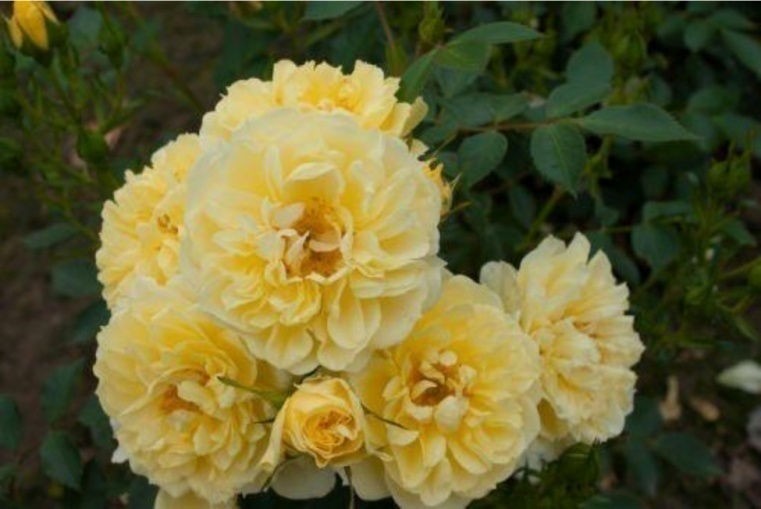
The third “Suffolk Rose” is usually referred to by its registration name as Rosa ‘Poulgode Suffolk’ (see photo, below right). It is a Floribunda Miniature Rose, yellow in colour with small 9 to 16 petals, in a cupped bloom form; it has a strong, wild rose fragrance. This is a product of the famous Poulsen Roser nursery in Denmark. This was a family business started in 1878 by Dorus Poulsen. His son, Dines Poulsen, introduced the first hybrid cross of polyantha roses with tea roses in 1907. This created a flower with the floral magnificence and colour range of the tea rose with the abundance of blooms of the polyantha. In 1930 a new class with the name “floribunda” was given to cultiv ars which were descended from crosses between hybrid teas and polyanthas. In 1981 the company introduced the miniature version.
The present variety was first bred in 1989 by Olesen-Poulsen. This is the professional name of the breeders, Pernille Poulsen, the granddaughter of Dines Poulsen, and her husband, Mogens Olesen, who took over the company in 1976. The new hybrid was introduced to Denmark in 1993 as ‘Yellow Cover’. It has a number of synonyms: Rosa ‘Golden Cover’, Rosa ‘Lexington’, Rosa ‘Lexiton’, Rosa ‘Sparkling Yellow’ and Rosa ‘Suffolk’.
Dianthus – Varieties named ‘Suffolk’
The background to the Dianthus genus is given on the Ips Misc. page of Planet Suffolk’s sister site www.planetipswich.com. These flowers are commonly known as ‘Pinks’. The following cultivars were grown by the breeder Gerald Kiddy of Wissett, Halesworth, Suffolk, in England, and named after his home county.

Dianthus ‘Suffolk Pride’ (see photo, right) is a compact spreading perennial with double, deep rose-pink flowers and is slightly clove scented. It reaches a height and width of 4 in (10 cm). This cultivar was collected by the Royal Horticultural Herbarium in 1991 and won an RHS Award in 1997.
Dianthus ‘Suffolk Summer’ (see photo, left) was collected by the Royal Horticultural Herbarium in 1990 and won the RHS Award of Garden Merit 1993. It is a compact evergreen perennial that grows to a height of 25cm, with blue-grey foliage and strongly clove-scented, pinkish white flowers 5cm in width. This hardy plant grows to make a clump.
The following six cultivars were grown by Gerald Kiddy and registered in 1993.
Dianthus ‘Suffolk Chorister’: First grown in 1981. A spread of 43mm. It has a white ground, with a vivid red to strong purplish red well-defined eye, with odd darker streaks. It is scented.
Dianthus ‘Suffolk Milkmaid’: First grown in 1990. It is a double bloom (meaning flowers with extra petals, often containing flowers within flowers). Height 45cm. A spread of 53mm, White; margins slightly serrated; clove-scented.
Dianthus ‘Suffolk Noble’: First grown in 1981. It is a double bloom. Short stem. A spread of 35mm, a deep-red; margins slightly serrated; not scented.
Dianthus ‘Suffolk Silk’: First grown in 1983. It is a double bloom. Height 40cm. A spread of 55mm, opens flat with cupped petals, opening with a deep yellowish pink with a pale yellow centre; margins slightly serrated.
Dianthus ‘Suffolk Sunset’: First grown in 1990. It is a double bloom. Height 47cm. A spread of 50mm. Cupped, a deep yellowish pink with the odd white fleck, giving a somewhat bicoloured effect; margins serrated; slightly scented.
Dianthus ‘Suffolk Yeoman’: First grown in 1990. It is a double bloom. Height 35cm. A spread of 60mm. White ground with a deep yellowish pink eye with diffuse markings; serrated margins; strong clove scent.
The next three cultivars were grown by Gerald Kiddy and registered in 2003.

Dianthus ‘Suffolk Hussar’: First grown in 1999. Height 15cm and a spread of 35-40mm. It is a double bloom (meaning flowers with extra petals, often containing flowers within flowers), pinkish red with a dark crimson eye, and deep purple lacing (see photo, right).
Dianthus ‘Suffolk Countess’: First grown in 1996. Height 36cm and a spread of 45mm. A double bloom, vivid purplish red with a slightly darker marking near the base of the petal.
Dianthus ‘Suffolk Festival’: First grown in 1996. Height 25-30cm and a spread of 45mm. A double bloom with an almost closed centre, a vivid deep pink with irregular stripes and flecks of near deep red. The fancy irregular markings give the flower a “festive appearance”, hence its name. It is strongly scented.
Dianthus ‘Lady Suffolk’ is recorded in the Dianthus Cultivar Register. Bred by R. Tunwell before 1972. Only description is a white flower, flaked purple.
Another plant, Dianthus ‘Suffolk Dorothy Deaton’, is an accepted name in the RHS Horticultural Database, but nothing else can be found about it. We wonder if this is an error for Dianthus ‘Sutton Dorothy Deaton’, grown in 2000 by M A Newby and first published in the Yorkshire plant list 2002 and also appears in the RHS Supplement for 2003. This was named after an old friend of the registrant and the registrant’s locality; Newby Hall and Sutton Park are in Yorkshire, not Suffolk.
Dahlias – Varieties named ‘Suffolk’
Dahlia is a genus of bushy, herbaceous perennial plants native to the high plains of Mexico. Although some species are found in Central America and Colombia where they were probably introduced from Mexico. A member of the Asteraceae or Compositae family, related species include the sunflower, daisy, chrysanthemum and zinnia. There are at least 36 species of dahlia, with hybrids commonly grown as garden plants.
Spaniards reported finding the plants growing in Mexico in 1525, but the earliest known description is by Francisco Hernández de Toledo, who was ordered to visit Mexico in 1570 by King Philip II to study the “natural products of that country”. They were used as a source of food by the indigenous peoples, and were both gathered in the wild and cultivated. The Aztecs used them as a medicine, and employed the long hollow stem of the Dahlia imperalis as pipes to move water from mountain streams to their villages. However, it was not until 1789 that the flower arrived in Europe. Abbe Antonio Jose Cavanilles, a Director of the Royal Botanical Gardens of Madrid, received the first specimens from Mexico that year. He named the flower Dahlia in 1791, in honour of his good friend, Dr Anders Dahl (1751-89), a noted Swedish botanist. In 1803 John Frasier, an English nurseryman, introduced the Dahlia coccinea from France, and in 1804 Lady Holland sent seed to Britain from Madrid. These became the beginning of garden dahlias in Britain that were first described in English botanical magazines. It was soon discovered that the dahlia could and would easily change its form, face and colour, so from the few plants that survived the journey from Mexico, commercial plant breeders since 1813 have been able to produce many thousands of brightly coloured cultivars of the dahlia. The exact date the dahlia was introduced to the United States is unknown, but in 1840 Thomas Bridgeman supplied a catalogue of “all the choicest varieties available”. Today, there are over 18,000 different cultivars.
In 1966, the international community of botanists and dahlia lovers finally decided how to classify dahlias in a way that was acceptable to all. The single flowering types were the first to have been cultivated. They have petals in circular rows around a visible central disk, much like a daisy. Most large flowering dahlias are doubles. Double flowering dahlias have multiple, overlapping layers of petals with no visible central disk. Dahlias are further classified by the diameter of the fully opened flowers. From there it gets trickier; shapes, petal arrangements and petal forms vary greatly. Flowers can be round pom poms, convex or wildly spiky, and of course they come in various colours and blends, except blue, black or green.
We only describe those classifications applicable to the dahlias with the name ‘Suffolk’. All of these are double flowering, having multiple, overlapping layers of petals with no visible central disk.“Ball dahlias”, as the name suggests, have flowers that take on the form of a ball.

“Cactus and semi-cactus” varieties have numerous petals that are long and pointed, and curve in slightly near the end, giving the flower a spiky look. With the cactus type the petals are narrow from tip to base, and in the semi-cactus type the petals have a broad base.
“Formal decorative dahlias” produce smaller blooms, perfect in form; the petals are generally flat but may curve a little, and have an even, regular placement throughout the flower. “Informal decorative dahlias” produce the largest blooms that can grow to more than 18 inches in diameter, and they look like their name sounds: the petals can be twisted, curled, bent downwards, and are generally in irregular patterns.
“Water-lily dahlias” get their name because their petals are broad and curve upward in a saucer-like shape similar to a water-lily.
The earliest cultivar we have found containing the name ‘Suffolk’ is Dahlia ‘Suffolk Hero’. The notable breeder, Samuel Girling (d.1846), of the Danecroft Nursery, Stowmarket, in Suffolk, England, developed this variety and it was exhibited at shows between 1837 and 1840, winning many prizes. It is classified as a ball dahlia and is in a dark red colour. (The name ‘Suffolk Hero’ has also been given to a later variety of Dahlia in 1975 (see below) and a variety of Primula auricula in 1846 (see Old Suffolk Bronze & Suffolk Hero - Varieties of Primula auricula,above)).
One that has been bred in North America is Dahlia ‘Suffolk Baby’: a miniature formal decorative type, less than 4ins in diameter, a dark burgundy-red in colour; introduced by 2008 in the USA by Skagit Heights Dahlia Farm in the State of Washington.
All of the other cultivars that we have found bearing the ‘Suffolk’ name have been introduced by Geoffrey H A Flood, a breeder who lives in Beccles, Suffolk, England. These are normally marketed through Braintris Dahlia Nursery in Beccles.
Dahlia ‘Suffolk Bride’: Medium semi-cactus type, 6 to 8ins in diameter, white; introduced in 1974.Dahlia ‘Suffolk Christine’: Medium semi-cactus type, 6 to 8ins in diameter, dark pink to lavender; introduced in 1982.
Dahlia ‘Suffolk Conquest’: Medium semi-cactus type, 6 to 8ins in diameter, white blending to lavender; introduced by 1975.
Dahlia ‘Suffolk Fancy’: It seems that a water-lily type with this name, coloured bronze, was first introduced in 1979 by Geerlings Dahlias, Heemstede, in Holland. In 1983 Geoffrey Flood introduced another water-lily dahlia with the same name, but orange in colour.

Dahlia ‘Suffolk Fantasy’: A water-lily type with a small diameter, 4 to 6ins, orange in colour; introduced in 1982 (see photo, left).
Dahlia ‘Suffolk Gold’: Medium semi-cactus type, 6 to 8ins in diameter, a rich golden yellow; introduced in 1975.
Dahlia ‘Suffolk Hero’: A small formal decorative type, 4 to 6ins in diameter, white in colour; introduced by 1975, reviving a name first used in 1837, as described above.
Dahlia ‘Suffolk Liz’: Medium semi-cactus type, 6 to 8ins in diameter, yellow colour; introduced by 1979.
Dahlia ‘Suffolk Prince’: A medium formal decorative type, 4 to 6ins in diameter, white in colour; introduced in 1979.

Dahlia ‘Suffolk Punch’: This was first introduced in 1973 by Geoffrey Flood as a medium informal decorative type, 6 to 8ins in diameter, rosy-red to purple in colour; the same name was given to a medium decorative type, dark red in colour, introduced by Flood in 1992 (see photo, right).
Dahlia ‘Suffolk Signal’: Medium semi-cactus type, 6 to 8ins in diameter, bright scarlet in colour; introduced by 1980.
Dahlia ‘Suffolk Snowball’: A small formal decorative type, 4 to 6ins in diameter, white in colour; introduced by 1975.
Dahlia ‘Suffolk Spectacular’: A medium informal decorative type, 6 to 8ins in diameter, pure white in colour; introduced in 1975.
Dahlia ‘Suffolk Straight’: Medium semi-cactus type, 6 to 8ins in diameter, white in colour; introduced by 1980.
Pelargoniums – Varieties named ‘Suffolk’
Pelargoniums are sometimes called geraniums but true geraniums are a separate genus of herbaceous plant. The background to the Pelargonium genus is given on the Ips Misc. page of www.planetipswich.com.
Pelargonium cultivars are divided into seven distinct groups. Varieties which are named ‘Suffolk’ are in four of these groups, as noted below.
Regal (R): Bushy evergreen perennials and shrubs with rounded leaves sometimes lobed or partially toothed, producing single, rarely double, flowers in shades of mauve, pink, purple or white grown for outdoor or indoor display.
Decorative (Dec): ‘Decorative Regals’ are descendants of the Regals grown in Victorian times, and come in various flower forms in a wide range of colours.
Angel (A): Similar to Regals, but more compact and bushy, having small round leaves and pansy like flowers. They always flower in profusion and can be grown as a pot plant or in hanging baskets.
Miniature (Min): Mature plants with foliage normally less than 5” (125mm) above the rim of the pot.
There are 10 cultivars listed by the Royal Horticultural Society (RHS) that have been named after Suffolk. The group to which they belong is shown in brackets, with the date last listed by the RHS Plant Finder. This implies that seeds are generally no longer available, although this may be because the growers retired and disposed of their stock in 2011. We found that Suffolk Coral and Suffolk Garnet (see photograph, below) were still being advertised.

Suffolk Agate (R) 2010
Suffolk Amethyst (A) 2010
Suffolk Coral (R) 2010
Suffolk Coral Salmon (R) 2007
Suffolk Emerald (A) 2010
Suffolk Garnet (Dec) 2010
Suffolk Gold (Min) 1998
Suffolk Jade (Min) 2010
Suffolk Jet (Min) 2010
Suffolk Salmon (R) 2010
The growers of these varieties, not surprisingly, were connected with Suffolk. Pelargonium ‘Suffolk Gold’ was exhibited by the Rev. C. Rowe of Bury St Edmunds in 1998. All the others, which seem to have a gemstone theme, were bred by Brian and Pearl Sulman of Mildenhall. Pearl was born into the Woollard family of Mildenhall, Suffolk, and her father Arthur was a well known and respected nurseryman. Brian and Pearl met at Wisbech Horticultural College, and they later took on the nursery business of Pearl’s father, dealing in speciality pelargoniums. At their peak, the couple did about 30 shows a year and were awarded 52 Royal Horticultural Society gold medals, including seven at the Chelsea Flower Show, and the society’s Anthony Huxley Trophy for their pelargoniums at the Hampton Court Palace Flower Show in 2009. They did their last show in 2010 before retiring and selling their stock in 2011. After a long illness, Pearl Sulman passed away, aged 65, in 2012.
Suffolk Punch Miggie – Variety of Lathyrus odoratus (Sweet Pea)
The sweet pea, Lathyrus odoratus, is a flowering plant native to Sicily, southern Italy and the Aegean Islands. Sweet peas have been cultivated since the 17th century and a vast number of cultivars are commercially available. They are annuals grown as twining climbers, with flowers in pastel shades from white through pink to blue and deep purple, and noted for their intense unique fragrance. Scottish nurseryman, Henry Eckford (1823-1905), cross-bred and developed the sweet pea, turning it from a rather insignificant scented flower into a major floral interest of the 19th century. By 1901, he had introduced a total of 115 of the 264 cultivars grown at the time.

The suppliers o f seeds for the hobby garden market has grown into big business today and it is customary for these suppliers to launch a new variety every year. The ‘Suffolk Punch Miggie’ (see photo, left) is one such variety introduced in 2022 for the 2023 season by Mr Fothergill’s Seeds of Newmarket in Suffolk, England. Mr Fothergill’s was established in 1978 by Jeff Fothergill and Brian Carey and over the last decade has been run by their sons, David Carey and John Fothergill. It is now one of Europe’s biggest suppliers of seeds, still run from its original location just outside Newmarket.
‘Suffolk Punch Miggie’ is a frilled, gently bicoloured variety. The flowers open with the upper petals a deep mauve and the lower petals a paler mauve. As the flower develops and becomes more mature, the upper petals fade so that they nearly match the lower petals. At its peak the plant is covered in various shades of mauve and the flowers are well scented too. The flower was developed by Essex sweet pea breeder Phil Thompson.
The name was given in recognition of the contribution of Margaret (Miggie) Wylie who has been a long-time active member of the Suffolk Punch Trust which supports the historic breed of Suffolk Punch horses. Miggie also founded, developed and maintains the Trust’s Suffolk Heritage Garden at Fothergill’s which brings together in one place a huge range of plants with a Suffolk connection: either bred by people from Suffolk, named after parts of Suffolk, or with some link to the county.For every packet of the sweet pea ‘Suffolk Punch Miggie’ sold, 25 pence is donated to the Suffolk Punch Trust.
The Suffolk Turnip
Turnips are native to temperate Europe, and have been cultivated for human and livestock consumption for over 4000 years. However, in the latter half of the 17th century an agricultural revolution occurred in High Suffolk with the introduction of turnip husbandry. Until then turnips had only been grown in market gardens, mainly as a food for poor people and livestock. Now, it became established as a field crop, and it was a long time before it was introduced into any other farming county. Richard Hill, a farmer of Toft Monks, which is actually in Norfolk four miles north of Beccles in Suffolk, is credited with introducing this new style of cultivation in 1661, and it soon spread to neighbouring farms in High Suffolk.
Around 1720, Viscount Townshend, a British Whig statesman and Secretary of State, promoted the use of turnips in a four-year crop-rotation system that enabled year-round livestock production on his estate at Raynham Hall in Norfolk, hence his nickname of “Turnip Townshend”. By this time the humble turnip had been grown for long enough in Suffolk as a field crop that it was now known as the “Suffolk Turnip”, or occasionally the “Norfolk Turnip”. Its botanical name is Brassica rapa var. rapifera.
At that time, turnips were distinguished by different names according to their shape and colour. The three common varieties were the round turnip, the long turnip or Suffolk turnip, and the yellow turnip. The Suffolk turnip was more oval than the others and grew to a larger size, being at least three times as long as it was wide, and the primary root tapered gradually to a long point at its base. It was very sweet and succulent, much relished by cattle. (As described in “A Compleat Body of Husbandry” by Thomas Hale, 1758) Livestock production relied on crops to sustain animals all year round, and turnips became important for winter feeding of sheep and cattle. However, the first hybrid turnip is recorded in 1844. With new varieties of vegetable forage crops becoming available that gave larger yields and better storability, the long turnip or Suffolk turnip lost popularity and is now rarely grown. Currently, most varieties of turnip are globe shaped.


Comments