

Suffolk Misc - Miscellaneous References to Suffolk from Around the World - Part 4


Order of contents on this page: (Click on the links below)
Food & Drink:
Food:
Drink:
Agricultural:
Please note:
Suffolk House, Penang now has its own sub-page under the Other Suffolks page
Recipes named after Suffolk
Listed below are recipes that are named after Suffolk, England; some of which date back at least two centuries. Also included is a recipe for Suffolk Waldorf Salad which originates in New England. If anyone knows of any other recipes containing the name, please email details to info@planetsuffolk.com.
A basic description of the preparation method for each is given, but more detailed instructions, measurements & cooking times can be found on various internet sites & in cookery books.
Suffolk Pie: Several food outlets in the county advertise “Suffolk Pie” as a “traditional dish” usually made in accordance with a “long-held family recipe”.
The constituent ingredients of these pies vary considerably and it has to be said that there is no such recognised standard recipe. However, there has certainly been a “Suffolk Pie” eaten since the 19th century since it accompanied Lord Kitchener on his Sudan campaign in 1898/99. In March 2016 a personal narrative by a newspaper correspondent of the time was re-issued in which he states that after the Battle of Omdurman in 1898: “On a central packing-case, which served as a buffet, stood several tins of “Suffolk Pie” and ox tongue, and for every man a biscuit or two” (The Downfall of the Dervishes, by Ernest N. Bennett). We have no idea what this “Suffolk Pie” contained, but it could have been the “Suffolk Medley Pie” (see below).
Suffolk Medley Pie: The “medley pie” is probably a very old dish. As its name implies, it had a combination of ingredients. It was held in some disrepute by the better social classes since it was based on leftovers. A correspondent in ‘Lloyd’s Weekly Newspaper’ (April 1845) refers to it as ‘a certain detestable piece of cookery, which in the north of England is called “a medley pie”, of which the ingredients are everything, the flavour nothing, …..you find beef, and rabbit, and bacon, and apples, and onions, and turnips, and carrots - a bit, in fact, of everything that has passed through the larder in the last fortnight.’
By the mid-19th century there were three versions recognised: the Leicestershire, Derbyshire and Suffolk. The Leicestershire and Derbyshire were very similar, being based on boiled bacon and roast pork, differing only in their fillings and seasoning. The Suffolk used a mixture of pork and pig’s kidney instead. The original Suffolk recipe was printed in ‘The Tamworth Herald’ in May 1936, and is also found on ‘The Foods of England’ website. Ingredients: ½ to ¾ lb. lean pork (remains of a cold joint may be used), 1 pig’s kidney, 2 large apples, 2 onions, 4 potatoes, teaspoonful powdered sage, 1 pint white stock, salt and pepper to taste. Cut the pork and kidney in neat pieces, arrange in a greased pie-dish, season, sprinkle with the sage and add stock or water. Peel and slice the apples, onions and potatoes, season and mix together, then pile in the dish on top of the meat. Cover and cook in a moderate oven for one-and-a-half hours, removing the cover for the last half-hour.
Suffolk Buns: Suffolk Buns have been made since at least the nineteenth century, & were originally made to be consumed on St Edmund’s Day (20th November).
Flour, ground rice & baking powder are placed in a mixing bowl, to which butter is rubbed in until the mixture resembles breadcrumbs. Caraway seeds & sugar are then added, after which eggs & milk are stirred in to make a paste. Once rolled out, the dough is cut into 2 inch rounds, approximately 1 inch thick. They are then baked in the oven until golden brown. Honey can be drizzled over when cooled. Currants are sometimes substituted for the caraway seeds, & honey can also be added to the mixture, if desired.
Suffolk Apple Cake: Lard or margarine is rubbed into a mixture of flour, salt & baking powder. When the mix resembles breadcrumbs, the sugar can be added & stirred in. Grated or chopped apples are then added, along with milk to make a firm dough. This should then be moulded into a round cake about ¾ of an inch thick, then baked until it rises & turns golden brown. Cut into wedges & serve with butter. Can be served hot or cold.
Suffolk Cakes: This recipe was collected during the nineteenth century by a Mrs Anstey, who was a cook for several Suffolk families.
Egg yolks are placed in a bowl & beaten, before sugar & lemon rind are added. Whisked egg whites are then stirred in, followed by flour & melted butter. The mixture is then beaten, before being put into bun cases or bun tins & baked in the oven until they turn golden & are springy to the touch.
Suffolk ‘Fourses’ Cake/Suffolk Beavers Currant Bread: Known in other parts of Britain as Lardy Cake, Lardy Bread, Lardy Johns or Dough Cake. Suffolk ‘Fourses’ Cake (sometimes called Suffolk Beavers Currant Bread) was traditionally eaten in the afternoon (at four o’clock) by farm workers in the fields, accompanied with beer.
Flour, salt & mixed spice are sifted together in a bowl, into which lard is then rubbed. Yeast, sugar & water are mixed & allowed to sponge, before being added to the flour with a bit more water to create a smooth dough, which is then kneaded & left to rise. Once doubled in size, currants are added & the dough is kneaded again, before being put into a loaf tin & covered. Once risen to above the height of the tin, it is baked for around 45 minutes. While still warm, it can be glazed with milk or water. Can be eaten plain or with butter.
Suffolk Harvest Cake: Flour, cornflour, bicarbonate of soda, baking powder, nutmeg & cinnamon are sifted together in a bowl, then crumbled yeast & sugar are added. Butter or lard is then rubbed into this, followed by a mixture of milk & beaten egg. Lastly, currants or sultanas & candied lemon or orange peel are introduced & the mixture should then be well stirred. It is then placed into a cake tin, covered & left to rise, before being baked for around two hours. When removed from the oven, a milk glaze can be applied while still hot. Can be served with butter.
Suffolk Raisin Roly-Poly: Flour, baking powder & salt are mixed together in a bowl, then suet & water are added to form a soft dough. It can then be rolled out to around ¼ inch thick, with raisins & sugar being added, before being rolled up in the manner of a Swiss Roll. After sprinkling with flour, it should be wrapped in greaseproof paper & rolled up in a lightly floured pudding cloth. It is then boiled in a saucepan of water for three hours. Once removed from the pan, it can be sprinkled with granulated sugar. It is then cut into slices & served with custard.
Suffolk Rusks: Butter is rubbed into sifted self raising flour & salt, until the mixture resembles breadcrumbs. Milk & beaten egg are stirred in before the dough is rolled out & cut into 2 ½ inch rounds. After baking for ten minutes, the rusks should be removed from the oven & split in half; then returned to the oven with cut sides upwards until golden brown. Once cooled, they can either be served with butter & jam or with cheese.
In other versions, sugar is substituted for salt, & yeast is also added. In this instance, they should be left to rise before being put in the oven.
Suffolk Trifle: Macaroons are soaked in wine or brandy. To make the custard, eggs, egg yolk & cornflour are beaten together, before warmed single cream is poured on & whisked lightly. This is then heated in a saucepan, stirring continuously until the custard thickens, then sugar is stirred in. After being allowed to cool, the custard is poured over the soaked macaroons. When cold, jam should be smoothed onto the custard & blanched almonds & chopped, candied peel added. Whipped up double cream can now be spread onto the trifle. More almonds & candied peel can be added as decoration.
Suffolk Rabbit Pie: Rabbit joints, belly of pork & onion, together with fresh parsley, thyme, sage, bay leaves & salt & pepper are placed in a casserole dish with water or stock & cooked until the meat is tender (around one to one & a half hours). A shortcrust pastry base is then placed in a pie dish, to which the meat is added, before being topped with a pastry lid. It is then glazed with milk or beaten egg & cooked for around 50 minutes. Although this can be served hot with potatoes & vegetables, Suffolk Rabbit Pie was traditionally served cold on Christmas day morning.
Suffolk Carrot Pie: Egg yolks, salt & pepper are beaten in a bowl, with flour gradually being stirred in to make a smooth paste, after which grated carrots & potatoes are added. Beaten egg whites are then folded in, before the mixture is put into a greased dish & baked in the oven until golden brown.
Suffolk Red Cabbage: This recipe is very similar to Blaukraut or German Braised Red Cabbage. Lard or butter are heated in a saucepan, into which thin strips of ham or diced pork are added, followed, a little at a time, by the sliced red cabbage. Once wilted, red wine vinegar, sugar & water or stock are added, together with cloves, bay leaves & seasoning if required. It is then placed in the oven on a low heat for around two hours. Variations include adding onions, diced carrot, juniper berries, caraway seeds, sliced apple or grated potato.
Suffolk Stew: This is a recipe traditionally served at weekends on Suffolk farms during the cold months of winter.
Lentils & haricot beans are left to soak in water overnight. Chopped potatoes, turnip, carrot & onion are placed in a saucepan, together with either best end or breast of lamb, which has been chopped into pieces. The drained beans & lentils, together with pearl barley are then added, along with parsley, thyme, bay leaves & seasoning. Water is added, brought to the boil, then covered & simmered for approximately three hours. Best served with.........
Suffolk Dumplings: Suffolk Dumplings are also known as Suffolk Swimmers, Suffolk Floaters or Hard Dumplings, due to being traditionally made from bread dough, rather than suet, which causes them to float rather than sink. They should be eaten hot, with two forks to pull them apart, thus releasing the steam. The recipe was first introduced in “The Cook and Housekeeper’s Dictionary” by Mary Eaton (1822).
Plain flour, baking powder & a pinch of salt are mixed together, then either milk or water is added & kneaded into a firm dough. It is then rolled into balls & extra flour added. It should then be placed in a saucepan of boiling water & allowed to boil for around 20 minutes. As well as an accompaniment to Suffolk Stew, Suffolk Swimmers can be served as a dessert with golden syrup. If this is the intention, currants can be added to the dough before rolling & boiling.
Suffolk Fish Pie: Cod or haddock are cooked in a saucepan with milk & seasoning. The fish is then taken out of the milk ( which should be kept) & flaked into a pie dish, with sliced hard boiled eggs placed on top. Meanwhile, butter is melted in a saucepan, to which flour & the milk used earlier are added & stirred until it thickens, after which parsley & capers are added. This is then added to the fish & eggs, with optional sliced tomatoes on top if desired. Mashed potatoes are spread on top & cooked in the oven until lightly browned.
Suffolk Trout: A whole trout with the head removed & a bay leaf inserted inside is placed in a frying pan with melted butter. Lemon juice & seasoning can now be added, before being covered & left to cook on a low heat for 20 minutes, turning halfway through. Serve garnished with lemon.
Suffolk Boiled Herring: Cleaned & gutted herrings are simply placed in salted water & boiled for around ten minutes, before being drained & served. Originally sea water would have been used.Lowestoft was especially famous for its herrings during the nineteenth & early twentieth centuries.
Suffolk Bread & Onion Pudding: Slices of bread are baked in the oven until they are crisp & dry, at which point they are crushed into crumbs. They are then mixed in a bowl with finely chopped onions, sage, milk, beaten eggs & seasoning, before being returned to the oven in a baking tin for half an hour.
Suffolk Trencher Bread: The Suffolk Trencher loaf of today is said to be based on recipes for bread made in East Anglia during Anglo-Saxon times. Today’s Suffolk Trencher is made with four types of flour, seven varieties of seeds and a dash of honey. (Many recipes simply for “Trencher” bread, without the Suffolk prefix, exclude the honey & the seeds).
The name “trencher” dates from medieval times, & was a thick slice of bread served at a feast or banquet, with a hollow or trench scooped out to make an edible bowl onto which meat & sauce could be poured; in other words, a makeshift plate. At the end of the meal, the trencher could be eaten, or otherwise it would be given to the poor as alms or fed to the dogs. The name derives from the Old French word “tranchier” meaning to cut. This practice continued until at least the sixteenth century, at which time wooden bowls began to be used.
Suffolk Oxtail Brawn: Pieces of oxtail are dusted with flour which has been seasoned with salt & black pepper. This is then fried in butter until browned. An onion studded with cloves, together with a bouquet garni consisting of parsley, sage, thyme, bay leaves & allspice berries wrapped in a leek leaf, are then added to the pot, along with vinegar & enough cold water to cover the contents. This is brought to the boil, then allowed to simmer until the meat falls off the bone. The herbs are then discarded & the meat stripped from the bone, before being returned to the stock & brought to the boil until most of the liquid is reduced. A sliced hard boiled egg is now placed in a bowl, with the meat & a small amount of the remaining stock on top. It is then covered with a plate or heavy object & left overnight in the refrigerator or cool place to set. It is usually served sliced with boiled potatoes & vegetables.
Suffolk Cured Pressed Tongue: This recipe can be found in Eliza Acton’s Modern Cookery for Private Families (1845). Beef tongue is rubbed with salt then left covered in a refrigerator or cool larder for twelve hours. The salt is then washed off & the meat dried, before being placed in a bowl & rubbed with more salt, peppercorns, brown sugar, coriander, bay leaves, juniper berries, ginger, mace, saltpetre & crushed cloves. It is then refrigerated for between three & five weeks to pickle; being basted each day with brine & any juice that is produced. At the end if this period, the meat is washed & dried, then simmered in a pan of water for four hours. Once drained, the bone, gristle & skin are removed & the meat is then placed on a plate & covered in aspic jelly. A heavy weight is then pressed down on top, & left until set. It is then served thinly sliced.
Suffolk Perch: Oil is heated in a casserole dish, to which tomatoes, onions, thyme, salt & pepper are added & allowed to simmer. Meanwhile, herring roes & breadcrumbs are mixed together, along with a spoonful of the tomatoes & onions. The cleaned & gutted perch is then stuffed with the breadcrumb mixture, before being placed on top of the remaining tomatoes & onions in the casserole dish. Cyder (Suffolk spelling of cider) is then poured on top. The dish is then baked in the oven. Fresh parsley can be sprinkled on top after cooking.
Suffolk Pork with Apples & Cyder Sauce: Butter is heated in a frying pan, into which small pieces of either fillet or tenderloin of pork are added. Once browned, the meat is removed from the pan, into which whole onions are now cooked until soft, before lemon rind, Suffolk cyder & stock are added & allowed to boil. The pork is now returned to the pan & allowed to cook until tender, at which time apples are added. After a few more minutes of cooking, the pork, apples & onions are removed, & are replaced in the pan by whipping cream & parsley, which are allowed to thicken with the lemon & cyder into a sauce. This is then poured over the meat & served hot.
Suffolk Fraze: Fraze is an old traditional English dish, which is a combination of omelette and pancake and can be served for either breakfast or a light lunch. It is thicker than an ordinary pancake and is made with “stiffer” batter. The OED cites its use as a food item dating back to 1338, when it was then spelt “froise” and by the 17th century as “fraise”. The word and food are undoubtedly of French origin, ultimately derived from Latin “frigere” meaning “to fry”. In 1686 it is recorded as a dish made with slices of bacon.
The recipe for Suffolk Fraze is to slice asparagus stalks in half lengthwise, wash and chop a green onion into 1/2 inch (1 cm) pieces, and dice ham, then set aside. Place flour, salt and pepper in a bowl and make a well in the centre. Crack in the eggs and whisk in cream to form a batter. Melt the butter in a frying pan over medium heat. Add the asparagus, chopped green onion and ham, and sauté for about 3 minutes. Then tip these out into the batter in the bowl and stir well. In the now-empty frying pan, heat a small amount of oil, then pour in 1/4 of the batter. Allow to fry for about 2 minutes, then flip and cook the other side for another 2 minutes. Repeat until all the batter is used. This should be enough to serve four people.
Suffolk Salad: This recipe is taken from a nineteenth century cookbook entitled Modern Cookery for Private Families by Suffolk, England resident Eliza Acton (1799 - 1859), first published in 1845. She was also a poet & published Poems in 1826.
A bowl is filled in alternate layers of shredded tender lettuce, minced lean ham, & sliced or minced hard boiled eggs (or just their yokes). English salad sauce is then added just prior to serving, together with thin slices of cold chicken or veal.
Suffolk Waldorf Salad: This variation on the classic Waldorf Salad is a New England dish, so presumably named after Suffolk, Massachusetts. It uses dried cherries and spinach in place of raisins and lettuce.
Mayonnaise, peanut butter & lemon juice are whisked together, before apples, celery & cherries are mixed in. It is then chilled for thirty minutes, before being served on spinach leaves with chopped pecan nuts sprinkled on top.
Suffolk Savouries: Listed on the “The Foods of England” website on traditional dishes of England, Suffolk Savouries are made from paste of butter, flaked bloater (herring), Worcester Sauce & cayenne pepper, & sometimes an egg or egg yolk. They can be served hot on Suffolk Rusks (see above)
Suffolk Spinach Soup: This is a cream soup of spinach & root vegetables, which is listed on “The Foods of England” website.
Spinach, turnip, onions, celery, carrots, parsley & thyme are added to a pot containing a broth, or the liquid in which meat has been boiled, together with a small amount of butter. This is then stewed until the vegetables are tender, then worked through a coarse cloth or sieve with a spoon. Fresh water, salt & pepper are then added & brought to the boil. It is served poured over small suet dumplings.
Suffolk Frumenty: Another listed on “The Foods of England” website is an historic dish dating from medieval days. Frumenty (or Furmety) was a popular, traditional dish in European medieval cuisine. In England it is first recorded in c.1390 in the manuscript “The Forme of Cury”, i.e. The Method of Cooking, ‘cury’ being from Middle French ‘cuire’: to cook. The authors are given as “the chief Master Cooks of King Richard II”.
Frumenty was served with meat as a pottage, traditionally with venison or mutton, and during Lent, with fish. For several centuries, frumenty was part of the traditional Christmas meal and in England it was particularly eaten on Mothering Sunday, the fourth Sunday of Lent, because live-in servants were allowed part of that day off to visit their mothers.
Frumenty is made primarily from boiled, cracked wheat (grains of wheat that have been crushed into small pieces), hence its name, which derives from the Latin word frumentum, ‘grain’. Milk or stock is added, and sometimes it is thickened with egg. Different recipes flavour it with saffron, spices, etc.
Suffolk Frumenty had the cracked wheat cooked with milk, honey, sugar and cinnamon. Recorded in “Good Things in England” by Florence White, 1932.
Suffolk Kitchel: This traditional dried fruit and almond filled pastry was eaten all over Suffolk and parts of Essex adjacent to Suffolk in the Middle Ages. A dictionary of Suffolk Words and Phrases (Edward Moor, 1823) describes it as:
“Kichel: A flat Christmas cake of a triangular shape, with sugar and a few currants strow’d over the top. Cocker says ‘Kichel’ is Saxon, a kind of cake also known as God’s Kichel, a cake given to godchildren when they ask blessing of their godfather.” The kitchel is mentioned in Chaucer’s Summoner’s Tale (c. 1386):
Give us a bushell whete, malte, o rice,
A God’s kichel, or a trippe of cheese.
It has been suggested that the kitchel’s original triangular shape was a reference to the Holy Trinity, as are the three cuts across the top.
The Oxford English Dictionary defines kitchel as a small cake, but claims that the origin of the word is obscure, and dates it and its variations from the 11th century. The Anglo-Saxon word cicel is related and means ‘a morsel, a little mouthful’.
It is believed that the kitchel may have originated from Suffolk since there are strong traditions in this county where a specific day was set aside in winter when food (of which the kitchel was one) was handed or thrown to the poorer people by the mayor of the town to symbolise the showering of God’s blessings upon the town. Aldeburgh, Bury St Edmunds and Harwich (just over the boundary in Essex) had such a custom, believed to date back to before the Norman Conquest. It was a way of getting through the lean period between November and March when little fresh fruit was on the market.
Ingredients: 50g unsalted butter; 500g of your favourite dried fruit; 200g ground almonds; 2 tsp mixed spice; some sugar; puff pastry; a little egg wash or milk if you prefer. Warm the butter in a thick bottomed pan or melt in a bowl, take off the heat and add the fruit, the almonds and the mixed spice. Mix well then cover with cling film and allow to cool. Roll the puff pastry into squares, the size is up to you. Put a generous amount of the filling on one half of the puff pastry but leave a gap around the outside; brush the gap with egg wash and fold the pastry over to make a triangle. Seal the edges by pressing with your fingers; egg wash the top of the kitchel and then with a sharp knife score three lines across the top. Sprinkle the top with sugar and bake in an oven at 200 degrees C until golden brown.
Suffolk Grumbly: This is a dish that has been popularised in recent years, but it does not seem to be a traditional recipe, and we do not know why it should be particularly associated with Suffolk.
It seems to have first arisen in the 1980s on the menu of The Green Man in Wraysbury, Middlesex, a pub that specialised in regional English dishes. The dish was one of the most popular, and after the pub closed several regular diners asked if anybody knew the recipe. The author Biff Raven-Hill, who had worked at the pub, published the recipe in 2009 in her “The Wartime Housewife” series. Biff likes to live frugally, and is always thinking of how to get her money’s worth. She likes to go back to wartime to learn and apply the old-fashioned skills that the housewives had to employ during those years of shortages and scarcity of food.
The name “grumbly” seems to be a portmanteau word deriving from two other food dishes, combining “grumble” from ‘grumble pie’, and “crumbly” from ‘crumble’. This in itself indicates a recent origin. A crumble is a fruit-based dessert with a topping in the form of crumbs, plus optional flavourings like cinnamon, lemon zest or nuts, that is baked until crisp. The ‘crumble’ is said to have been invented in Britain during World War II, when food rationing made pie crusts an impossibility; it was first met in print as a food item in 1947. Americans sometimes call the crumble a ‘crisp’. ‘Grumble pie’ is a dish of American origin, a pie with a cinnamon-flavoured crumble topping, a favourite with children, and said to be named because it was “to stop their tummies from grumbling”. This became known in Britain when American servicemen and their families were based in this country. The county name may have become attached because of the number of American bases located there.
Butter is melted in a pan, then flour is stirred in to make a thick paste. Milk is then gradually stirred in & the mixture is simmered until it thickens, before cheese & mustard are added to create a cheese sauce. Meanwhile, sausage meat, onion, breadcrumbs & mixed herbs are mixed together in a bowl, half of which is placed into a lightly greased ovenproof dish. Half the cheese sauce is then poured into the dish, followed by the rest of the sausage mixture, then the remainder of the sauce. Paprika is then sprinkled over the top. It is baked in the oven for one hour & served with vegetables & chips (French fries).
Suffolk Beer Puffs: This is a recent addition to the list of foods named Suffolk. The dish was created by Paul Foster. Keen to further his own style of cooking Paul became head chef at the Tuddenham Mill Hotel, located at Newmarket, Suffolk, in 2010. Paul raised the restaurant from one to three AA rosettes (the AA’s supreme accolade) within 18 months. After four years, he moved to The Dining Room at Mallory Court in Bishops Tachbrook, based 3 miles south of Leamington Spa. It marked a return to the chef’s Warwickshire roots, but by then he had given the Suffolk name to a distinctive bar food bite. In 2016 Paul was runner-up as Britain’s National Chef of the Year.
There are a variety of snacks referred to as “puffs”, all of which are basically different shapes of dough tossed in a deep fryer for several minutes until they puff up. It is debatable who started what when, but modern deep frying as a fast-food snack became popular in America in the 20th century. Novelty deep-fried foods were introduced at American fairs, and puffs flavoured with beer are thought to have originated in the 1950s as snacks at American sports events.

Paul Foster created this crispy, beer-flavoured bar snack to nibble before the main meal. Its ingredients to serve 8 people comprises 50g of lemon thyme, 50g of St Lorenzo Sea Salt, 150g of 00 flour, 50g of brown rice flour, 90ml of bitter beer (pale ale), and 2g of salt. Pick the leaves off the lemon thyme and dehydrate for one hour; once dry, grind in a pestle and mortar until fine, add the sea salt and grind lightly until they are both well mixed. Mix all of the other ingredients for the dough in a food processor until they come together. Remove from the food processor and knead by hand until smooth. Wrap in cling film and rest for 1 hour. Gradually work the dough through a pasta machine until it reaches its thinnest setting. Cut the dough into 1cm wide strips and deep fry at 170°C (340°F) turning constantly until they are puffed up and golden. Once they are fried, remove the puffs and season with the lemon thyme salt.
Suffolk Baked Custard: This recipe has appeared in recent cookery books and articles. Credit for this is given to the “Bangers n’ Mash Cookbook”. This recipe is said to have originated in Ipswich, Suffolk, England in the 1920s. It is very easy to make. The ingredients are 2 large eggs, 2 ounces of white sugar, 1⁄4 pint low-fat milk, warmed, and grated nutmeg. Beat the eggs and sugar together, stir in the warm milk and pour into individual dishes. Grate a little nutmeg on top of the mix and bake for one hour at 250 degrees F. Serves two.
(See also New Suffolk, New York page for details on New Suffolk Clam Chowder)
A recent creation is the Suffolk Punch Pie, served at the Piebald Inn in Hunmanby near Filey in North Yorkshire, England. The pub is famous for its range of around fifty pies, each named after a breed or type of horse. Suffolk Punch Pie is described on the menu as “Chicken tikka - chicken breast marinated in tikka spices and cooked gently in tomatoes and cream”. Presumably, the spicy nature of the ingredients is the ‘Punch’.
There are two other recipes that are commonly quoted on the internet as “Suffolk” dishes, but these are really alternative names for other existing recipes. They are:
Suffolk Almond Pudding: An alternative for the Ipswich Almond Pudding (see Ips Misc. page on www.planetipswich.com).
Suffolk Pond Pudding: This name for a suet pudding recipe has recently become widespread. However, there is a general consensus by cooking experts that this has arisen from a printer’s error in a cookery book and should be properly referred to as the Sussex Pond Pudding. This is a much older dish and the recipes are exactly the same.
“Somillo”
“Somillo” was a brand name for edible peanut oil manufactured by Suffolk Oil Mill, Inc. of Virginia, USA, as a salad dressing. The name was derived from the initial letters of the first two words and ‘Mill’ with the final letter ‘o’ for ‘operations’. Peanut oil is a mild-tasting vegetable oil derived from crushed peanut meal. It was often used for added flavour in Chinese and Southeast Asian cuisine, and became a popular alternative source during the war years in the USA when there was a shortage of other oils. The idea for selling it as a salad dressing came from Luther Wellons Caulk, Jnr (1899-1983). Born in the city of Suffolk, Virginia, he spent his whole career from 191 7 in the peanut oil production business with the Suffolk Oil Mill company. Luther quickly rose to executive level and by 1945 had become the major shareholder of the company. The name “Somillo” was first introduced in August 1948 and registered as a trade name in July 1951. The company was bought by J. Lewis Rawls, Jnr in 1968 (who championed the merger of Suffolk and Nansemond County), and was closed down in 1976, when the name “Somillo” was allowed to lapse. In 2004 the vacant Suffolk Oil Mill factory in East Suffolk still advertised the product (see photograph, right).
Lord Suffolk Cocktail
This recipe for the Lord Suffolk Cocktail is found in the original “The Savoy Cocktail Book” (1930). It is said that whichever Lord Suffolk this cocktail refers to, he certainly had a sweet tooth!
1/8 Italian Vermouth. (½ oz Carpano Antica)1/8 Cointreau. (½ oz Cointreau)5/8 Gin. (2 oz Plymouth Gin)1/8 Maraschino. (½ oz Luxardo Maraschino)Shake well with ice and strain (lemon peel)Serve in a cocktail glass (4.5 oz).
Duke of Suffolk Cocktail
This is the signature drink in the Suffolk Arms bar on East Houston Street, Manhattan (see Suffolk in the Names of Public Houses, Bars & Inns section, above) . It was created by the bartender Giuseppe Gonzalez when the bar opened in 2015, as the bar’s version of Irish Coffee. It is served hot and replaces the coffee by English Breakfast and Earl Grey teas. The recipe is:
• 1½ ounces Hendrick’s or Ford’s Gin
• Brew Hot Sweet Tea (an equal blend of English Breakfast and Earl Grey sweetened with ¾ ounce simple syrup)
• Pour into a coffee mug or glass
• Add the gin
• And a dollop of heavy cream as a float
Suffolk Rose Cocktail
Created in 2011 by Ereich Empey, a cocktail historian (Musings on Cocktails website). He wanted to combine two classic cocktails, Kir Royal and Jack Rose, into a new hybrid. The Kir Royal is a classic French champagne cocktail and the Jack Rose contains applejack, grenadine and lemon or lime juice which was very popular in the 1920s and 1930s. The name he gave to this creation came from ‘Jack Rose’ combined with the English county that he thought was very reminiscent of the champagne country in France, emphasised further by the Aspall cyder produced in Suffolk that was used instead of champagne.
The recipe is:
• 5 ounces sparkling demi-sec cider
• ½ ounce pomegranate grenadine
• ½ ounce lime juice
Add the grenadine and lime juice to a chilled glass and top up with about 5 ounces of Aspall’s dry cyder. Garnish with a lemon twist.
Lady Suffolk Cocktail and Suffolk G&T
Two other drinks whose recipes are not known, but it is known why they are named. The Gray Mare pub (formerly Dempsey’s Pub) at 61 Second Avenue, East Village, New York, takes its name by reference to the famous trotting champion horse (see Lady Suffolk below). It is fitting that she should have a cocktail named after her and the Lady Suffolk Cocktail is said to be an “effervescent mix of Monopolowa vodka, prosecco, cucumber and green tea”.In London, the Haymarket Hotel has a Suffolk G&T which “is a secret blend of botanicals (the various seeds, berries, roots, fruits and herbs used to flavour gin) used to infuse our own Indian tonic essence, stirred with premium juniper-led Tanqueray gin and a lime twist”. The name comes from the location of the hotel which is in a Regency building tucked away on Suffolk Place, just off Haymarket (see Suffolk Street & Suffolk Place, City of Westminster SW1 on London Suffolks page).
Lady Suffolk Cocktail
The recipe for this one is known and it is not named after a horse. This cocktail is the invention of Joann Spiegel from Cork in Ireland and can be found at The Dead Rabbit in New York City. This is a multi award-winning Irish bar, renowned for its exceptional cocktails, Guinness and legendary Irish Coffee. This sweet drink is enhanced with a little kick by the black pepper and a touch of egg white, giving a beautiful smooth feel to the mouth.
Ingredients:
• Black pepper
• 1⁄4 oz. merlet creme de peche
• 1 oz. peach juice
• 3⁄4 oz. lemon juice
• 1⁄2 oz. simple syrup
• 1 1⁄4 oz. Everclear®
• 3⁄4 oz. Egg whites
Combine all the ingredients including a pinch of pepper and dry shake with egg whites. Add ice and reshake. Double strain into ice filled old fashioned glass. Garnish with a slight dust of black pepper.
Suffolk Buck Cocktail
When ginger ale or ginger beer is mixed with citrus juice and any of a number of base liquors in a drink, it is known as a “Buck”. Early cocktail books list recipes for the gin buck or London buck cocktail, and variations of rum bucks were called the Shanghai buck, Jamaica buck, etc. The origin of the name and cocktail is obscure. It is believed to be a derivation from “Buck’s Fizz”, traditionally made by mixing two parts champagne and one part orange juice. This drink was first served in 1921 at London’s Buck’s Club. The Americans have a theory that the drink evolved from the Horse’s Neck, a non-alcoholic mixture of ginger ale, ice and lemon peel that had been around since 1895. In the 1910s a brandy or bourbon would be added to give it “a kick” just like that of a horse or a buck.
The Suffolk Buck Cocktail was created in 2016 by John McCarthy, the Master Distiller for Adnams in Southwold, Suffolk.
It comprises:
• 50 ml Adnams Rye Hill Malt Vodka
• 25 ml Ginger Syrup
• Juice of one fresh lime
• Shake over ice
• Add crystallised ginger and the lime zest.
Beers & Cyders Named ‘Suffolk’
Beer
Several breweries in Suffolk, England, have used the name of the county for their beer products. In addition, four breweries just across the Suffolk boundary have used the name, two in Essex (one that moved across the border from Suffolk to Essex from 2005 to 2017 before returning to its native county), one in Norfolk and one in Cambridgeshire. A special case is a brewery in Gloucestershire who has also used the county name (see separate article below on Suffolk Mountain Ale). Overseas, in the USA the name has been used by five breweries, one each in New York State, North Carolina, Massachusetts, Colorado and Michigan. In addition, two breweries in Canada use the name ‘Suffolk’, one in British Columbia while the other in Ontario uses a street of that name for one of its brews.
We would acknowledge the use made by us of the excellent Beermad web-site. This site is recognised as an authoritative source for Real Ales produced by the brewers of the British Isles. The database contains details of cask beers known to have been produced since 1976. This has enabled us to check our records of the Suffolk (and Ipswich, see Beers Named ‘Ipswich’ section on www.planetipswich.com) beer names; where the only reference we have to a name is from this database we have shown the reference in italics: Beermad.
Greene King, based in Bury St Edmunds, was established in 1799. Since 2015 they have been the largest British owned brewery in the country with over 3,100 managed, tenanted, leased and franchised pubs, restaurants and hotels, including Chef & Brewer, the Hungry Horse and Old English Inns chains, as well as Loch Fyne restaurants. The brewery was founded in Bury St Edmunds in 1799 by Benjamin Greene, from a Northamptonshire family. In 1806 he acquired the present Westgate Brewery site. In the early years Benjamin Greene was in partnership with others, but it was only when Greene inherited a West Indian plantation in 1823 that his financial future was secured, and the family soon became sole owners of the business. In 1887 it merged with the adjacent St Edmund’s Brewery of Frederick William King (founded in 1868) to create Greene King.
They currently make five ales with ‘Suffolk’ in the name as covered below. However, as is common with many of the larger breweries, the same brew is marketed under different labels (names) to suit the preferences of drinkers in other countries and various parts of Britain, so our first one is known by three names.
Strong Suffolk Vintage Ale: Introduced in 2000, this is a dark, full bodied bottled beer, almost ruby in colour with a spicy fruit cake aroma and flavours that hint at caramel, burnt toffee and oak. It has an ABV (alcohol by volume) of 6%. Strong Suffolk Vintage Ale is unique in that it is Britain’s last example of an ale made by the blending of old and young beers. The two brews from which it is blended are not sold as products in their own right. The technique of ageing and blending to achieve an equilibrium of malty sweetness and acidity was typical in the late 1700s and 1800s, but had vanished by the 1900s. The “old” component is aged in wooden barrels, and is the only beer in Britain still to employ that method. ‘Old 5X’, which is brewed to the maximum strength possible (around 12% ABV) and left to mature in oak barrels for a minimum of two years, and ‘BPA’ (said to stand for Burton Pale Ale), a dark, full-bodied freshly brewed beer with a 5% ABV is then added just before bottling. In Britain, where everyday ales are quite low in alcohol this entitles the beer to be known as “Strong Suffolk”. However, this beer has been sold in the North American market since 2002 as Olde Suffolk English Ale. This is because the term “Strong” would confuse the Americans who think of a 6% ABV beer as normal strength. In 2013 it had a slight name change to Strong Suffolk Dark Ale. However, it also continues to be sold under the Strong Suffolk Vintage Ale label, particularly in Europe (see images of the three brands below). Note the similar name (without the ‘e’ in Olde) of Old Suffolk Strong Ale a home brewing kit marketed since 2012 by Ritchie’s Festival Premium Real Ale Kits (see entry further below).

As an additional marketing promotion for American tastes, this brew later came out with the words “aged in oak vats” on the label (see photo, right) and was sold as Olde Suffolk Oak Aged Old Ale 2004.

Suffolk Porter: Introduced in 2014, a bottled stout with an ABV of 5.4%, Suffolk Porter is described as a rich full bodied stout with intensity & depth, chocolate & liquorice flavours & a smoky aroma.

Suffolk Springer: This premium dark ale celebrates Suffolk’s Newmarket Racecourse & the National Horseracing Museum. According to the bottle’s label: The term ‘springer’ refers to a racehorse whose odds dramatically shorten. A rare but rewarding moment for those ‘in the know’. The bottle version (6% ABV) came on the scene in 2009, and a year later the cask version appeared with a slightly lower ABV of 5.5%.

Suffolk Explorer: This was released in the summer of 2017 as a ‘pale ale bottle’ (4.8% ABV). At present it only seems available in Australia, where it is advertised as “crafted in Suffolk with our British brewing excellence, creating a crisp, easy-drinking English Pale Ale”.
Heritage Suffolk Pale Ale: Two limited edition premium beers, Heritage Suffolk Pale Ale (5%) and Heritage Vintage Fine Ale (6.5%) have been released in bottle and cask in January 2018. Using just five barley seeds and ancient recipes from the brewery archives, the Heritage Series beers date back to 1825 and are typical of the taste of ales consumed in rural Suffolk at that time.
There are several versions of how Chevallier barley came into existence, but the one believed to be most authentic comes from the History of Debenham (1845) and is as follows. About the year 1820, John Andrews, a labourer, had been threshing barley and on his return home on taking off his shoes he discovered in one of them part of a very fine ear of barley. He planted the few grains from it in his garden which next year gave three or four ears of barley. These were noted by his landlord, the Rev. John Chevallier, who requested that they be allowed to ripen. John Chevallier then obtained and sowed the seeds produced, and over the next few years gradually extended the acreage until in 1825 he had grown a viable crop. The seed became known as the “Chevallier”. It became very popular and for a century was the most widely-grown type of malting barley. In the 20th century the Chevallier seed fell out of favour to new seeds with their improved yield per acre.
However, in the early 21st century, maltsters were investigating the characteristics of barley varieties that are no longer grown. With only a handful of seeds preserved in seed banks the process used by John Chevallier was repeated until enough barley was being harvested that a proportion could be malted. Greene King state that they took five preserved Chevallier seeds from their seed bank and resowed them to create three fields of barley, and then made the brews to see how they tasted. These were obviously thought good enough for today’s palate. The bottles of Suffolk Pale Ale and Vintage Fine Ale have been designed to look as they would have back in the 19th century.
Five Greene K ing brews no longer produced are:

Suffolk Punch: Brought out in 1997 with an ABV of 4.3%, but appears to have been short-lived.
Suffolk Summer: Brought out in 2003 and lasted until about 2012. Said to be similar to an American Pale. It had an ABV of 4.3%. A light orange hue with an aroma of apple juice, strong malt and a bit of mint. A refreshing bitter finish.
Suffolk Swift: A bitter brewed from 2010 with an ABV of 3%. This has a gold to copper colour and medium bitterness. The aroma is light nuts, some fruit and light hops, but the flavour is said to be non-existent to mild.
Suffolk Warmer: Our only source of information for this beer is Beermad. It had an ABV of 4.3%.
Greene King also brewed Tolly Cobbold Suffolk Ale to keep alive the great tradition of these two former breweries whose names are synonomous with Suffolk brewing. In 1989 the Tolly Cobbold brewery on Cliff Quay in Ipswich was closed down by its new owners after 256 years of brewing at the site. However, a management buyout in 1990 saved the brewery. It was then acquired by Ridley’s Brewery of Chelmsford, Essex, in 2002, but this company finally closed it that year. (However, see information below under Suffolk Pride, the Earl Soham Brewery.) Three years later, Ridley’s Brewery was taken over by Suffolk-based Greene King. Both Ridley’s and Greene King continued to brew the old Tolly Cobbold brands under their original name, usually, on an occasional basis.
Tolly Cobbold Suffolk Ale was mainly brewed for the American market. In America, the name ‘Suffolk’ seems to have a resonance of idyllic country life where beer is always drunk under a glorious sun. Under American legislation you are not allowed to give a geographical name to food or beverage unless it comes from the place so named. This gives an advantage to our county breweries.
Tolly Cobbold Suffolk Ale (4.6% ABV) was marketed in the USA by the original brewery in Ipswich from 1996 since the Liquor Control Board then registered it for sale in Pennsylvania. It was a bottled beer described as “an English Pale Ale with a smooth, nutty flavour, pretty thick texture and a nice sweetness. A little flowery, tastes maltier when it warms”. Although gradually phased out in Britain, Greene King continued production of this brand for America, retaining the name and all the familiar features down to the famous Suffolk Punch horse on the label (see picture, right). Production stopped in about 2011 and, other than old stock, this beer is no longer available.
Strange as it may seem, although there are many references to “Suffolk Ale”, there is only one brewery other than Tolly Cobbold that we have found that has actually named one of its brews with this name. This is the Suffolk Ale (7.0% ABV) brewed by Propolis Brewing. It is an Old Ale style beer in the tradition of Oud Bruin (Old Brown) also known as ‘Flanders Brown’. This style of beer originated from the Flemish region of Belgium. The name refers to the long aging process, up to a year. It undergoes a secondary fermentation which takes several weeks and is followed by bottle aging for several more months. There is no clue as to why this particular brew is called Suffolk Ale.
This brewery is in Port Townsend, Washington State, USA. There is quite a lot of information about this brewery on the Internet because of the unique approach taken by its owners, Robert Horner and Piper Corbett. This couple established Propolis in June 2012 and describe their products as “Seasonal Herbal Farmhouse Ales inspired by old world tradition and new world ingenuity”. The ales are brewed with various concoctions of wild foraged flowers, herbs, heather and cherries and are seasonally based. Their beers are often barrel-aged and wild fermented, bringing an added complexity that has earned numerous awards and accolades. The name “Propolis” is a metaphor. It is a reference to a time long past, coming from two Greek words: ‘pro’ which means ‘before’, and ‘polis’ which means ‘city’. This is also the term applied to a sticky resin that honey bees produce by mixing saliva and beeswax with sap and other substances exuded by trees. The bees use the propolis (also called ‘bee glue’) to seal the opening into their ‘cities’ or hives to keep out unwelcome intruders. The logo of the brewery is predictably a honeybee.
Mauldons Brewery was established as a family business in the south Suffolk town of Sudbury in 1795 when Anna Maria Mauldon began brewing at the Bull Hotel. It claims to be the oldest brewery in Suffolk. It was bought by Greene King in 1958 which closed the brewery in 1960. It was not until 1981 that the brewery was re established by Peter

Mauldon, the great grandson of Anna Maria, who had been the former chief brewer at Watney’s. In December 1982 the first barrels of beer were being brewed again by Mauldons in Sudbury. On the retirement of Peter and Jane Mauldon in 2000, the brewery was sold, but the family name was retained for its brews. The brewery uses only traditional methods and materials, and it was felt that the business is at its best when in the hands of a family. Thus, in 2019 it was bought by a local farmer who has continued the tradition of a family-run brewery.
Today, as well as making, amongst others, several beers that make reference to Charles Dickens’ books & characters, they produce Suffolk Pride. At 4.8% ABV, this is a full bodied strong bitter, light in colour with a deep dry finish. It is available as both a cask & bottled ale. Suffolk Pride is sometimes sold as Suffolk Punch.
Since 2013 Mauldons has also brewed Suffolk Comfort (6.6% ABV), a ruby coloured, strong peppery ale with a rich balance of malt and hops and some fruitiness, living up to its name for smooth and easy drinking.
Another brew which was discontinued in 2008 was Mauldons Suffolk Pale Ale 3.6% ABV, also known as “Mauldons Bitter”. This was a traditional session bitter with a strong floral nose and a lingering bitter finish.
St Peter’s Brewery was established in 1996 by real ale enthusiast John Murphy who purchased the somewhat derelict St Peter’s Hall, dating from 1280, at St Peter South Elmham near Bungay in the north of the county. The modern brewery is adjacent to the moated medieval hall. The distinctive oval shape of the 500ml bottle is based on an eighteenth century gin bottle.
Suffolk Gold is a 4.9% ABV premium bottled beer brewed with Suffolk grown First Gold hops & Suffolk malt, producing a full bodied beer with a lasting hop aroma. In November 2019 the brewery launched St Peter’s Suffolk Gold Gluten Free (4.9% ABV) bottled beer.
Other ales from St Peter’s Brewery with ‘Suffolk’ in the name are Suffolk Extra Gold (4.2% ABV) which is described as ‘a rarely brewed crisp golden ale’, & Suffolk Smokey (4.8% ABV), a peated beer with a sweet, malty & smoked aroma.
St Peter’s Brewery also brew Sainsbury’s Suffolk Blonde Ale (4.7 % ABV) for Sainsbury’s supermarkets as part of their “Taste The Difference” marketing range. A traditional ale brewed with Hallertau hops and a proportion of East Anglian wheat to give yeasty flavours typical of German wheat beers.
A Suffolk Weiss (4.8% ABV) is also included in the beer list for 2019, but must have been a short-lived brew because it does not appear again. A weissbier (German for ‘white beer’) uses 50% wheat to barley to make a light-coloured top-fermenting beer; also called ‘wheat beer’ in English-speaking countries.
In January 2021 the founder of St Peter’s Brewery, John Murphy, retired and sold the company for an undisclosed sum to three private investors ‘who share a passion for good beer’. The group was led by Derek Jones who is the new chief executive officer and has over 20 years global experience in the brewing industry.
Also in Suffolk, England is the Briarbank Brewing Company, situated close to the Waterfront in Fore Street, Ipswich. This is a microbrewery associated with the Isaacs-on-the-Quay complex in Ipswich. It started production in an old 1960s Lloyds Bank building in April 2013. It takes its name from the house of Aidan Coughlan, an Irish businessman who lives in Ipswich. He established himself in the telecommunications business in 1984 and later expanded into the leisure and restaurant/refreshments industry. Isaac Lord was a local businessman who bought this Ipswich waterfront site from the Cobbold brewing family in 1900. Some buildings date from the early 15th century to late 18th century, reflecting the site’s commercial and industrial use over four centuries. The whole complex was eventually purchased by Aiden Coughlan in 2003, who has taken the sympathetic restoration and refurbishment of Isaac Lord’s as a bar and restaurant business to its present success.
Among their first brews in May 2013 was Briarbank SPA (3.6% ABV). SPA stands for Suffolk Pale Ale. This is described as “a hoppy chestnut ale with a lovely citrus aroma from the choicest cascade and WGV (Whitbread Goldings Variety) hops”. This same brew also goes under the name of Ipswich Pale Ale (see Beers Named ‘Ipswich’ on www.planetipswich.com).

Amongst a wide variety of ales brewed here are Suffolk Pride (4.8% ABV), which is described as a malty beer with a copper colour & slight toasty flavour; & Suffolk Brown Ale (3.3% ABV) which is a traditional brown ale with a sweet malty body. In April 2021 Suffolk Haze (5.0% ABV) was released. This is a New England IPA and, as its name implies, it is a creamy, hazy beer to look at, but apparently one of the best to drink.
Other beers produced by Briarbank include Briar Bitter, Cardin‘ale’ Wolsey & Briar Lager.
Adnams, one of Suffolk’s best known brewers was established in 1872 when George and Ernest Adnams bought the Sole Bay Brewery in Southwold.
Although today none of their regular products bear the name ‘Suffolk’, since 2015 they do brew Suffolk Bitter exclusively for Marks and Spencer. At 5.2% ABV, this bottled beer is described as having a full aroma, refreshing taste and long finish. The label features the famous Southwold beach huts (see picture, above left).

Also in 2015, Adnams came out with Suffolk Single Variety British Hop Jester IPA, again exclusively for Marks & Spencer (see picture, left). British hop production had been in decline with the introduction of new flavours and aromas brought in from the USA and Australia. In 2012, UK hop merchant Charles Faram & Co, along with Liberty Beer and Moor Beer Co launched a brand new British variety called Jester. (Jester is a registered trademark of Charles Faram.) Jester hops were bred with the intention of replicating the bold, punchy citrus flavours that are so predominant in the US and New World hops. This beer is brewed in Adnam’s Suffolk brewery with Jester hops, grown on Stocks farm in Worcestershire. Made with a new hop, this IPA is a sort of gooseberry, lychee and grapefruit punch. 5.2 % ABV.
Adnams also used to brew a sweet ale from about 1964 to around 2000 with an ABV of 4.8% called Suffolk Punch (see label, below left).

Brewers often market the same or near-same product by more than one name. This can be the result of a brewer simply changing the name, but not the recipe at different points in time, or the brewer distributing this beer under different names in different countries. Adnams was one of the Suffolk breweries that took advantage of the county name to market their beer in America (see comments under Greene King, above).

Adnams regular and most iconic beer is that known as Southwold Bitter (3.7% ABV in cask, 4.1% in bottle and can), a session bitter brewed with the finest East Anglian Pale Ale malt barley, sourced locally to the brewery, combined with crystal malt and a pinch of black malt to provide substantial support for the English Fuggle and Golding hops. It was first brewed in 1967 and was originally called “Adnams Best Bitter”; by 2000 had been renamed “Southwold Bitter” when it became “Adnams Bitter”; in 2005 it became “The Bitter”, but returned to “Southwold Bitter” in 2011. However, from 1994 the packaged version in bottle and cans at 4.1% ABV was known as “Suffolk Strong Ale” and depicted a scene of the brewery on the label (see photo, right). This was marketed in America under this name from 1996 when the Liquor Control Board registered it for sale in Pennsylvania. It was retired in 2011 when Adnams Southwold Bitter became the generic name for both cask and bottle/cans.
Adnams Suffolk Extra Ale was a regular ESB (Extra Strong Bitter) (4.5% ABV) introduced about 1997. It was described as “a dry, crisp, refreshing, and distinctly hoppy example of its style, with a fair amount of sweetness ”. The brew was retired under this name in 2002. It then became known as Adnams SSB. It was exported to America where it was also marketed under its full name of Adnams Suffolk Special Bitter. This was also phased out from 2011, being largely replaced in 2014 by Adnams American IPA both cask (4.8%) and bottle (6.8% ABV). However, Adnams no longer produces these brews with the Suffolk name, although all these are still sold in the American market.
Another beer associated with Adnams was a limited production of a brew created in 2010 by the Phantom Canyon Brewery named 1936 Strong Suffolk ESB (Extra Special Bitter) (3.35% ABV). This was part of a “Revival Series” whereby the brewery revives for a short period notable brews from the 19th and early 20th centuries. This recipe is that from the 1936 Adnams Strong Suffolk originally brewed by the brewery in Suffolk, England.
Phantom Canyon Brewing Co is a micro-brewery located in the basement of the three-storey historic Cheyenne Building, constructed in 1901, in Colorado Springs, Colorado, USA. The Cheyenne building derives its name from Chief Two Moons of the Cheyenne tribe, who participated in Custer’s Last Stand in 1876. The image of this Native American leader in his headdress is carved in the stonework on the corner of the front entrance to the building. It originally housed the local offices of the Chicago, Rock Island and Pacific Railroad. Between 1909 and 1963, it was a cheap hotel for tourists. In the 1980s, there were plans for its demolition, but it was saved in 1991 by the Wynkoop Brewing Company which purchased and restored this historic building.
The “Wynkoop Brewing Company” in Denver was the first brewpub* in Colorado, opening in October 1988. It was also one of the first brewpubs in the nation and is now one of the largest microbreweries in the entire United States. It and the Phantom Canyon Brewing Company are the brainchild of John Hickenlooper and his five business partners. Hickenlooper served as the 42nd governor of Colorado from 2011 to 2019 and as the 43rd mayor of Denver from 2003 to 2011.
In 1993 the Phantom Canyon Brewing Company opened in Colorado Springs. It claims to be the oldest brewery in that city. It specialises in hand-brew beers. The brewpub includes a restaurant and bar, a pool hall and banqueting facilities. It takes its name from the scenic canyon of the same name in Colorado. The canyon got its name because of ghostly sightings said to be of a state prisoner who was executed in the 1890s.
* Our American cousins have coined this new word: a ‘brewpub’ is an establishment, typically one including a restaurant and an entertainment area, selling beer that is brewed on the premises.
Now we have Admans Suffolk Clone (7.0% ABV) produced by the Wunderbrau Brewery. Although this undoubtedly existed and is described as a “Strong English Ale” introduced in 2015, this looks very much like a ‘send-up’ of Adnams Suffolk Special Bitter recorded immediately above for the American market. The latter beer was replaced in 2014 by an American IPA by Adnams that did not contain the name ‘Suffolk’. The clue may be in the ‘Suffolk Clone’ and the ‘Wunderbrau Brewery’ that could have come from a disgruntled customer who preferred the discontinued article. The brew is also described as a “homebrew” in the USA. There is a Wunderbrau Brewery in Cincinnati, Ohio, but this is a regular brewery with no record of this brew. Wherever the brewery was, it did not survive for a second brew.

Hoxne Brewery was a micro-brewery creating hand-crafted real ales established in this Suffolk village in 2013 by Dan Steggles, who progressed from making his own home brews. His brew named The Suffolk Punch was a traditional English bitter with an ABV of 4.5%. It prided itself as: “Just like the draught horse who inspired this real ale, Suffolk Punch is all British, a beer that any stiff upper lip would be proud to taste.” The brewery moved five miles to the adjacent Suffolk village of Palgrave in 2016 and then moved back to Hoxne in 2017. Late in 2018, it was reported that the brewery had closed.
Suffolk Punch was also a beer brewed by Fenland Brewery in Little Downham, near Ely, Cambridgeshire. The beer had a strength (ABV) of 4.6%. It was described as a smooth amber bitter, slightly sweet and medium hopped. The brewery only lasted ten years, being founded in 1997 in Chatteris, Cambridgeshire, by husband and wife team Rob and Liz Thomas. It was bought in 2003 by businessman David Griffiths and moved to new premises in Little Downham the next year, where it became the Fenland (Isle of Ely) Brewery. It went into administration in November 2008, finally being dissolved in January 2010. (It should be noted that the Isle of Ely Brewery, founded in 2014, is not related.)
A Suffolk Punch IPA (4.9% ABV) was brewed by Muirhouse Brewery in Ilkeston, Derbyshire, England in 2019 and 2020. It is no longer produced. The Muirhouse brewery is a micro-brewery that began in 2011 as a 100 litre plant in the family garage with brewing taking place every week on a Sunday. It was named the Muirhouse Brewery because the owner Richard’s surname is Muir and the beer was produced in his house’s garage. There is no particular reason known why this brew should be given this name.

The Nethergate Brewery was born in 1986 in the small Suffolk town of Clare. Like many great ideas it was conceived in a pub by former Head Brewer, Ian Hornsey, and his business partner Dick Burge. In 2005 the brewery was moved across the county border to Pentlow in Essex. The brewery acquired a reputation for brewing consistently high quality distinctive beers. In 2011 the brewery was acquired by the newly-formed Clare Brewing Company, who changed the name in 2012 to Growler Brewery. However, the new owners were unable to continue the success. In March 2014 the brewery went into administration and its future looked bleak. However, a consortium led by founder Dick Burge purchased the ailing brewery and brewing has continued since, with a return to the ‘Nethergate Brewery’ name and a primary focus on selling beer to local free houses. Nethergate have had notable success in winning many awards for champion beers, one of which is Suffolk County (4.0% ABV). Described as a best bitter with a chestnut colour. A biscuity malt dominates with a punching bitterness. It has a flavour of fruits, citrus, caramel, honey and nuts.
In January 2017 Nethergate Brewery announced that it had acquired a new site near Long Melford in Suffolk. In November 2017 it returned to its Suffolk roots, and moved into a new purpose-built brewery with a brewery shop and tap-room at the hamlet of Rodbridge Corner, half way between Long Melford and Sudbury.
Porter’s Suffolk Bitter (3.5% ABV) is recorded by Beermad as being brewed by Nethergate on behalf of the now closed brewing house Porter’s. We can find no information on the last-named.

Marc Bartram started Bartrams Brewery in 1999 in a small industrial unit in the village of Thurston, Suffolk, using a five barrel plant purchased from Buffys Brewery. After early successes, demand grew and this micro-brewery had to share the facilities of other breweries from 2003. However, in 2005 Marc Bartram moved the original brewery plant to a building on the Rougham Airfield, Bury St Edmunds. From 2005, he brewed Suffolk ‘N’ Strong (5.0% ABV). This is an amber-brown colour, described as a strong, light bitter with well balanced malt and hops, having a mild caramel sweetness. (See also IP(30)A on the www.planetipswich.com, Misc. page - Beers Named ‘Ipswich’.)
Previous regular beers that are no longer brewed are Bartram’s Suffolk Spring (4.5% ABV), an ESB (Extra Special Bitter), Suffolk Trinity (3.8% ABV), a best bitter named after the three Suffolk breeds, the Suffolk Punch horse, Red Poll cattle and Black Faced sheep, and two specials; Suffolk Hopped (4.4% ABV) and Suffolk Lite (4.8%). Details of these four are provided by Beermad.
Marc Bartram decided that “the market for real ales is ‘saturated’” and closed his business in March 2018.
Suffolk Pale Ale (4% ABV) is a brew by Watts & Co. This micro-brewery is in the house of Oliver Watts, a part-time brewer. He started it in January 2016 originally in Colchester, Essex, but moved later that year to Debenham in Suffolk. Only small batches are brewed and it is sold as a regular beer, mostly at the Victoria Inn at Colchester.
Suffolk Pale Ale (7.0% ABV) was also produced by another micro-brewery: Newrybar Brewery in New South Wales, Australia. You may well ask why does this small town outfit name a brew thus. Simple, Newrybar is only 10.4 km (6½ miles) from Suffolk Park, New South Wales. This and another beer were the only two brews produced in this home brewery in 2016 by a guy called Luke.
Harwich Town Brewing Company was established by Paul Mellor in 2007, reviving a centuries-old tradition of brewing in Harwich, Essex, which had died out in 1876. This micro-brewery was based in an old bus depot adjacent to the railway station shunting yard, but has now moved to shared brewery accommodation at the inland Essex village of Coggeshall. Introduced as a Special in 2011, The Suffolk (4.5% ABV) was a cask porter, and was named after the train ferry of that name (see Ships Named Suffolk page). It was a traditional porter, very dark brown in colour, the black malts giving a toffee flavour, with a slight sour tartness in the hoppy finish.
Another micro-brewery named Lidstone’s Brewery operated out of a garden shed at Wickhambrook, near Newmarket, Suffolk from 1998 to 2003. This was established by Peter Fairhall who gained a reputation for brewing some wonderful beers, among them were two named Suffolk Draught (4.3% ABV) and Suffolk Pride (4.3%). In 2000 he and his sister bought the Kingston Arms, a somewhat run-down pub in Cambridge with the intention of moving the brewery plant into the cellar of the pub. Within a year they had turned the pub round and it became the tap for Lidstone’s Brewery, getting into The Good Beer Guide. However, in 2003 Peter decided to move to Wensleydale in North Yorkshire and Lidstone’s Brewery ceased operations, becoming instead Wensleydale Brewery.
Suffolk n See and Suffolk n Good (both 4.6% ABV) were two beers once brewed by Tindall Ale Brewery. The irony is that the brewery has always been located in Norfolk, although its postal address is Bungay in Suffolk. This micro-brewery was founded in October 1998 by Alan and Angela Green at their house in the tiny hamlet of Thwaite St Mary just north of Ditchingham, Norfolk, across the River Waveney from Suffolk. The brewery took its name from nearby Tindall Hall, a listed building. Suffolk n See (only source for this is Beermad) soon disappeared, but Suffolk n Good was a commercial success. It was a bottled ESB (Extra Strong Bitter), a premium orange beer; its flavours were sweet toffee malts with juicy, fruity hops, and some yeast. In 2001 the brewery moved to Seething, even further north into Norfolk. The anachronism of a beer named Suffolk being brewed in Norfolk led to its demise in 2004, to be replaced by Norfolk n Good. At the end of September 2006 Alan and Angela retired and the brewery ceased operations. However, they will produce the occasional brew for special events on request.
Suffolk ’N Good (4.5%) is also the name of a brew by Millest’s Mediocre Microbrewery. This microbrewery says that it supplies the heart of Essex and the palettes of the Millest clan and friends. This brew, made in 2020, was given its name because it was based on the ‘Geordie Winter Warmer’ beer making kit bought at Suffolk Food Hall, a farm shop located just outside Ipswich in Suffolk. This is described as “a very smooth, well-hopped dark ale with a rich flavour and full head” enough for making 40 pints. For the uninitiated, a ‘Geordie’ is a person from Tyneside in the north-east of England.
Suffolk Poacher or is it Norfolk Poacher? And now we have a bitter (4.1% ABV) that is trying to keep quiet about where it is actually brewed. Not surprising, since it comes from Brandon Brewery. The market town of Brandon is actually located in Suffolk but extends over the border into Norfolk. In 2012 the brewery launched a bronze coloured bitter with a rich berry fruit flavour. And it offers whichever label is preferred: either it is “Suffolk Poacher” or it is “Norfolk Poacher”. The brewery was opened in 2005 by Dennis Cooper and is housed in an old dairy of a 15th century cottage. It is now under different management, but its location remains unchanged. If we just say it is adjacent to the High Street, I think the reader will deduce the county in which it is brewed.
Suffolk Blue Punch (3.9% ABV) was a fruit beer brewed only to order by St Jude’s Brewery in Ipswich, England. This was a micro-brewery that lasted from 2006 to 2012. (For more information, see www.planetipswich.com, Misc. page - Beers Named ‘Ipswich’.) This punch was blue in colour with a fresh blueberry taste; made with ale and brewed in the traditional manner.

Men of Suffolk (6.1% ABV) was an English Strong Ale brewed occasionally from 2007 at Elveden Brewery, Suffolk. It was a bottle beer, dark with the aroma of lemon, peach and pine. This small brewery was set up in 2003 on the Elveden Estate by Brendan Moore of the nearby Iceni Brewery for his daughter Frances. It brewed only occasionally with most production being bottled, mainly for sale on the estate farm shop. A small amount of cask beer was also occasionally produced. The brewery ceased production in 2015.
Suffolk Thatch (4.0% ABV) is a British bitter brewed by Iceni Brewery, mentioned above. Brendan Moore established this brewery at Ickburgh in Norfolk in 1995 and moved its operations to the Elveden Estate in 2018. It ceased production in May 2019 but revived brewing in mid-2021. In August 2022 Suffolk Thatch was released.
Mill Green Brewery was a micro-brewery situated behind the traditional White Horse Inn at the hamlet of Mill Green, Edwardstone, near Sudbury, Suffolk. Both establishments are owned by local farmer and cider producer, John Norton. The brewery was designed to be as energy-efficient as possible and was built with environmentally friendly and sustainable materials. Production started in 2008. An early brew was Suffolk Pale Ale #1 (Topaz and Simcoe) (4.3% ABV). This was an Indian Pale Ale brewed using Suffolk barley and the world’s best hops, in this case Topaz and Simcoe. In 2015 Suffolk Saison (6.0% ABV) was created. This was a strong hazy pale farmhouse ale brewed with Suffolk barley and hops then fermented with Saison yeast.

In 2016 Mill Green Brewery ceased production but re-opened shortly afterwards as Little Earth Project, now specialising in wild-fermented sour ales. In February 2017 the new brewery released its Stupid Sexy Suffolk (7% ABV). By all accounts this will have no trouble in winning the “Best Named Beer of the Year” (see image right).
It is a sour red beer of the Oud Bruin (Old Brown) or Flanders Brown type. This is a style of beer originating from the Flemish region of Belgium. The name refers to the long aging process, up to a year. It undergoes a secondary fermentation, which takes several weeks to a month, and is followed by bottle aging for several more months. Stupid Sexy Suffolk has been aged in French red wine barrels for six months, brewed by using local hops, Suffolk barley and rye malt. It pours a hazy, reddish amber with an off-white head. The taste is said to be crisp, balanced and tangy with a subtle, red wine presence.
This has been followed by Stupid Sexy Suffolk (Blend 2) with a 6.5% ABV, released in January 2019. The aim of the brewers is to create a beer that is most like a wine, in this case a Burgundy. Like the wine, this beer is a very dark red.

Stupid Sexy Suffolk (Blend III) is the third blend in the sour Flanders red ale style with a 5.5% ABV. Released in 2021, it is a deep ruby red in colour and was brewed by combining 10 barrels of varying aged beer, from 4 to 14 months. In the boil, aged hops were added to give the beer a note of tannins. Finally, the beer was aged in barrels, with the brewery’s own mixed culture of wild yeast and bacteria. It is said to be the most wine-like of these three ends.
The trend continues. The Stupid Sexy Suffolk IV (5.4% ABV) released in 2021 is the fourth blend and contains four different barrels with the oldest dating from November 2018 and the newest brewed in September 2020. The older barrel brings more wood character to the blend, while the newer barrels add a cleaner, crisp acidity. Stupid Sexy Suffolk V10 (5.5% ABV) seems to have been released out of sequence since there is a review of this beer in 2020. We presume the letter V stands for the fifth of this trend of sour red ales, but what the number 10 signifies is anybody’s guess.
The Norton family have long been prominent as farmers, publicans, cider-makers and, since 2008, brewers with the Mill Green Brewery, now the Little Earth Project. Father, John Norton, still owns the properties but today, much of the brewing is done by his son Tom Norton. Dry Hopped Suffolk Cider is one of the products of the cider-making side of the family’s businesses and is covered further below in the cider section.
Another Suffolk Bitter (3.5% ABV) was sometimes advertised as a regular brew of Oulton Ales Brewery between 2002 and 2008. It was generally referred to as just Oulton Bitter (info. from Beermad). Oulton Broad, a suburb of Lowestoft, Suffolk, had a brewery of that name on an industrial estate close to Lake Lothing prior to 1988, but not much is known about it. Charles Forbes bought the plant and premises that year and Forbes Brewery started brewing, opening up a small area of the building named The Brewery Tap to be used as an outlet for their beers. At the beginning of 1993 the brewery was taken over by Green Jack Brewing Co. but after a split between partners in 2002 that site became Oulton Ales, and Green Jack moved to Lowestoft. Production of Oulton Ales ceased and The Brewery Tap closed in late 2008.
Initially Tim Dunford and Dave Bird started brewing as the Green Jack Brewing Company in 1993 at Oulton Broad on the same site as the Forbes Brewery. The two companies went into a partnership later that year. Tim Dunford took full control of the Green Jack business in 1994. The name of the brewery stems from ‘Jack in the Green’, also known as ‘Green Jack’, an old English folk custom associated with the celebration of May Day. It involves a person wearing a conical wicker or wooden framework that is decorated with foliage.
In 1996 the Green Jack Brewery took over the historic, traditional public house The Triangle Tavern in Lowestoft, which had always been a ‘real ale’ haven. Since taking over the pub, it has become increasingly popular because of the large range of quality real ales on offer. After the partnership with Forbes ended in 2002, Tim Dunford and Green Jack Brewing began brewing behind The Triangle Tavern. In 2005, brewing awards were won at Leicester, Peterborough, Ipswich and Norwich CAMRA beer festivals. In 2008 a new much larger brewery was established in an old Victorian fish smokery and processing shed in Love Road, Lowestoft. Most production was moved there, with short runs of stronger beers remaining at The Triangle Tavern. In 2011 the small brewery behind The Triangle Tavern was closed with all production moved to the main plant in Love Road.
In August 2021 a new Green Jack brew was produced called Suffolk Blonde Lager (5.2% ABV). Although staff at The Triangle Tavern claim this as a new brew, lager connoisseurs say that it is “nothing more than the Suffolk Blonde by the Chevalier Brewing Company”. Whether it is the same recipe being used under licence from that company is unclear at present. (See also Chevallier Brewing Company further below.)
Another name which appears several times is Suffolk Pride. This is shown as a beer of 4.1% ABV by Beermad for the Earl Soham Brewery in north Suffolk. This brewery is better known because of its later connection to the famous Tolly Cobbold brewery at Ipswich. It began at Earl Soham in 1983 as a micro-brewery run by John Bjornson in an old chicken shed behind The Victoria pub that he owned. It moved to new premises nearby in Earl Soham in 2003. Jeremy Moss, a local Suffolk man who had previously worked for the big breweries, joined as a partner in 2008 and, in 2009, they re-opened part of the old Tolly Cobbold Cliff Quay brewery (see Tolly Cobbold Suffolk Ale under Greene King, above) with The Brewery Tap as its main sales outlet, run as a separate enterprise by Jeremy Moss. As the joint enterprise of these sister breweries successfully grew, it became increasingly likely that the two operations would effectively merge. This happened in 2012 when production at Cliff Quay ceased because the loading bay was demolished for redevelopment, and for a time production was temporarily contracted out. Finally, in 2013 the Cliff Quay plant was moved from Ipswich to new premises at Debenham, 12 miles north of Ipswich, but only 5 miles west of Earl Soham. Although a brewing site remains in Earl Soham, near to The Victoria pub, most production for the Earl Soham Brewery is now at Debenham.

Old Suffolk Strong Ale: This is a brewing kit produced as part of the Festival Premium Ale Homebrewing range. This beer is a strong dark ale & is said to be based on a ‘well known pub beer’. The ingredients include Boadicea hops, & the finished product is a strong dark ale with a woody character, an aroma that hints at wood & vanilla, & a good balance between dryness & sweetness. It has an ABV of 6%. Each kit contains malt, yeast, sugar & hops, makes 40 pints, & is ready to drink in four weeks.
The Festival Premium Ale Homebrewing range is marketed by Ritchie Products who are based at Burton-on-Trent, Staffordshire, a traditional brewing town in the English Midlands. This company was founded by John Ritchie in the early 1960s and began selling wholesale wine home-making kits in 1967. In 2001 they expanded into beer making kits.
A half owner of Ritchie Products, Richard Blackwell, who has been involved in the UK home brew market for over 30 years, left to set up his own company called Love Brewing in 2010 in Chesterfield, Derbyshire. Under the trade name Beerworks Craft Brewery Series, beer kits are marketed, including one named Sheepdog’s Pride Suffolk Bitter. This is described as having a “Heady aroma of spicy cedar and pine followed by rich honey and uplifting lemon with the palate tempering the malt sweetness, giving an aftertaste of verdant berries and pears in abundance”.
Calvors Brewery started brewing in early 2008. It specialises in high-quality, traditional bottom-fermented lager. It is a micro-brewery on Home Farm at Coddenham Green, 8 miles north of Ipswich. Alec Williamson’s great-grandfather purchased the farm in 1922. The farm was previously known as Calver’s Farm from which is derived the name for the brewing business, with a slight change of spelling. Calver was the surname of a 19th century farmer. With his brother destined to take on the farm from their father, Alec decided to look for an opportunity of his own. With the ale market being very competitive, he decided to concentrate on lager. Alec ordered some brewing kit and set it up at the rear of a storage shed. The first product in 2008 was Calvors Premium, with a strength of 5.2% ABV. In February 2009 a second lager, Calvors 3.8, was added to the range, the name reflecting its lower alcohol content. This was launched in bottled and draught form from the start. This brew was also marketed under the alternative names of Calvors Suffolk

Lager and sometimes as Coddenham Suffolk Lager. However, these names and the brew were soon replaced by the familiar brands that Calvors produce today. These do not have the name Suffolk, except for the following brew.
On 1 August 2016 the University of Suffolk, formerly known as University Campus Suffolk (UCS), became an educational institution with the fully-fledged status of a university. To mark this event the University has joined with Calvors Brewery to launch a specially brewed beer called Suffolk Graduate (3.8% ABV) in April 2017 on Ipswich’s Waterfront, the location of the University. The name and branding for this beer was designed by James Tye of Achieve Creative who graduated from the University in 2011.

In April 2021 an English IPA was released by Calvors with the exotic name of Hoax Suffolk Sheep IPA (4.2% ABV). That this is not a hoax, we offer an illustration of the can (left). There is really nothing further on which to comment other than to say a lot of breweries seem to be entering “the silliest beer names” competition.
In June 2022 Calvors closed down its operations as a consequence of the financial difficulties brought about by the coronavirus pandemic. The same month the product lines were acquired by Lacons Brewery of Great Yarmouth. This brewery was originally founded in 1760 and shut down in 1968, but was revived in 2013.
Suffolk Leopard’s Head (4.2% ABV) is a beer that did not exist brewed by a company that was in the imagination. There are still references to be found to this beer and the Vintage Ale Company. It was in fact part of a fraudulent scheme set up in England under the auspices of Vintage Hallmark plc. Equity in Vintage Hallmark turned out to be worthless when the company collapsed in January 2003 owing just under £80 million, mainly to American investors. This led to an investigation by the Serious Fraud Office. It turned out to be the largest UK drinks investment scam to date, resulting in the imprisonment and disqualification from holding office or conducting business by its main perpetrators when it finally came to trial in 2011. The fraud was operated by sales staff in Peterborough and Luton though the business used a prestigious registered address in Mayfair, adding a veneer of respectability. The fraud involved persuading American and Canadian clients from 1995 to invest in a range of alcoholic drinks and wine with the promise of a 50% return over 10 months from their investment when the brewing company was established. The Vintage Ale Company was set up (on paper) in February 2002 and three brews were said to have been made, one of which was Suffolk Leopard’s Head. The beers were supposed to be contract-brewed to the company’s own recipes, one of the contract breweries being Tolly Cobbold. The whole thing collapsed in less than a year in January 2003 without a drop being brewed, let alone drunk.

In America, the Mystic Brewery of Chelsea, Suffolk County, Massachusetts produced Descendant Suffolk Dark Ale. Mystic Brewery, founded in 2011 by Bryan Greenhagen who majored in biochemistry, specialised in Belgian-style farmhouse beers known as ‘Saison ales’. With an ABV of 7%, Descendant Suffolk Dark Ale is described as a cross between a dry Irish stout & an English porter, which is then fermented with saison yeast with a touch of molasses. This creates a rich cherrywood flavour & aromatic finish. To quote the brewery’s own website “We thus dubbed our recipe a Suffolk Dark Ale, as an homage to our immigrant ancestors”.
A special release in 2011 was Bourbon-Barrel Aged Descendant Suffolk Dark Ale (ABV 7%) which had been immersed in a single premium bourbon barrel from Gordon’s Fine Wine and Liquors, the bourbon characteristics from the barrel complementing the beer’s dark malts and molasses.
In October 2019 Mystic Brewery closed down.
In Boulder, Colorado, the Mountain Sun Pub & Brewery since 2012 has produced a Suffolk Punch with an ABV of 6.9%. The brewery states that “this is our British inspired version of the American Imperial IPA style. It is brewed with English malts and is dry-hopped with East Kent Golding hops to provide an aggressive English hop character.” Reviews say that it is “very much English with just enough hops to make it more bitter than ‘bitter’.” The brewery was opened in October 1993 by Kevin Daly, an inspiring lawyer who had a greater taste for brewing.
Founded in 2010 by David Manson and Andy Langlois, Blackrocks Brewery in Marquette, Michigan, is among the top craft breweries in the state. Soon after they began operation, Blackrocks Suffolk Pub Ale (4.7% ABV) was a special release by guest brewer Chris Chutte. The idea was to produce a beer similar to what you would find in an English pub, and what better than a Suffolk pub? This brown bitter ale was served with moderate carbonation. The balanced barley malt and slight fruity flavour made for a notable session beer.

The Royal City Brewing Co. was f ounded by Russell Bateman and Cameron Fryer, and opened in June 2014 on Victoria Road South, Guelph, Ontario, Canada. Along with its three flagship brands - Smoked Honey, Dry Hopped Pale Ale and Morning Stout - it produces Suffolk St Session Ale (4.2% ABV). Guelph was named in honour of the homeland of the British royal family, the Hanoverians, hence its nickname of “The Royal City”, adopted by the brewing company. The “Session” in the name refers to this being a lower-alcohol beer, akin to an English Pale Ale. “Suffolk St” is one of the oldest roads in the city, but is not otherwise of any significance to this particular brew that we know of. Suffolk St Session Ale is described as a full-bodied, light bitter with a clear flavour of bready malts, and a faint touch of citrus orchard fruits, such as apple and apricot. It is said to be similar to Arkell’s Best Bitter.
In early 2 018 the brewery launched an Imperial March Suffolk Street IPA (8.5% ABV) described as having the flavour of malt and spicy caramel with some hop elements (see photo, left).
The Main Street Brewing Company is another craft brewery opened in May 2014 by Nigel Pike and Cameron Forsyth in Vancouver, British Columbia, Canada. It is located in a 1913 heritage building originally used by the Vancouver Brewery complex in the heart of the old Brewery district of Vancouver, which used to take its water from the Brewery Creek (now built over). In early 2018 the brewery released a cask special English-style India Pale Ale (IPA) named Suffolk Punch (7.0% ABV). It is described as a dark amber colour with a strong bitter and piney resin taste, and the aroma is mildly earthy and bretty. This latter term is used in the alcohol industry to indicate the flavour of spoilage yeast called brettanomyces or “brett”, generally considered in a negative connotation with most brews, but can be regarded as adding a spicy flavour to others.
Back in England again, two more beers that we include have ‘Suffolk’ as the descriptive addition to their name to indicate the type of beer concerned. These are from Mr Bees Brewery based in Trimley St Mary, near Felixstowe, in Suffolk, England. This is a micro-brewery established by beekeeper Tim Berni, to add to his business selling bee products. Tim started production in early 2017 and brews twice a week.

The beer is brewed using Suffolk malted barley, English hops and a subtle hint of honey from Tim’s 200 beehives. Three brews were produced in 2017 and all are named with a play on the word ‘bee’: Bee Lightful Suffolk Honey Beer (4.3% ABV), Best Bee-R Suffolk Best Bitter (4.0% ABV), and Bee Clipse Fall Back Beer (4.5%). The latter is a ‘Schwarzbier’ or ‘black beer’, a dark German lager similar to stout in that it is made from roasted malt, which gives its dark colour. It is described as “Fall Back Beer” after the American custom of producing a new beer in the Fall on Halloween (31 October), the weekend that they turn back their clocks, giving them an extra hour to party.
In May 2017 an English Bitter named Suffolk-ation (4.1% ABV) was produced by Moodie Brews, a home brewery in Bury St Edmunds. We know nothing regarding this brewer, but the in-word at the moment is ‘Suffolkation’, usually used in a derogatory manner (see Suffolkation in Literature section, above).
Back overseas to the United States, a new pub/brewery has a new beer. In January 2018 Hyde Brewing who opened “The Suffolk Punch” in Charlotte, North Carolina, in July 2017 (see Suffolk in the Names of Public Houses, Bars & Inns, above) released their Suffolk Brunch (6.0% ABV) and next year The Suffolk Brunch 2018 (6.0% ABV). It is a sweet stout described as having “the aroma of milk chocolate complemented by the character of roasted malts and Mountain Air coffee”. “Brunch” is a portmanteau word made from ‘breakfast’ and ‘lunch’ and is a meal (or in this case a drink) that combines elements of both, particularly when breakfast has been missed. The brewery (now renamed Suffolk Punch Brewing) released a traditional Indian pale ale named Suffolk Session IPA (4.0% ABV) in February 2019.
In July 2022 the Suffolk Seltzer (6.0% ABV) was released. Seltzers are typically made with just three ingredients: sparkling water, alcohol and flavourings. Both beer and seltzer are brewed and fermented from a sugar source that when paired with yeast creates alcohol. The basic concept is that a little sugar is added to carbonated water (seltzer), which is then fermented by introducing yeast so that the sugars are converted into alcohol. This produces a low calorie drink with fruity flavour combinations compared to the calories contained in a light beer. Seltzers taste like fizzy sugar water and are not as filling as beer or other drinks. The Suffolk Seltzer combination contains Mango, Pineapple and Passion Fruit.
And one that is actually brewed in a Suffolk, USA - Pride of Suffolk (6.1% ABV), a pilsner lager that was brewed as a special edition by the Blue Point Brewing Company on 29 October 2017 for the annual Suffolk County Marathon. This brewery is located in Patchogue, Suffolk County, Long Island, in New York State. It is the largest “craft” brewery on Long Island. The brewery was founded in 1998 by Mark Burford and Pete Cotter after the two friends noticed a lack of fresh beer on Long Island at that time. The brewery takes its name from the nearby South Shore hamlet of Blue Point. Their first beer brewed was the now famous Toasted Lager, an American amber lager that has a unique flavour gained from the fire brick kettle used to toast the malts. In 2014, Blue Point was acquired by Anheuser-Busch InBev SA, a multinational brewing holdings company based in Leuven, Belgium, for nearly $24 million.
In May 2019 a Suffolk Golden Mild Ale (3.5% ABV) was released by the Houndstooth Brewing Company, a microbrewery in Greenfield, New Hampshire, USA. This venture into the brewing business by Richard Stadnik began in 1999 when he established Pup’s Cider Company. However, he did not start fermenting cider at his house until 2003, supplying the local restaurants and shops with his produce. From this beginning he later branched out about 2015 into beer making, forming the Houndstooth Brewing Company in 2017. We have no idea why he named his companies as they are, nor why a brew in New Hampshire has been given the name Suffolk.
Surprisingly, after the many glowing commendations of the “wonderful golden ales of Suffolk”, we reach one that is actually named thus and is brewed in England, but confusingly not in Suffolk. Suffolk Golden Ale (4% ABV) has been brewed by Hepworth & Co. of Pulborough, Sussex, England, since at least 2011. Andy Hepworth started brewing after leaving university and moved to Horsham’s King & Barnes brewery in 1980 where, within five years, he was the youngest Head Brewer in the country, winning many awards. In 2000 with the sale of the Horsham brewery, Andy and others were determined to maintain the traditional brewing techniques. The new independent brewery was established that year and began production in 2001 and has never looked back.
Suffolk County Stout (14.3% ABV) is an English-style stout brewed and released in April 2021 by the Chicago-based Goose Island Beer Company. Goose Island is a 160-acre (65-hectare) artificial island in Chicago, Illinois, created in 1857 when the North Branch Canal was cut across the meandering path of the North Branch of the Chicago River. Some Irish factory workers took up residence on the island which took its name from the geese they kept.
The founder of the brewery was John Hall, who toured Europe and decided that “America deserves some damn fine beer like this” that he had experienced the other side of the Atlantic Ocean. He settled down in his hometown, Chicago, and in 1988 began making his own brews modelled on those he had tasted in Europe. By 1995 John’s beer had become so popular that he had to open a larger brewery on Goose Island and, from there, business just kept expanding. It was only a matter of time before the ‘big boys’ of the brewing industry would sit up and take notice. This happened in 2011 when the Anheuser-Busch Companies, one of the largest American brewing enterprises, headquartered in St Louis, Missouri, bought the Goose Island Beer Company for $38.8 million.
And why should a brewery based in Chicago name a beer after Suffolk County when it is nowhere near any of these places? Well, it is an Imperial stout brewed with English hops and English malts then aged in Adnams’ single malt whisky barrels from Suffolk County, England. A profitable collaboration with the Southwold company deserves recognition of its origins. As for the beer it “pours pitch black, shiny, thick, and completely opaque. A thin, weak head forms on the beer momentarily before dissipating, leaving no residual head.”

Greetings from Suffolk (4.0% ABV) is an English Oat Pale Ale produced by Hilden Brewing Company, a craft brewery in Lisburn, Northern Ireland, established in 1981. They state that “they are Ireland’s oldest family-run, independent brewery”. Ann and Seamus Scullion re-introduced into the island of Ireland the tradition of a local brewery making beers of distinctive character and taste when they founded their brewery in the courtyard of Hilden House, the former home of the Barbour linen barons. This family-owned affair has now passed from founders Seamus and Ann Scullion to the next generation: Owen, Francis, and Siobhan. In 2021 Hilden decided to brew limited editions of beer that paid homage to the history and place behind a different beer style, each label beginning with the words “Greetings from…..”. Greetings from Suffolk was the second edition to be produced.
We have three brews produced from 2019 to 2021 from the Grey Ghost Brewery. This is a home brewery owned by a ‘ David F.’ at Carlton Colville, a suburb of Lowestoft in England. He named his brewery after the breed of his dog Alfie – the logo of the brewery is that of a dog. This was a Weimaraner, originally hunting dogs from the city of Weimar in Germany. This breed is referred to as “the grey ghost”. The coat of the Weimaraner is a ghostly grey that makes it easily recognisable.

Suffolk Chap (2.9% ABV), an English Mild Ale, and Huge Suffolk Chap (12.0% ABV), an English Barleywine, are two of the brews. The same image of a “Suffolk Chap” is on both brews. We are not sure whether he is supposed to put the fear of God into the viewer or whether he is intimating that something distasteful has just happened. Maybe they got a Norfolk Chap to be the model and only told him at the last moment he was “doing it for Suffolk”.

Suffolk Kriek (7.0% ABV) is a lambic fruit beer by the same brewer. Traditionally, a ‘lambic’ is a sour and dry Belgian beer, fermented spontaneously with wild airborne yeast as opposed to the carefully controlled fermentation of conventional ales. It is often flavoured with fruit, such as cherries or raspberries. “Kriek” is the Flemish word for the sour Morello cherries from the area around Brussels that were originally used in the fermentation process. As this type of cherry has become more difficult to find, some brewers have replaced these with other varieties of sour cherries. The presence of cherries predates the almost universal use of hops as a flavouring in beer. Once the fermentation process begins, the beer is stored in barrels and left to age for up to three years. Typically no sugar will be left so there will be a fruit flavour without sweetness. The result is a distinctly sour beer.
Several home brewers have used names that are familiar as shown in the next two entries. Suffolk Best Bitter 2o16 (6.3% ABV), an ESB (Extra Strong Bitter), and Suffolk Strong 2016 (6.1% ABV) have the year produced as part of their title. These were brewed by Barry Stuart Homebrewing, described as an “English brewer”. As most of these two beers were consumed in the vicinity of Preston, Lancashire, England, particularly at Penwortham, we have no trouble in confirming the statement that this is “an English brewer”.
Suffolk Strong Ale (8.0% ABV), a Belgian-style strong dark ale, and JB’s Suffolk Special (5.3% ABV), an American IPA, were two beers brewed between 2013 and 2019 in Suffolk, Virginia, USA, by Brunelle Brewery. This brewery is otherwise known as Dr Justin F. Brunelle. Justin is a native of Virginia, living and working in Hampton Roads. His day-time job is to research and apply emerging technologies in order to assist government and individual companies. He also brews beer in his garage at home. The JB’s Suffolk Special was an annual brew that came out in different strengths and contained the year in its name, as follows: JB’s Suffolk Special (2014) 6.5%; (2015) 6.7%; (2016) 6.8%; (2017) 6.5%; (2018) 6.5%; and (2019) 6.9%.
Suffolk Summer Ale (4.6% ABV) was a blonde ale brewed in 2015 by Phen Dog Home Brew. This is described as an ‘American Home Brewery’ but does not indicate where this is. However, as some of the brews produced by this brewery are consumed in Bennett’s Creek Park which is in Suffolk, Virginia, we hazard a guess that the brewer lives in the city which gave its name to the beer. A medication used to treat urinary incontinence in cats and dogs is phenylpropanolamine, and this may relate to the name of the Phen Dog “brewery”. It would not be beyond the imagination that the brewer has a connection with the notable Bennetts Creek Veterinary Care in Suffolk.
Suffoktoberfest (5.2% ABV), a Märzenbier or Octoberfest Bier, produced in 2018 and Suffolking Hazy IPA (6.9% ABV), an American IPA released in early 2019, are two brews from the Brick & Mortar Brewing Company, located in Suffolk, Virginia. The Märzenbier or Octoberfest Bier is a German style amber lager. This originated in Bavaria before the 16th century. At that time beer was forbidden to be brewed in the months from April to September, so the Märzen was brewed in March to a special recipe that would allow the beer to last during the months when brewing was forbidden. The beer was kept in the cellar until late summer, and came out to be served at the Oktoberfest.
The Brick & Mortar Brewing Company claimed to be the first brewing company in Suffolk, Virginia, when it opened in an historic 1915 downtown building in March 2018. Due to increasing operational and financial complications, the original husband and wife co-owners, Dave and Rachel Stacknick, sold out in 2019 to a group of local investors. The latter were organised by another husband and wife team, Scott and Jennifer Siebert, who had been with the brewery since its inception. The ownership group decided collectively that the best way forward was to rebrand and a decision was taken to rename the brewery. This name is Nansemond Brewing Station (see next entry).
The renamed Nansemond Brewing Station opened in September 2019 in downtown Suffolk in the same building as the former Brick & Mortar Brewing Company. The brewery’s new name hearkens back to Nansemond County, which became part of modern-day Suffolk after a 1974 merger, and the nearby Seaboard Railway Station, which dates to the late 1800s and now operates as a museum. Scott and Jennifer Siebert now direct day-to-day functions. As they are Suffolk residents, it is probably appropriate that they came up with It’s Always Sunny in Suffolk (6.3% ABV), a sour IPA released in 2021. The local press described it as a “sour IPA with ‘Wildbrew Philly Sour Yeast’ raspberries, and blueberries, a tasty tart but balanced beer that made our hearts feel sunny”. In May 2022 this was followed up with It’s Always Sunny in Suffolk Season 2 (7.0% ABV), described as “tart & fruity”.
Suffolk Saison (6.7% ABV) and Suffolk Saison W/Brett (6.0% ABV) are two of the only three brews by The DMV produced between 2014 and 2018. Both are described as Farmhouse Ales. We only know that The DMV is in the United States and is a home brewer. DMV in America stands for the metropolitan area of the District of Columbia, Maryland and Virginia.
Suffolk and Grate (ABV unknown) was a homebrew by Coadinghaylor’s at Coadingham Hops, a micro-brewery in Saint Peters, Pennsylvania, USA. This beer seems to have had only one brew about which nothing much is known. It was described as a “Blackstrap Bourbon Stout”. ‘Blackstrap’ is a dark, very thick molasses, a residual by-product of sugar refining. ‘Bourbon’ is a protected name in the United States; it must be produced in the country and from at least 51% corn and stored in a container of charred oak. The micro-brewery has several brews to its name and went into production in 2009. Coadingham Hops can be found in various local craft beers brewed in the locality. However, there is little else on record about this product or its name. (There is obviously a connection with the Suffolk & Gratest 2025 noted below as a recipe in the Homebrew section. Whether they are one and the same brew, we cannot tell).
The Sage of Suffolk Downs (5.0% ABV) is an experimental saison brewed with sage in 2012 by the Noddle’s Island Brewing Company. This is a home brewer in East Boston who has been selling brews since 2010; Suffolk Downs was the name of the racecourse at Boston.
Summers in Suffolk (6.0% ABV) is a Farmhouse Ale brewed at home by Empty Pitcher Homebrewing. This brewer has been going since 2020 and has produced numerous brews. By what is revealed in exchanges on the website he seems to live in Ajax, Ontario, Canada, in the eastern part of the Greater Toronto Area, and may be the guy called “Jeff P.” Perhaps he enjoyed many happy summer holidays in one of the Suffolks.
Suffolk Wheat Doppelbock (7.7% ABV) by the Suffolk Brewing Company. “Doppel” means ‘double’. A ‘doppelbock’ is a bigger and stronger version of the lower-gravity German-style bock beers. A ‘wheat doppelbock’ uses 40 to 60% wheat. The beer is very copper to dark brown in colour, full-bodied and the alcoholic strength is at the higher end. This brew was produced between 2015 to 2019 by a home brewery in the United States. It is presumed that the brewer lives in one of the Suffolk Counties in the USA, but otherwise we know nothing of this Suffolk Brewing Company. The original Suffolk Brewing Company was located in Boston and lasted from 1861 to 1918.
Suffolk Strong Old Ale (6% ABV) was a Porter homebrew by Brewed To Be Wild produced between 2016 and 2020. Nothing is known about this brewer other than he/she is located in England.
Suffolk Swill (5.2% ABV) is a Brown Ale homebrew produced in 2012 by somebody living in the United States who called himself English Andy.
Western Suffolk Pale Ale (ABV not known) is one of only two homebrews produced in 2012 and 2013 in the United States by The Cottage Meadery. As all the drinking of the beers from this brewery takes place in Bayport, Islip, Suffolk County, New York State, it can be assumed that the name of this brew also indicates that the Cottage Meadery is indeed in the west of Suffolk County, as is Bayport.
Another Suffolk IPA (9.2% ABV) has been available since April 2021 from Altitude Brewing & Supply in Denver, Colorado, USA. This claims to be Denver’s oldest homebrew supply store and nano-brewery, run by Steve Wigginton since 2014.
Old Suffolk Punch (5.5% ABV), a traditional dark, English strong ale home brew by Devlin Brewery, released in July 2022. This is a very small nano-brewery specialising in gluten-reduced brews. It is located in Poringland, a village in Norfolk, just south of Norwich, in England. The “brewery” would seem to be based in a house in Devlin Drive, a road in that village.
1890 Suffolk XXXX (6.0% ABV) is an English Pale Ale released in July 2022 by Machine House Brewery in the Georgetown neighborhood of Seattle, Washington State. This is an historical, mild recipe based on a recipe from Southwold, Suffolk, England, and brewed in collaboration with beer historian Ron Pattinson. It pours a medium to dark golden amber with a small white head and has an aroma of biscuit and lightly caramel malt, grassy hops, apple juice and hints of toffee. It is described as medium bodied with light to moderate creaminess and a satisfying bitterness.
Machine House Brewery has been producing authentic cask-conditioned ales since 2013. The co-founders Bill Arnott and Alex Brenner began brewing high-quality beers of all styles within the British tradition, including English style beers brewed from historical recipes, specialising in cask ales, which are naturally re-fermented in the serving vessel and therefore do not carry the artificial fizz of most modern beers. The cool “cellar temperature” they are served at also means that these beers are not ice-cold, like most American beers, but resemble the traditional warmer beers brewed in Britain.

Roughacre Brewery, another microbrewery, established in 2018 originally at Castle Camps in Cambridgeshire but in January 2021 moved to the historic market town of Clare in Suffolk, England. Sarah and Mark Jackson run Roughacre Brewery. The microbrewery specialises in small-batch brews. All its beers are bottle and cask conditioned and are free from gelatine or other animal products, making them suitable for vegetarians. To quote from their website: “By using only the very finest malts and hops and producing each of our beers in small quantities we are able to create exceptional ales…..this method allows us to experiment with different beer styles”. They have produced two which include the name Suffolk in the type of beer brewed: The Hawker Suffolk Porter and Clare Skies Suffolk Pale Ale which is also sold as Clare Skies Suffolk Summer Ale, both 4.8% ABV (see images). The label with a tower on a mound with two World War II aircraft positioned on each side is used (with only minor refinements) on most of the brews produced by this microbrewery. Although there is no explanation given for this label, it seems to us that the tower looks like that of All Saints church in Castle Camps (‘All Saints’ is also the name of one of their brews). ‘Clare Skies’ is an obvious pun on ‘clear skies’ which brings us to some of the other names used by Roughacre Brewery. The original home of the brewery was adjacent to the Castle Camps airfield which saw duty in World War II to a number of squadrons. The silhouette of two fighter aircraft of that era reflects this historic backdrop. The names of those famous aircraft are remembered in the brews. ‘The Hawker’ is the Hawker Hurricane, a British single-seat fighter aircraft that was notable alongside the Spitfire during the Battle of Britain in 1940. The Hurricane inflicted 60% of the losses sustained by the Luftwaffe in the campaign and fought in all the major theatres of the Second World War. The brewery has also produced beers under other aircraft labels: Hurricane ESB; Mosquito IPA; and Vulcan DIPA.
Homebrew Recipes
In addition to the beers and ciders that are produced for sale to the public or sold as home brewing kits, there is a web-based community known as the “Brewers Friend” where brewers can share, criticise and discuss recipes. The senders of the recipes can remain anonymous or use a pseudonym. The team behind this website is a group of highly dedicated and experienced brewers and technologists who disseminate the detailed information of how to make their own individual brews, each of which is given a specific name. Those with “Suffolk” in the name are given below.
Suffolk & Gratest 2025 (10.0% ABV), a Russian Imperial Stout, recipe listed from July 2015 by Coadinghaylor Creations located in North Coventry Township, Chester County, Pennsylvania, USA. Essentially, this is a beer with a larger volume of alcohol, several percentages higher on the ABV scale than usual. After a failed attempt to send Porter to Russia (it spoiled on the long journey), a beer was brewed with a higher alcohol content and greater bitterness, what we now know as Russian Imperial Stout. Stronger versions of stout were made in order to withstand the boat trip to St Petersburg without spoiling. (See also Suffolk and Grate above).
B&W’s Suffolk Country Pumpkin (4.4% ABV), an Autumn Seasonal beer, recipe listed from October 2017. This is an amber to copper coloured, spiced beer with the ingredients associated with Autumn: nutmeg, cinnamon, cloves and ginger. The brewer uses the pseudonym Wazza and is from Sudbury in Suffolk, England.
Suffolk Strong Ale (4.2% ABV), as its name implies, a “British Strong Ale”, i.e. a best bitter. The recipe was sent by a brewer whose pseudonym is Marcos-1 and is from Featherston, North Island, New Zealand. The recipe is listed from September 2018.
Adnam’s Suffolk Ale 1918 XX (2.6% ABV), an historic English Mild Brown Ale brewed by Kinglucky of Tonbridge, Kent, England, in October 2019 from information of the historic recipe of Adnam’s Brewery provided by the beer historian Ron Pattinson.
Suffolk Ruby Ale (5.5% ABV), a British Brown Ale. The recipe is by Colin Churchward from Rudgwick, West Sussex, England, June 2020. It is a tribute to Adnam’s Broadside (Ruby) Brown Ale, hence ‘Suffolk’ in its name after that brewery’s location. This beer has a ruby colour and a nice hoppy aroma, brewed with two yeast strains (like Adnam’s Broadside).
DAM Sunny Suffolk (4.8% ABV), a British Golden Ale from a recipe of July 2020. The brewer has the pseudonym of DAM, otherwise Paul DT from Stratford, England.
7 Suffolk Bitter (4.9% ABV), a moderately strong British Bitter from a recipe by J Evans from Elmswell in Suffolk, England, in October 2020.
Suffolk Punch Drunk (5.9% ABV). An anonymous brewer posted this recipe in November 2021 but no description of the type of beer is given.
A Peculier Suffolk Dark IPA (4.9% ABV), an English IPA, the recipe from a brewer in East Yorkshire, England, in September 2022. It is a simple English IPA with a dark hue, using some wild hops picked in a Suffolk garden in 2021, hence the ‘Suffolk’ in the name. It reminded the brewer of Theakston’s Old Peculier, malty and a little sweetness. Theakston’s Old Peculier (often misspelt as “Peculiar”) is one of Britain’s oldest and most famous beers, brewed by Theakston Brewery located in the Yorkshire Dales market town of Masham, North Yorkshire. A ‘Peculier’ is an ecclesiastical district, parish, chapel or church outside the jurisdiction of the bishop of the diocese in which it is situated. The word means Particular, not odd as in the word Peculiar. The ecclesiastical territory was distant from its archbishopric at York and the church’s tax collectors were in danger of being mugged on the long route between the two places, so the Archbishop granted the town of Masham the right to keep the tax and govern its own affairs, and it thus became the “Peculier of Masham”.

Between November 2010 and April 2013 the Chevallier Brewing Company produced a lager named The Suffolk Blonde (5.2% ABV) at its micro-brewery at Aspall Hall, Debenham, Suffolk (see label left). In April 2013, however, it was re-launched as “Outlier English Craft Lager”, brewed under licence by Shepherd Neame, Britain’s oldest brewer, which is based in Faversham, Kent. The Chevallier Brewing Company was set up as a separate business in October 2010 by Henry Chevallier-Guild who, with his brother Barry, were the eighth generation co owners of the Aspall company, more famous as makers of Suffolk Cyder. In October 2017 Henry placed the Chevallier Brewing Company into voluntary liquidation so that he could pursue his many other interests.
In December 2022 The Suffolk Blonde (5.2% ABV), originally brewed by the Chevallier Brewing Company, was re-launched after an absence of a decade. It was produced by using Chevallier Heritage malted barley, the best quality barley in East Anglia. This was first propagated by the Rev John ‘Barley’ Chevallier on the Aspall estate two centuries ago (see Heritage Suffolk Pale Ale under Greene King brewery above for its history). There may also be a connection with the Suffolk Blonde Lager produced in August 2021 by the Green Jack Brewery (see entry above).

This new The Suffolk Blonde is brewed by Bruha Brewing under the Chevallier name (see photo, right). The latter name is contained in a circular logo above the beer’s name. The Bruha Brewing Company is based in Eye, Suffolk, on the Norfolk/Suffolk border. It is the brainchild of Marc Medland and Rob Breakwell.
Prior to launching Bruha as a new brand in September 2020 Rob Breakwell was the National Account Manager at Adnams. For Marc, beer was a hobby that became a business. He started to home brew and, as his beer got better, he decided to start his own brewing company. Marc commenced brewing in 2014 at Rokeby Old Hall in Wilby, eastern Suffolk. Taking inspiration from the local war-time USAF base at nearby Horham, the brewery was named Station 1-1-9 and the theme of its brews was American hopped beer. The original brews were sold in bottles with labels of scantily clad pin-up girls reminiscent of the 1940s period when such designs were common-place on aircraft and in the mess-rooms of the aviators. However, we were now in the 21st century and the art-décor of 70 years ago was not found amusing by everyone. Because of complaints from feminist groups and fellow-brewers (who thought that “scantily clad pin-up girls” were giving Station 1-1-9 beers a distinct marketing advantage), the labels had to be replaced by images of animals (neither the animals nor the girls were on bottles with a ‘Suffolk’ name, so we decline to show them here. But the offending images can be seen on the Internet!)
After two years of brewing in a shed, Station 1 1 9 moved to the current premises in Eye in 2016. Later on in 2020, Rob came on board to give the brand more focus, to find new routes to market and a name change to Bruha Brewing. As for the name of the brewery, we have been unable to find out why “Bruha” was chosen. We are left to speculate. It could be a contraction of “brouhaha” meaning hubbub, a lot of noise or clamour at an event (such as the fuss made over the images of the 1940’s ladies). This word entered the English language from the French in 1890. It comes from Medieval French ‘brou, ha, ha’, an exclamation used by characters representing the cry of the devil when disguised as a clergyman in 15th-century medieval theatre. It may also be related to the Hebrew ‘barukh habba’ meaning ‘blessed be the one who comes’. ‘Bruha’ in Sanskrit means ‘gigantic’; in Czech it means ‘belly’; and in Filipino it means ‘witch’. You can take your pick until we are advised otherwise.
Meanwhile, back to the Aspall and Chevallier names that appear in several places on this page. Aspall has been the home of the Chevallier family for nine generations. It is a hamlet north of the small market town of Debenham in mid-Suffolk. It was Temple Chevallier (1674-1722), a member of an ancient Jersey family, who came to England and bought the estate in Aspall in 1702. He died without issue and the Aspall estate was inherited by Clement Benjamin Chevallier (1697-1762). In 1728 he brought apple trees from their native island of Jersey and planted an orchard that started the Aspall apple cider and vinegar business. Today the Aspall orchards grow 46 different varieties of apple. The oldest trees date back to 1900.
This remarkable family has produced members that have achieved note in other fields. The Rev. Temple Chevallier (1794-1873) was an eminent mathematician and astronomer who has a crater on the moon named after him. John Barrington Chevallier (1857-1940) was a notable footballer who appeared for the Old Etonians team in four FA Cup Finals between 1879 and 1883 (won two, lost two). He later played for Derby County until the death of his father in 1885 brought him back to Aspall Hall to run the family business. In the following years he became heavily involved in pioneering advanced agricultural techniques in Suffolk, served on local councils and was a justice of the peace. His daughter Peronelle became one of the first women to attend university and, after taking over the business from her father in 1940, she became one of the founding members of the Soil Association in 1946, through which she championed organic growing that is necessary to create and sustain a ‘living’ soil.
John Chevallier Guild (1933-2020) was the man who saw an opportunity to modernise Aspall. After joining the family business in 1970 he installed the first new apple press in nearly 250 years, replacing the original 1728 wooden press with a modern hydraulic one. John’s sons Barry and Henry continued the family legacy. Barry and Henry became co-owners of Aspall, Barry taking on responsibility for sales and marketing while his brother Henry managed production. Their aim was to revive the cider market so that English Cyder regained its place alongside wine as a drink acceptable to partake on social occasions. In 2000 the brothers re-launched their cider range with a new recipe and a unique bottle inspired by one that their great-grandfather JB Chevallier used in the 1920s. The spelling of ‘cyder’ in the branding is because that was how cider was spelt when Clement started the business in 1728. The Aspall bottle is now trademarked and recognised the world over as a signature bottle for Aspall Cyder.
Which leads us nicely on to....
Cyder
Cyder is the common alternative spelling of cider in Suffolk, England. Three producers in the county are known to use the name ‘Suffolk’ in the title of their beverages.
Aspall was founded by Clement Chevallier in 1728, at the fifteenth century Aspall Hall near Debenham in central Suffolk. The business was still run by the Chevallier family up until January 2018. That month the US brewing giant Molson Coors bought Aspall and will undoubtedly retain such a prestigious name. The Aspall company produce cyder, apple juice & vinegar. Many of their cyders are branded as ‘Suffolk Cyder’ as below. These are available in bottles and keg unless otherwise stated:
Aspall Premier Cru Suffolk Cyder is Aspall’s flagship cyder & has an ABV of 7%. It is a dry cyder described as having a clean, light aroma of dessert apples, a good acid balance, soft tannins & an elegant, long finish. Only available in 330mml and 500ml bottles. Previously known as Aspall Dry Premier Cru Suffolk Cyder, and has been packaged for Export as Aspall Dry Suffolk Cider and as Dry English Draft Cider (both ‘draft’ and ‘cider’ are spelt this way on the labels).
Aspall Suffolk Draught Cyder, at 5.5% ABV, is a medium dry cyder, with a crisp & delicate flavour of fresh pressed apples. This cyder was launched in 2003 to celebrate Aspall’s 275th anniversary & is available in bottles & on tap. It was previously known as Aspall Draught Suffolk Cyder.
Perronelle’s Blush Suffolk Cyder is a 4% ABV cyder that has a dash of blackberry juice added to give it a salmon pink colour. It has a sweetish palate, a floral, apple & fruit aroma, & combines a mix of apple & blackberry flavours. The name derives from Perronelle Guild (nee Chevallier - 1902-2004) who ran the business for 40 years as well as being a founder member of the Soil Association.
Aspall Suffolk Organic Cyder has a rich, full and slightly sweet palate, with an aroma of traditional bittersweet cyder apples, supplemented with floral & spicy overtones. It is golden in colour with an ABV of 7%. Only available in 500ml bottles. Previously known as Aspall Organic Suffolk Cyder, then Aspall Classic Organic Suffolk Cyder to the present Aspall Suffolk Organic Cyder in 2015.
Isabel’s Berry Suffolk Cyder is a 3.8% ABV sweet cyder named after Isabel Chevallier (1869-1931), the wife of Aspall owner & manager JB Chevallier. It is described as having a good acid balance & a lingering aftertaste of redcurrants & raspberries.
Harry Sparrow Suffolk Cyder (4.6% ABV) is described as medium dry with a floral aroma & cedar overtones of apples. It is named after George Henry (Harry) Sparrow (1891-1979) who began working for Aspall at the age of fifteen & went on to become the company’s head cyder maker. He served with the Suffolk Regiment during World War I.
Clement’s Four Suffolk Cyder is named after Aspall founder Clement Chevallier (1697-1762). As the name suggests it has an ABV of 4%. It is described as having a gentle fruit flavour with fragrant wood overtones & the aroma of spring flowers.
Clement’s Delight Suffolk Cyder was also named after Clement Chevallier. First produced in 1999 with an ABV of 7%, it is no longer available.

Imperial Vintage Suffolk Cyder is named in honour of JB Chevallier’s success at the Imperial Fruit Show in 1921. At 8.2% ABV it is described as having a fudgy flavour enhanced by bitter-sweet apples, with notes of raisins, dates & prunes. The No. 285 on the label (see photo, right) refers to the fact that this is the 285th year that Aspall have crafted a special vintage cyder. Only available in 500ml bottles.
Cyderkin Traditional Suffolk Cyder is sold in 20 litre boxes and is said to be a recreation of the style of still cyder commonly found in English ale houses of the 17th, 18th & 19th centuries. At 3.8% ABV it is slightly sweet with a dry finish, & has a clean aroma of fresh green apples & toffee.
Temple Moon Still Suffolk Cyder (5.8% ABV) is a crisp still keg cyder with a floral aroma & a fresh apple finish. The name derives from the Reverend Temple Chevallier (1794 - 1873), the great grandson of Aspall’s founder, who was a prestigious scientist & academic, & who identified a crater on the moon known as the Chevallier Crater. Available only in draught 50 litre kegs.
Aspall Mulled Suffolk Cyder (4.7% ABV) can be served warm or chilled, & is described as having the aroma of sweet spices with cinnamon, clove & ginger notes, with a long spicy aftertaste.
Aspall Crisp Draught Suffolk Cyder (5.5% ABV). Available in 500ml and 750ml bottles only. This cider seems to be aimed mainly at the overseas market, being very popular in Germany and Australia. Described as “clean and crisp with an incredible fresh apple aroma”.
Aspall Medium Suffolk Cyder at 6.8% ABV is also labelled by Aspall as Medium English Draft Cider and as English Demi-Sec Draft Cider (both ‘draft’ and ‘cider’ are spelt this way on the labels). Available in bottles and on draught; it is for Export only. Described as a sweet, semi-dry and lightly tart apple cider with hints of yeast.
Aspall Medium Dry Suffolk Cyder is no longer brewed, but had a 4.7% ABV. Available in 330ml bottles and for Export only. Described as having a full fruity aroma of fresh pressed apples. Ideal as an aperitif and as a partner for white meats and spicy food.

Aspall Festival of Britten Still Suffolk Cyder (8.4% ABV) was a limited edition launched on 8 June 2013 at the opening of the Aldeburgh Festival, the music and art event Benjamin Britten founded in Suffolk in June 1948 (see his biography on the Suffolk, England, page). This cyder was also unveiled at the Royal Albert Hall and international venues, including Carnegie Hall in New York and venues in Berlin and Munich where they were celebrating the anniversary of Britten’s birth in 1913. He was one of Britain’s foremost composers who was born, lived and worked in Aspall’s Suffolk heartland. Britten was a regular visitor to Aspall Hall through the 1950s and 1960s, and he bought his cider directly from the family. The label features a picture of artist Maggi Hambling’s sculpture “Scallop” on Aldeburgh Beach which is dedicated to Britten.

From 2016 a similar name arrived on the scene with the Aspall Six Still Suffolk Cyder (6.0% ABV) as shown left. We have no idea what the ‘six’ signifies, but we assume that the brewery wished to remind their customers how ‘cyder’ should be spelt.

The supermarket Sainsbury’s ‘Taste the Difference’ marketing range was relaunched in 2011 with two ciders under their name brewed by Aspall. These are Sainsbury’s Suffolk Cyder (4.6% ABV) in 550mml bottles. Described as “light in colour and delicate in flavour. This cider has a slightly farmy aroma and taste, with red apple flavour”. The second one is Sainsbury’s Elderflower Suffolk Cyder (5.4% ABV) in 330mml bottles (see photo, right). Predictably, cider with an elderflower extract.
Using the more usual spelling of ‘cider’, is Giggler Suffolk Sparkling Cider, which is produced by Tim Chapman at Grove Farm in the village of Bramfield, between Yoxford & Halesworth. It is described as a medium sweet, slightly sparkling cider with a champagne-like fruitiness and dry finish. Giggler cider is grown, pressed and bottled on the Suffolk coast in four different ABVs: 5.9%, 6.2%, 6.5% and 7.0%.
The Suffolk Apple Juice & Cider Place on Cherry Tree Farm at Ilketshall St Lawrence in Suffolk produces two ciders named JC’s Medium-Sweet Suffolk Cider (see image, left) and JC’s Medium-Dry Suffolk Cider, both now 5.0% ABV, originally 6.4% ABV (in 2005). Hand pressed at the farm in a traditional manner using a blend of Suffolk apples and matured for two years in old port barrels. This small family firm has revived the traditional way of cider making. JC stands for the owner, Jonathan Coules.
David and Rebecca Upson, husband and wife owners of Stoke Farm Orchards at Battisford, near Stowmarket in Suffolk, England, make bottles of their freshly pressed apple juice available to the local community and supermarket shop. The apple juice is made entirely from fruit grown at their orchards, which has become renowned for growing juicy varieties. They originally sta rted out as pig farmers in 1984 and it was not until 1993, when a BBC Radio presenter tasted the apples in the orchard and suggested that they turn them into apple juice, that the cider business began.
Their Dograpper Suffolk Russet Cyder (6.5% ABV) produced in May 2019 is a dry cider made from the delicious Suffolk Russet apples grown in their orchards. The bottle has a picture of a “dograpper”. This is a dialectical name used in parts of England for a “beadle”. He was originally an official of a church who would usher, keep order, and assist in religious functions. A beadle used to have a short staff with a thong and, if a member of the congregation had fallen asleep and was snoring, the beadle would give the culprit a sharp tap with the thong as if he was ‘rapping a dog’. Whether this is an allusion to the effect that the cider has on the drinker, we can only guess.
Dry Hopped Suffolk Cider (7.0% ABV) has been produced since 2015 by Castlings Heath Cottage Cider. John and Margaret Norton have been making cider since 1983 on their farm in Groton, a village in Suffolk, England. Castlings Heath Cottage is a small scale cider maker producing cider in the traditional way using local organic apples. The cider is in its simplest form, with nothing added and nothing taken away, it has a classic East Anglian dry, tart flavour. Castlings Heath ciders turn up at beer festivals from time to time, but usually are only available locally and particularly at the establishments owned by or linked with the family. John Norton owns the Little Earth Project which is run by his son Tom (see under Mill Green Brewery above).
Scrumped Suffolk Cyder (5.5% ABV) produced by Eh Boy’s Homebrew. Made from scrumped Suffolk hedgerow apples with a bunch of garden crab apples thrown in. Described as “nice, sharp, dry and sour” after two years in the bottle. (In case the terms in British English may not be known elsewhere by English speakers, “scrumped” is slang for ‘stolen’ or ‘taken from somebody else’s property’ and crab apples are essentially small, sour apples.) Since all consumption of the various brews produced by this home brewery since 2016 is in Clare in Suffolk, England, we assume that is where the brewery is located and the reason why the brew can be called “Suffolk Cyder”. “Eh Boy!” is a way of calling somebody’s attention in the East Anglian dialect.
Suffolk Mountain Ale & the Suffolk Mountain Rescue Service
In 1997 Whitbreads stopped producing West Country pale ale in their Cheltenham brewery. Tolly Cobbold, the Ipswich brewers, spotted an opening for their pale ale and in June 1997 launched their “Cotswold’s PA” in the west of England through a Cheltenham wholesaler, with the inference that it had been brewed there “specifically for the Cotswolds”. Incensed that the Ipswich brewers had not done their homework and did not realise that the Cotswolds never has an apostrophe ‘s’, as well as encroaching on his patch, Charles Wright of the Uley Brewery (a notable Cotswolds’ brewery), retaliated in kind.
Charles soon discovered that the new brew was nothing more than Tolly Cobbold’s normal bitter with a different label, so he complained to the Trading Standards Office. They forced Tolly Cobbold to change their labels to make it clear that the brew came from Ipswich. To further emphasise the point, Charles then rebranded his Hogshead Cotswolds pale ale and launched it on East Anglia as Suffolk Mountain Ale. The highest point in Suffolk is 446 feet, whereas the Cotswolds reach to 1083 feet. The point was duly recognised and both brews were only short-lived.*
* Without the ‘s’ ending, there is currently a “Cotswold Pale Ale” with an ABV of 4.7% brewed by Hook Norton Brewery in Oxfordshire.
However, this was not before the Suffolk Mountain Rescue team had consumed their fair share of Suffolk Mountain Ale. This rescue service was formed in 1990 and, since there are very few mountains in Suffolk, they used to exercise their skill by climbing a net hung from the 12 foot high ceiling of a pub in Bildeston in Suffolk. This was presumably to whet their appetite for the main pursuit of consuming alcohol. The Suffolk Mountain Rescue Service is a charitable organisation that raises money by its various activities as far away from mountains as possible. In 2016 it recruited the services of Prince William (who was then with the East Anglian Air Ambulance) as its first helicopter pilot.
Suffolk Bitters
For our non-British readers, “Bitter” is an English term for pale ale, and it is probably the most popular type of beer in the UK, so this item will cause some confusion for our British readers expecting to acquaint themselves as to where this alcoholic beverage can be found in Suffolk. They are referred instead to the preceding article on the Beers & Cyders Named ‘Suffolk’.
Elsewhere, “Bitters” are a form of patent or proprietary medicine made by steeping herbs, roots, and other spices in alcohol, such that the end result is characterised by a bitter or bittersweet flavour. The earliest origins of bitters can be traced back as far as the ancient Egyptians. This practice was further developed by medieval apothecaries and bitters were first patented for sale in 18th-century England, where so-called physicians claimed the bitters were remedies for digestive and circulatory disorders. These bitters could be anywhere from 30 to 50 percent alcohol, so they were also a convenient excuse to drink, particularly at times when indulging in alcoholic beverages was frowned on; an adult could take regular swigs from a bitters bottle “for the sake of his or her good health”. People believed that bitters worked, because the effects of the alcohol made them feel better, at least temporarily.
Bitters reached their height of popularity in the United States between 1860 and 1910, around the time the Temperance Movement was gaining steam. “Suffolk Bitters” was a brand-name manufactured from 1865 to 1874 in Boston, taking its name from the county in which that city was located. The company that manufactured this medicinal drink was ‘Philbrook & Tucker’ on Blackstone Street, Boston, and the full title of their medicine was “Suffolk Bitters Life Preserver”. It was advertised for ‘the dyspeptic, the bilious and debilitated…...as an appetizer the invigorating properties of this tonic are unsurpassed’. Since traces of opium and cocaine were mixed in with the alcohol, it is not too surprising that the medicine had ‘invigorating qualities’.
The founder of the company, Joseph W Philbrook (1836-1875), began his career as a grocer before going into partnership with Herman Tucker in 1860. Philbrook bought out the latter’s share in 1874, but died soon after. The family then sold the business to others, although the name was retained until about 1890 by which time the market for this particular product had declined.
In 19th-century United States, bitters tended to be pricey, and come in fancy, colourful figural glass bottles. Once the contents were emptied, bitters bottles were often kept as decorative objects, instead of being thrown away. Suffolk Bitters came in a pig-shaped bottle and today they are very much collectors’ items (see Suffolk Bitters Pig Bottles, in Odds & Ends section below).
Suffolk Pink, Suffolk Rose and Suffolk Bacchus (Wines)
A few hundred yards south west of Ickworth House, an 18th Century mansion, lies what was once the estate’s walled kitchen garden. Table Grapes were grown here in Victorian times. In 1995 the walled garden returned to the cultivation of grapevines when Charles and Jillian Macready planted 2.5 acres of vines, this time with the emphasis on the production of fine English wine. The south facing slope of the walled garden provides a sheltered and idyllic setting for the Ickworth Vineyard at Horringer, Bury St Edmunds, Suffolk, England.
The Pinot Noir is an internationally renowned red skinned grape used in the production of Champagne and this was used to produce a Rosé called Suffolk Pink. It was a sparkling wine, bottle fermented in the ‘Méthode Traditionelle’ as is Champagne. The ‘Suffolk Pink 2002’ won the silver medal in the 2006 English and Welsh Wine of the Year competition. Unfortunately, the Ickworth Vineyard is no more. In 2011 the vineyard lease ended and the Macreadys had to remove their vines. The National Trust now had a policy where all walled gardens had to be returned to what they were originally intended to be.
Nevertheless, the name Suffolk Pink still exists for a wine produced by the Giffords Hall Vineyard at Hartest village in Suffolk, located seven miles from the medieval town of Lavenham. Linda and Guy Howard purchased the vineyard in 2005 and at the time produced an English sparkling wine. The Giffords Hall label was officially launched in 2009 with a Rosé and a Bacchus still wine. Over the years Giffords Hall has achieved success at national and international level and continues to produce wines of the highest standard. Guy sadly passed away in 2019 but Linda and their children, Ellie and Harry, continue his legacy.
The full name of the wine is Giffords Hall Sparkling Suffolk Pink NV. The wine is named after the county’s traditional limewash applied to houses (see Suffolk Pink - Colour below). This sparkling Rosé made in the house style has a pale pink rose colour, with a delicate floral nose, alongside raspberry and redcurrant fruit flavours. (The NV stands for ‘non-vintage’ which means that it is not made from a singular year, but instead is a blend of several years of reserve wines to create a consistency that the consumer can identify with the house style. Non-Vintage is also the most difficult wine to make.)
It should be noted that this wine is not produced from the Suffolk Pink Grape (see Fauna and Flora section, below).
In 2013 a sparkling white wine was produced by Valley Farm Vineyards at Wissett, near Halesworth in northern Suffolk, and named Suffolk Rose. The major component is a Pinot gris, bottle-fermented in the traditional manner. The vineyard was first planted in 1987 and specialises in producing quality grapes.
Bacchus is a German white grape variety that is perhaps most notable for the production in England of crisp, white wines. It stems from a crossing of grape varieties created by Peter Morio in Germany in 1933 and named after Bacchus, the Roman god of wine. It was not permitted for use in commercial wines until 1972. Bacchus was first planted in England in 1973 and it is now second among white grape varieties to Chardonnay. In general the cooler UK climate produces a Bacchus with more freshness and acidity. The better examples tend to come from vineyards where yields are tightly controlled and the Suffolk sandy/clay soil produces a wine known as the Suffolk Bacchus. Several Suffolk vineyards market this Bacchus under their vineyard name; however, two of them actually label their wines as ‘Suffolk Bacchus’. They are Giffords Hall (noted above), and Lavenham Brook Vineyard at Brent Eleigh. The latter vineyard was established in 2003 by local farmer Nick Thomson who sold it in 2015 to its current owner, Lady Victoria Getty. She is a renowned English philanthropist and former model, widow of Paul Getty who belonged to one of the wealthiest families in the world. In 2019 the vineyard received the prestigious Gold Medal Sommelier Wine Award for its 2017 Suffolk Bacchus.
Suffolk Gin & Suffolk Vodka

A family run, Suffolk-based craft distillery, making premium quality, small batch Suffolk Dry Gin the traditional way. Gary Wilkinson was a chemist working in the alcohol industry, specialising in distillery products such as gin and vodka. The constant travelling was affecting his health, so Gary made a life-changing decision to quit and start his own business. He invested in setting up a distillery in his home village of Glemsford, just south of Bury St Edmunds in England. Gary and his wife wanted to create a brand for this new gin distillery that was synonymous with Suffolk, so it was named the “Suffolk Distillery” and began operations in 2016. The traditional bottle carries the logo of the distillery, a coronet and a wolf’s head (above, left), reflecting the legend of the wolf that guarded the decapitated head of King Edmund after he was killed in 869.

In July 2017 they launched their first brand, Suffolk Dry Gin (right). This earned them an enviable reputation for the quality and taste of their new gin.
Marketed under the Suffolk Distillery label they now have several gins to try at their standard alcohol content of 43% ABV and one at an eye-watering 57% ABV (Navy Strength). As well as the traditional Suffolk Dry Gin and the Suffolk Dry Gin Navy Strength version, there is Suffolk Distilled Rhubarb Gin and two limited editions named Suffolk Dry Gin Mandarin & Cranberry and Suffolk Dry Gin Strawberry & Cucumber.

In 2018 the Distillery ventured into a new line with the release of their Suffolk Vodka Rhubarb & Honey also at 43% ABV.
Traditional gin obtains its predominant flavour from juniper berries. Another version known as ‘Sloe Gin’ is made from ripe sloes, also called the blackthorn. This is a small flowering shrub (Prunus spinosa) with a fruit similar to a small plum (the sloe). An earlier product bearing the Suffolk name was Suffolk Hunt Sloe Gin (28% ABV). This was produced in the 1950s by the Bury St Edmunds’ distillers Hunter & Oliver Ltd (see photo, left). The product name was a play on the surname Hunter and, of course, it was made in the county which did indeed have a ‘Suffolk Hunt’ that chased foxes. A ‘sloe gin’ possibly helped the pursuers go a little bit faster!
Hunter & Oliver Ltd was founded in January 1927 in Bury St Edmunds and continued as an active distillery into the 1970s. It is now a dormant company within the Whitbread Group. Its stoneware and bottles have become collectables, some being auctioned still contain the liquid in them.
Suffolk LightsTM Yerba Mate Tea
The indigenous communities of present-day Paraguay first cultivated and used yerba mate prior to the European colonisation of the Americas. Its consumption was exclusive to the natives of only two regions of the territory that today is Paraguay. Only after the Spanish discovered its potential did it become widespread throughout the other possessions of the Spanish Crown in South America. Mate or maté is a Quechua word that means ‘container for a drink’ or ‘gourd’; yerba is a variant spelling of hierba Spanish for ‘herb’. Hence, yerba mate translates as the “gourd herb”, i.e. the herb one drinks from a gourd. This is a traditional caffeine-rich infused drink. It is made by soaking dried leaves of the holly species Ilex paraguariensis in hot water to make the beverage known as mate which is served with a straw in a container typically made from a calabash gourd. (The calabash, also known as the bottle gourd, is the fruit of a vine cultivated in tropical areas of the world, grown not primarily for food, but for use as containers.) The promotional piece states: “This 100% organic mate simply enhances Argentine mate with ginger and Manuka honey, making for a light body, but surprisingly complex blend. Mate connoisseurs will appreciate the unfolding of layers of flavors and textures. Our premium granulated honey has a long list of health benefits. Sweet, with just a bit of zest, Suffolk Lights is one of our most elegant blends”. The product can be sold loose but is mainly produced in tea bags. There you have part of its name. It has a “light body” and may make you ‘light-headed’ if another part of its promotional advert is to be believed: “when consumed, it introduces a lifestyle that promotes peace, togetherness, and equality beyond race, class, and gender”. And why ‘Suffolk’? Simple, the manufacturer resides in Patchogue, Suffolk County, New York State. The company concerned is Circle of Drink Inc., formed in 2013 which started commercial production in 2017. It is a small organisation with around 10 employees. Its founder, Dave Askaripour, was raised on Long Island, New York. Starting with a visit to Buenos Aires in 2009 which led to a two year move to South America, Dave was introduced to yerba mate and began researching and learning all about the beverage and the best type of gourd in which it can be brewed. Returning to New York in 2011 he established the Circle of Drink community of mate drinkers and from there the idea of “spreading the word” to the wider world came to fruition in 2017.
Suffolk Wagon (Suffolk Box Wagon) & Suffolk Long Cart

Suffolk Wagon or Suffolk Box Wagon (occasionally called the Suffolk Farmer's Cart): The three counties of Norfolk, Suffolk and Essex are great wheat-growing areas and, being in close proximity to the Netherlands, the high-sided style of wagon common in that country was introduced to eastern England in order to hold and carry far bulkier loads than hitherto had been possible. The flat terrain made it possible for wagons of a much larger size to be employed that would have been unworkable on the hilly countryside elsewhere in England. According to “The Cyclopedia of Arts, Sciences & Literature” (Abraham Rees, 1819) the “Suffolk Farmer’s Cart” had only just recently been introduced, so its manufacture probably dates from the end of the 18th century. The entry states: “In agriculture a convenient and useful sort of cart for farm purposes which has lately been introduced into Suffolk with great benefit and advantage.”
East Anglian wheelwrights developed a large open wagon with a box-shaped body, the typical “box-wagon” or “box-cart” of the farm. This was an improvement over the “bow-wagon” which was a simple wagon with laths (thin narrow strips of wood) bowed over the wheels, similar to mudguards, to prevent the straw from contact with them. Another feature that distinguished the East Anglian type, other than its larger size, was that the headboard could be adjusted since it was made in two parts and held in place by small keys fixed to short chains. Another unusual feature was the habit of East Anglian wheelwrights to make the fore wheels smaller in diameter than those to the rear. Each county had its own style although there was much intermingling with one another, and they did not conform to precise county boundaries. The Suffolk Wagon can only really be distinguished from the Norfolk Wagon by the Suffolk having a larger wheelbase.

Suffolk Long Cart: Another farm cart, probably dating back to medieval times, is the Suffolk Long Cart; a two wheeled non tipping cart used for harvesting.
Suffolk Drill & Suffolk Coulter
Being farming country, it is not surprising that Suffolk, England has given its name to a former pre-eminent agricultural machine invented in that county.
Scattering (or broadcasting) seed by hand is wasteful, since it leads to a poor distribution of seeds and low productivity. Farmers realised early on that they needed a method to increase the ratio of crop yield to the quantity of seeds sown. All crops grow best at a certain density, which varies depending on the soil and weather conditions. Additional seeding above this limit will actually reduce crop yields, in spite of more seeds being sown, as there will be competition among them for the minerals, water and soil available. Drilling is a method of improving this ratio and the drill plough was invented by both the ancient Chinese and Babylonians. Drilling is making a shallow furrow in as straight a line as possible, funnelling seeds into it at a constant rate, and then closing the furrow. Straight lines were necessary so that neat rows were spaced out making hoeing (weeding) easier to perform. This whole process was labour-intensive, and by the 18th century the requirement was how to mechanise this process in an efficient manner.
The first successful mechanisation was by Jethro Tull in England in 1701. It was a machine with a box (a hopper) filled with seed that had pipes leading from it to the ground. A rotating cylinder with grooves cut into it allowed the seed to pass at a constant rate from the hopper into the pipes set at regular distances from each other. Arranged in front of the pipes was a set of knife blades known as coulters. In operation, the seed drill was dragged forward to allow the coulters to cut open the soil, and the seed was deposited along grooves in the coulters to direct the seed into the freshly cut soil at regular intervals. The seeds could then be covered by a harrow that followed from behind. This sowed the seeds in three neat rows, limited the wastage and made the crop easier to weed. This basic design was improved with the use of levers to adjust the height, and more pipes and coulters being attached to allow more rows to be dug in what became known as the Norfolk Block Drill.
By 1800 the old Norfolk Block Drill was the only one in use, where all the coulters were fixed in one transverse wooden beam, but could not be moved independently from each other. This had the disadvantage of not being able to plant the seeds at a uniform depth on uneven or sloping ground. What was needed was a mechanical device that allowed the coulter system to ride over uneven ground, with pressure being applied to the coulter to deliver the seed continuously at a specified depth, thus preventing gaps where the seeds had not fallen that resulted in bare patches in the cropfields.
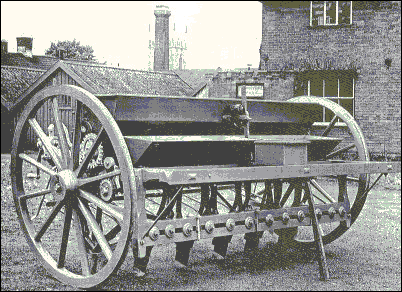
In 1800 James Smyth, a wheelwright at Peasenhall in Suffolk, his brother Jonathan and a local farmer, Robert Wardley, produced the first seed drill in which each coulter was fixed to an independent lever for ready adjustment to different widths, and devised a method using springs where pressure could be exerted to ensure that the seeds would be planted at a uniform depth. A further improvement was a steerage method by which the ploughman, walking behind the moving drill, could hold the transverse line of coulters steady, and thus preserve the parallel straight lines of planting when the horse or wheels of the drill strayed from a straight line. James Smyth later also introduced a feature that enabled the machine to deliver manure and seed at the same time. It was now possible to plant the correct amount of seed at the right depth. This greater control meant that seeds germinated consistently and it resulted in a much-improved crop yield.

These and other improvements Smyth made set the pattern for one of the principal types of seed drill used in Britain. It became known as the Suffolk Drill. Smyth’s firm (The Suffolk Seed Drill Company) became the leading specialist manufacturer of seed drills. Soon, Suffolk Drills were being sold all across Britain and into export markets. James Smyth died in 1843. His son, James, carried on the business, which remained in family control, and the reputation of their drills was so good that Smyths were able to remain and expand in this rather isolated village in Suffolk. However, the family was bought out in the 1960s and the factory was closed down in 1967, after 167 years of production.
Although the original Suffolk Drill has been superseded by better modern seed-drill machines, and the delivery of seed is now under computer control, the original design for the coulter still survives today and is known throughout the world as the Suffolk Coulter.
Suffolk Scythe
The scythe as a reaping implement is first recorded as being used around 500 BC, & is probably named after the Scythians; a nomadic pastoralist people who lived in the area around the Caspian Sea & eastwards into modern day Turkmenistan, Uzbekistan & Kazakhstan, who used a similar tool to the modern day scythe to harvest hemp. The Romans are known to have used them, & it was probably they who first brought the scythe to Britain.
According to East Anglian Crafts by Norman Smedley (1977), the Suffolk Scythe was the favoured scythe in the eastern counties of England prior to the introduction of the American Scythe. Usually made from ash, birch or alder, the “snaith” or shaft of the Suffolk Scythe is curved in an ‘s’ shape, & is, at around 5 ft 10 in, shorter than the English Scythe, which usually measures around 6 ft. The last foot or of the Suffolk Scythe shaft is hexagonal in section & ends in a point. At around 4 ft, the “chine” or blade is longer than the 3 ft blade of the American Scythe.
Suffolk Wheel Plough & Suffolk Swing Plough

Many counties & regions of England had their own particular type of wooden framed plough prior to the nineteenth century; most of which had remained unchanged for centuries & were suited to the terrain & soil of the area concerned.
By the 1830s, J.R. & A. Ransome of Ipswich (later Ransomes, Sims & Jefferies) were making more than eighty different types of plough, many bearing the names of counties such as Essex, Kent, Hertfordshire & Bedfordshire. Two bearing the name Suffolk were also being produced at this time. They are described in The Farmer’s Magazine of February 1835:
The Suffolk Wheel Plough: This plough is described as having a single handle, two wheels & a high, rather cumbersome carriage. It was ideally suited to the lighter soils of Suffolk & elsewhere in East Anglia.
The Suffolk Swing Plough: The Suffolk Swing Plough is described as having a single handle &, apart from the beam & draught irons, being similar in structure to the Suffolk Wheel Plough. It was very popular in East Anglia at that time.
More Agricultural Implements named after Suffolk
The Suffolk Heavy Harrow, Suffolk Horse Drag Rake, Suffolk Portable Thrashing Machine & Suffolk Crusher: These were all recognised makes of agricultural implements that were advertised for sale in the farming journals of the 19th century. They are referred to with illustrations in The Implements of Agriculture (1843) by James Allen Ransome. In each case a modification to the basic design and dimensions had been made by Ransomes of Ipswich for suitability in the use of these implements on the soils of Suffolk & elsewhere in East Anglia.
Suffolk Punch Lawn Mowers
Named after Suffolk’s famous heavy horse, the Suffolk Punch lawn mower was first produced in 1954, manufactured by Suffolk Iron Founders Ltd at Stowmarket, England. This company had been going since 1913 making castings for various local businesses and subsequently cast-iron consumer goods such as mangles, mincers and simple lawn mowers. The Suffolk Punch is seen as the first modern motor lawn mower due to its compact but powerful four stroke petr ol engine; many of its design features being later adopted by other manufacturers & with most domestic cylinder mowers still having a similar layout and appearance today. Many thousands were sold, not just in the UK, but also overseas. In 1958, Qualcast acquired Suffolk Iron Founders and continued to manufacture in Stowmarket, and in 1991, moving their entire lawn mower operations there, they renamed the company Suffolk Lawn Mowers. Other mowers with the Suffolk name were also produced over the years, from the 1950s through to the 1980s. These included the Suffolk Colt, Suffolk Pony, Suffolk Squire, Suffolk Corporation, Suffolk Auto-Swift & Suffolk Super Colt. In 2006 a new range of Suffolk Punch lawn mowers, both electric & petrol, was launched. These

include:
Suffolk Punch SP 12E Electric Cylinder Lawn Mower
Suffolk Punch 14SK 14 inch Self Propelled Petrol Cylinder Lawnmower
Suffolk Punch 17SK 17 inch Self Propelled Petrol Cylinder Lawn mower
The mower works were subject to a management buyout in 1992; this in turn was sold to the German group Robert Bosch GmbH in 1995. Bosch then licensed the Suffolk Punch brand name to be used by major retailers and other lawnmower manufacturers and the name passed into obscurity for a number of years.
In May 2011 Bosch sold the design and manufacturing rights to the Suffolk Punch petrol and electric cylinder mowers to Allett Mowers. However, the acquisition did not include the Suffolk Punch brand name nor the individual mower model names which were retained by Bosch Lawn and Garden. As a result, the former Suffolk Punch mowers were now manufactured at Allett’s production centre in Hixon, Staffordshire, to the same design and specification as their forerunners, but sold under a different brand name and new model designations by Allett. In the same year Bosch licensed the Suffolk Punch brand name to Global Garden Products Italy S.p.A. (now STIGA S.p.A.), and mowers with this name were made for the European market.
The Suffolk Punch was among the most reliable domestic motor mowers ever produced in the UK and it gathered a growing band of loyal and dedicated devotees whose demand for spare parts ensured that some limited production continued at the Stowmarket factory. However, Bosch closed the factory in 2019. In 2021 Allett Mowers revived the Suffolk Punch name for the company’s range of cylinder mowers, thus the Suffolk Punch purchased today may be made in the Allett factory in Staffordshire, England, or it may be made in a Global Garden Products factory in Italy.
Suffolk Barns

Many areas of Britain have their own distinctive style of local architecture, and in an agricultural region such as Suffolk there are traditional farm buildings. The Suffolk Barn is such a building. Modern barns are typically steel buildings. However, prior to the 1900s, most barns were timber framed forming very strong structures to withstand storms and heavy loads of animal feed. The typical structure is common to most eastern counties and comprises a large double wagon door on its lateral side rather than at the end of the barn. The barns are normally without a basement and stand on level ground. The interior has a central open area that acted as a threshing floor in previous days, and also divided the building into two separate areas, one for hay and grain storage and the other for livestock. In the USA this design is known as the English Barn, and was most popular in the northeast region of the United States, where the early American pioneers brought a design familiar to them as most of these colonists came from eastern England.
Suffolk Barns are noted for using material and colours that are specific to the landscape of East Anglia. Oak is grown locally and is used as the main timber framework and support. Suffolk Barns are tiled with traditional red and pink pantiles that create the familiar ridge and furrow profile distinctive to the whole of the east side of England and Scotland. This is a geographical feature that is a legacy of the days when the main trade contacts for the eastern counties were with Holland and Belgium, and clay pantiles were brought back from those countries as ballast in the ships.
Suffolk Horseshoe, Suffolk Bell & Suffolk Basket - Corn Dollies


Corn dollies are intricately woven straw shapes, usually constructed from wheat, oats, rye or barley. Prior to the advent of the combine harvester, they were made as part of the ritual that accompanied the cutting of the last sheath of corn; symbolising the capturing of the corn spirit. They would then be hung in the farmhouse until the following spring, when they would be returned to the field, thus releasing the spirit to be reborn in that year’s crop. As a symbol of fertility, they are also sometimes given as wedding gifts.
Many counties throughout Britain came to have special “trademark” designs. Suffolk has the Suffolk Basket (see photo, right), the Suffolk Bell & the Suffolk Horseshoe; the latter also having a variant called the Suffolk Horseshoe & Whip (see photo, left).
“Suffolk Punch” Steam Tractor

In October 1917 the engineering company Richard Garrett and Sons Ltd of Leiston, Suffolk, launched the “Suffolk Punch” steam tractor intended to compete directly with internal combustion-powered alternatives. The company had long been associated with steam-driven equipment for use on both road and farm. As its promotion campaign proclaimed: ‘the “Suffolk Punch” is a most apt name. It fully merits this appellation on account of its sound and robust construction, its hauling power and the ease with which it can he handled’.
One of the chief advantages claimed for this new steam-driven tractor, was that it could do duty all the year round. It could be employed on both farm and road. It was stated to be equally suitable for ploughing and threshing, drawing reapers and binders, cultivators, harrows, etc., as well as for driving such machinery as a saw bench, grist mill or chaff cutter. On the road the machine could haul a load of 10 tons, enabling it to transport farm produce efficiently. The “Suffolk Punch” was geared to a fast speed of 5 miles per hour in addition to ordinary ploughing speed. The driver’s position at the front gave him a full and uninterrupted view of the road, and of the field when ploughing. In general design it was arranged on the principle of motorcar steerage, and the various controlling levers were situated so as to be easily accessible from the driver’s seat. The boiler was of the locomotive type, and was fitted with a specially large firebox. A superheater was fitted in the smokebox, thus increasing economy both in fuel and water consumption.

Garretts was a family business from 1778 to 1932, after which the company passed into the hands of Beyer Peacock. The works finally closed in 1981. However, the historic core was preserved and opened as The Long Shop Museum, Leiston, in 1984. It includes the sole surviving “Suffolk Punch” steam tractor on display.
In 1925 Garrett developed a ‘modern’ steam-powered tractor also known as the “Suffolk Punch” (see image, right). It included a 40 HP engine and was designed for ploughing, pulling work and threshing. It was too expensive to compete with other tractors and only eight were built.
Suffolk Billhook

In bygone days, tools and equipment for use on the farm and countryside were produced by the local blacksmith. Since each craftsman was concerned to make tools specifically for his own locality, there was considerable variation in design to suit local conditions. Thus, the simple billhook varies from region to region in the British Isles, and several hundred different patterns of billhook have come into existence. The Suffolk Billhook (see picture, right) was designed for cutting undergrowth in banks and edges that were mostly below the level of the worker’s hands. Consequently the blade was heavier at the front and, to deal with the rough sedge, rushes and roots, the Suffolk Billhook has a slightly convex blade with a short straight bevel (a projection from the edge) at the end for dealing with roots.
The “Suffolk Boys”
In the last years before the outbreak of the First World War, the New Zealand government initiated a scheme of immigration for farm boys. They were brought out to alleviate a shortage of farm labour. Each contingent would comprise 50 boys mainly recruited from orphanages in the UK, who were to be trained in all aspects of farming life. The first group arrived in January 1911 on board the SS Athenic. A second group came out in January 1914 on the SS Ayrshire, and the third contingent arrived in March 1914 on the SS Suffolk. When war clouds gathered later that year, the scheme was abandoned.
The SS Suffolk arrived in Auckland on the 1st March 1914, and the 51 youths in the party were immediately dubbed the “Suffolk Boys”, although they actually came from all over the United Kingdom. In fact, there was only one farm boy actually from Suffolk: Sidney Pledger from Stoke-by-Clare (standing at 6 foot and born in 1892, he was hardly a boy!).
These immigrants had to enter a contract with the New Zealand government whereby they agreed to work for an approved farmer for a period not less than one year at a wage of not less than 7s 6d (37½ pence) per week, with board, lodging and clothing. Their wages were to be paid into a post office account under the control of the Labour Department from which they were given weekly pocket money. If a boy reneged on the agreement, except in cases of serious illness, he had to pay the New Zealand government the full cost of the passage to the country (£8).
“The Suffolk boys appear to be intelligent, sturdy, well-mannered young fellows, who should very soon develop into first-class farm hands and good citizens” (Otago Daily Times, 5 March 1914). We assume they lived up to this early promise, since the tag “a Suffolk boy” stuck for some time in New Zealand farming circles as a measure of praise.


Comments