

Suffolk Misc - Miscellaneous References to Suffolk from Around the World - Part 5


Order of contents on this page: (Click on the links below)
Products:
Duke of Suffolk Slash Panelled Pants and Duke of Suffolk Faux Leather Doublet Suffolk Stripe and Suffolk Check
The Suffolk Latch & Suffolk Hinge

Originatin g in Suffolk, England during the sixteenth century, the Suffolk Latch was in common use until the early part of the nineteenth century; becoming popular throughout Britain & spreading to Europe & America. Often used on garden gates, wooden doors & sheds, the Suffolk Latch incorporates a simple thumb actuated lever. It differs from the later developed Norfolk Latch in that it has no back plate to which the thumbpiece is attached. Originally hand forged by blacksmiths, Suffolk Latches have now become popular once again & are manufactured from a variety of materials such as wrought iron, steel, brass, pewter & wood.
William Twopeny (1797-1873), whose drawings of architecture, furniture, woodwork and ironwork were accumulated over many years of travel throughout Britain, is sometimes said to have given the Suffolk Latch its name.
A development from the Suffolk Latch is the Suffolk Hinge. A hinge is a mechanism allowing a door, gate or shutter to swing on a fixed point or post. Hinges come in various sizes and patterns, each with a different use. They are invariably described by the shape they most closely resemble. The two classic hinges are the T-hinge and the L-hinge, and they can come in various decorative designs, but the most common are the penny (or bean)-head end and the arrow-head end. With the Suffolk Latch, the latch part (the opening/closing mechanism on the opposite side of the door from the thumb actuated lever) was invariably shaped with a penny (or bean)-head end, and this has given rise in North America to this shape being referred to as the “Suffolk” type. Thus, in North America hinges of this shape are known as Suffolk Hinges. With the economy in language, let alone print-space, that this provides, this American definition is now becoming more prevalent on this side of the Atlantic.

In North America described as a Suffolk Strap Hinge (in Britain a T-shaped hinge with penny head end)

In North America described as a Suffolk L-Hinge (in Britain an L-shaped hinge with penny head end)
Suffolk Door, Suffolk Door Knob and Suffolk Rim Knob
A particular type of internal frame and ledge door is made in what is known as the Suffolk-style; in other words a “Suffolk Door”. These have a distinctive look with a plain front containing vertical panels within a frame, and the back of the door has a raised frame with a matching single ledge running horizontally across the centre. The central ledge makes it easy to create a half-glazed door that has the effect of providing greater light and brightness to the room.
The Suffolk Door is a traditional design found in cottages, and certainly known from the 17th century, but is not especially specific to this county in England. However, like many other traditional items associated with the rural countryside, it has come to be known as the Suffolk Door. Traditionally, it was made from solid oak, but modern doors can be made of other material, including UPVC (plastic). In North America this design is called the “Mexicano” and seems to differ only in the material used, which is traditionally from American White Oak.
Internal Suffolk - Door (Front) Internal Suffolk - Door (Back) Glazed Suffolk - Door
Suffolk Door Knob: There is also a “Suffolk Door Knob” (see image, below), although we are not sure how specific this is to the county, or whether it is really a particular design.

Door handles/knobs are surprisingly recent. The first documented invention of the door handle with its turning spindle and spring mechanism was patented in the USA in 1878. However, the use of handles and knobs on doors is documented by illustrations in sales catalogues, extending back into the 18th century.
Really traditional Suffolk Doors have the Suffolk Latch (see The Suffolk Latch & Suffolk Hinge, above) rather than a door knob, and advertisements for cottages often have the phrase “Suffolk doors with Suffolk latches” as a selling point. Our guess is that if a Suffolk Door has a doorknob instead of a latch, an astute salesman would undoubtedly call it a “Suffolk Doorknob”.

However, the Suffolk Rim Knob is certainly a recognised design (see image, left). A Rim Knob is a pair of door knobs designed specifically to fit onto a Rim Latch. They are available with or without a lock mechanism. The main difference is that only one of the knobs will have a Rose Plate (the circular plate to which handles and knobs are attached), the other fits directly onto the Rim Latch/Lock. The latter is a traditional latch or lock mechanism which is concealed in its own case and is fixed onto the inside face of a door rather than morticed into the frame.
Suffolk Puffs
In the sewing world a Suffolk Puff or Yo-Yo is a little circle of fabric that is traditionally used in quilting and patchwork. They are simply circles of fabric, formed in such a way that the fabric is gathered in the middle, giving them a puffed look in the centre. The puffed look can be enhanced by putting some wadding or padding underneath.
This technique dates back to before the Victorian era, and “puffs” are first recorded in 1601. However, puffs made mainly from old worn out clothes and fabric scraps seem to have originated in Suffolk, England, in the 19th century among the families of the agricultural labourers, who were keen not to waste anything. Pieces were sewn together to make quilts and Suffolk Puffs became the name of this type of patchwork by the end of the century.

Suffolk Puffs were especially popular from about 1910 to the 1950s and were mostly used as one-patch units in random scrappy designs or geometric arrangements to construct coverlets, pillow shams , cot quilts and the like. They were great for using small scraps and recycled fabrics and were often made by children and beginners as well as frugal homemakers.
In America the same type of quilting is now known as a “Yo-Yo quilt”. It is thought that this name derived from the popularity of the toy of that name, and in some respects the round shape and bunching of material resembles the yo-yo toy. The toy was known by this name in the Philippines in the 19th century, but is not recorded in America until 1916 when an article about Filipino toys appeared in the “Scientific American” magazine. The toy was introduced to America in 1928 by a Filipino businessman, so the name given to the quiltwork probably originated after this year.
Suffolk Bay Cocktail Tables

In 1943 the Hammary Furniture Company was established in Lenoir, North Carolina, USA, and took its name after its founder, Hamilton (Ham) Bruce and his wife, Mary. From 1947 Mr Bruce began to manufacture a group of occasional tables, and soon the company started producing mahogany and gum tables with leather tops exclusively, all in genuine Honduras mahogany.
One of the range of designs manufactured by the company is the “Suffolk Bay” cocktail table collection. This takes its name from the former name of a bay on the island of Saint Vincent (see The Ones That Got Away page). The range was inspired by the stately plantations of 19th Century British West Indies; a colonial period that adapted the furniture styles of Georgian England with the materials available from the islands. The tables are crafted from Honduras Pine with bases made from a combination of cast resin and aluminum, and have clear glass tops. This wood provides a high durability, and the carved motifs on the panelwork reflect a Caribbean flavour.
The American furniture manufacturer La-Z-Boy Inc. (pronounced “lazy boy”) based in Monroe, Michigan, acquired the Hammary Furniture Company in September 1986 and the latter is now a division of that group of companies.
The Suffolk Chair
The Suffolk Chair (see photo, right) is an upright wooden chair with a thin curved seat set on a stool base, which evolved in Suffolk, England over the course of several centuries. Usually made from elm, oak or mahogany, the characteristic that makes the chair unique to Suffolk is the design of the back, which has small wooden bobbins (usually three) set between two horizontal rails.

Another type of chair originally from Suffolk is the Mendlesham Chair (see photo, left). Created during the period 1780 & 1820, by father & son Daniel & Richard Day in the village of Mendlesham in central Suffolk, the Mendlesham Chair has a solid wooden seat, with an inclined back which is a separate construction from the legs. There is also a “window” or gap at the base of the back frame.

As may be expected, the Suffolk name for chairs has been hijacked by brands that are nothing to do with the place nor have any connection whatsoever with a “Suffolk style”. It is noticeable that Suffolk again has the sense of ease and comfort since it is the settee, sofa and armchair that are the recipients of this award. In Britain the Fairway Furniture Suffolk Range comprises the Suffolk Chair (armchair), 2 Seater Suffolk Sofa, 3 Seater Suffolk Sofa and Suffolk Storage Stool. John Harding founded the company in 1856 in Plymouth. J.Harding & Sons not only sold furniture which they made themselves, but were also timber dealers and undertakers. In 1976 the company opened its first out of town store, under a new name - Fairway Furniture. The business is still in the hands of a sixth generation of the Harding family.

In the USA, the Suffolk Rocking Chair by Klaussner Home Furnishings is of note. It is an armchair placed on curving supports (rockers) - see image left. Apparently the “rocking chair” is an American invention, so it is only appropriate that this piece of furniture seems to be popular in that part of the world. This upholstery business in Asheboro, North Carolina, was founded in 1963 by Stuart Love. He sold the company to European furniture magnate Hans Klaussner in 1979 and in 2017 it was acquired by New York-based private investment firm Monomoy Capital Partners. The company also sells the Suffolk Swivel Glider which sits on a round base that allows the armchair to swivel round to face in any other direction.
North Carolina is also the home of another Suffolk Range comprising the Suffolk Sofa, Suffolk Love Seat, Suffolk Swivel Chair, Suffolk Swivel Glider, and the Suffolk Ottoman. (A “love seat” is to Americans what us unromantic Brits know as a “two seater sofa”.) These are made by the Hickory Chair Furniture Company which has been going since 1911. The chairs are not made from the wood of that name. It so happens that the company is located in the place called Hickory in North Carolina. The beginnings of this company go back to two brothers George and Waldron Bailey who, in 1900, moved to Elkin, North Carolina, from New York to begin a chair factory (the Elkin Chair Company) that only made one style of dining chair. George bought out his brother and invited local Elkin businessmen to join him in what was renamed the Surry Chair Company. In 1911, George learned that the demise of the wagon industry of Hickory had left many woodworkers out of a job. Hence, with labour in plentiful supply the Surry Chair Company relocated, the Hickory Chair Furniture Company was born and the company diversified its range of chairs.
Suffolk Lantern Clock
This is an antique piece that is occasionally seen for sale at auctions. It is thought by many people to be a specific style of clock. However, it basically describes an old lantern clock that was made in the county of Suffolk, England.
A lantern clock is a type of antique, weight-driven wall clock that strikes the hours on a large overhead bell. The name is probably a corruption of the French word “laiton” meaning brass, the main metal of which lantern clocks are made, although the clock’s shape resembles the rectangular lanterns of that period that were also hung on the wall. They were the first type of clock widely used in private homes. It is generally accepted that the first lantern clocks in England were made by Huguenots who had fled from Flanders and France to London at the end of the 16th century. Lantern clocks became common in Britain from around 1620, and rapidly settled into an established design which continued largely unchanged for about 150 years.
Before the invention of the pendulum in 1656, lantern clocks had a limited accuracy to perhaps 15 minutes per day and, as such, almost all lantern clocks have just one clock hand, the one that indicates the hours. The pendulum increased the accuracy of clocks to such a degree that existing lantern clocks were converted with pendulums being added to the back. However, clockmakers kept building most lantern clocks without minute hands as a matter of tradition. Longcase clocks with 8-day timekeeping made lantern clocks obsolete, and lantern clocks disappeared from London in the first decades of the 18th century. In rural areas they continued to be produced until the beginning of the 19th century.

Most clockmakers were in London before 1640, but after this date Bristol and Salisbury also became important locations for clockmaking. The earliest reference to the craft in Suffolk is with Robert Sparke of Cockfield, who died in 1648 and is described as a clockmaker in his will. The first lantern clock in Suffolk is believed to have been made by Luke Cocksedge of Bradfield St George, who was still alive in 1652. Both these locations are on the outskirts of Bury St Edmunds, and this town in Suffolk became a major centre of clockmaking from the 17th to 19th centuries.
Although he was not the earliest clockmaker in the town, Richard Rayment (c.1686-1754) of Bury St Edmunds is the best-known and most prolific maker of lantern clocks from around 1714 until his death in 1754. Rayment’s lantern clocks have an individual style about them, particularly with regard to the half hour markers between the numerals which are nearly always lozenge-shaped. Other clockmakers of this period, especially in East Anglia, copied this style and, to this extent, it could be said that this represents the “Suffolk Lantern Clock”.
Suffolk Kiln
Brick making has taken place since the Roman period, but after the departure of the Romans from Britain there was little requirement for bricks; timber and stone being in plentiful supply. The revival of brick making in eastern England in the late 13th and early 14th centuries was a result of an increasing shortage of good timber, and the influence of Europe where brickwork was used much more extensively. By the Tudor period brickmaking is recorded in the Woolpit area in 1574 (see Suffolk White Bricks, below).
Bricks are moulded from clay and sand mixed with water to the desired consistency, and then laid out to dry. Even after drying in air the green (raw) bricks contain water, so the shaped clay is then “fired” (burned) to finish the drying process and achieve strength. The simplest way to do this is with a large pile of bricks and fuel mixed together and ignited. The main problem is there is little control over the final temperature. The knowledge and experience of the brickmaker was critical to the process to know when the correct temperature was reached, and when the heat should be allowed to slowly dissipate over a period of time. Overheating can cause distortion and cracked bricks, whilst others left under fired are too soft for use.
There were very few kilns at first, and production was only seasonal. Bricks were generally fired on site in “clamps” by itinerant workers near to the clay source. A clamp was a temporary construction of unfired or green (raw) bricks which was dismantled after firing, and could be transported and erected near to the clay source. Clamps varied, but there were general rules which most followed. The floor had to be level and was made of burnt brick. Channels were made in the floor and filled with fuel, usually crushed coke but any fuel would suffice, wood and charcoal commonly being used. An average size clamp would take two or three weeks to burn out.
Eventually most sites developed some form of permanent kiln, the earliest of these being the updraught kilns. The most basic was the Scotch Kiln that had four walls and was open at the top, with side doors to fireholes that led under a perforated floor onto which the bricks were stacked. The heat passed up through the bricks and out of the top of the kiln. It took approximately three days to burn off the moisture from the bricks, at which point the firing was increased for the final burn. The whole cycle usually took about a week.
A later development came to be known as a Suffolk Kiln after the practice found in that county. These were fired on the same principle, but the kilns were smaller and built into a bank. One reason for this was to provide ease of access for loading and unloading from the side wall rather than from the end, and since the bank itself acted as a natural chimney, it enhanced the kiln’s draw and provided better insulation. The Ebernoe Brickworks in West Sussex has a Suffolk Kiln, built before 1795, which is now a scheduled ancient monument.
The Suffolk Kiln and other early types of kiln are now obsolete. Modern kilns are downdraught kilns where the heat is pulled through the bricks from the draught created by a large chimney above the kiln.
Please sign the Guestbook
Suffolk White Bricks

Suffolk White Bricks (sometimes known as Woolpit White Bricks) are made from Gault or boulder clay found in the area around the village of Woolpit in central Suffolk, England, that was laid down during the Cretaceous period around 120 million years ago. The clay in this area contains a high chalk content unique to Suffolk that, when fired, turns the bricks a creamy white colour. The deposits also contain red veins which were used to make the more conventional red bricks. Suffolk White Bricks, however, gained a reputation for being more durable & of superior quality, henceforth they were much sought after & became twice as expensive to buy compared to the red variety.
Brickmaking is first recorded in the Woolpit area in 1574 & continued for almost four hundred years; production finally ceasing in the early 1950s. Many buildings in Suffolk were faced with White Bricks from Woolpit, such as the Great White Horse Hotel in Ipswich, Hengrave Hall, & many buildings in & around Bury St Edmunds. With the coming of the railways in the nineteenth century, Suffolk White Bricks began to be exported further afield.
Other places in Suffolk also made White Bricks, such as Ballingdon on the River Stour; once a separate village, but now a suburb of Sudbury. It was from here that White Bricks were transported to London for use in buildings such as the Royal Albert Hall.
There is a popular story that Suffolk White Bricks were shipped to America & used in the construction of the White House in Washington DC (built between 1792 & 1800). There are even sources that suggest that the bricks were loaded onto ships from the barge quay at Martlesham, before setting sail down the River Deben on their journey to America. Sadly this seems to be no more than an “urban myth”, as the White House is built primarily of white-painted Aquia sandstone sourced from Virginia. It seems that someone equated “White House” with “White Bricks” & the legend grew up around this erroneous assumption. However, if anyone knows any different, please let me know by emailing info@planetsuffolk.com
Suffolk Sailcloth
“Suffolk”, as well as “Ipswich” & “Double Ipswich”, are three types of sailcloth known to have been exported from Ipswich during the late sixteenth & early seventeenth centuries, during a period when sail making flourished in the town. Sadly no records survive today to tell us exactly what qualities or features made “Suffolk” sailcloth unique.
Suffolk Hempen Cloth
This was a name given to a particular type of linen once renowned for its quality throughout Britain. In the 18th and early 19th centuries the end product came from factories in Norwich, but such was its fame that the good people of Norfolk had to swallow their pride and it was advertised for sale as “Suffolk Hempen Cloth”.
Small scale flax production was once widespread throughout the eastern counties, but by Tudor times it had become concentrated in the Waveney valley on the borders of Norfolk and Suffolk, particularly at Bungay (in Suffolk) and Diss (in Norfolk). In the 17th century the small town of Diss in Norfolk became the centre for the collection and distribution of Suffolk Hempen Cloth at its cloth-hall. Later, the unbleached linen cloth was sent to better equipped factories at Norwich where it was dressed, improved and dyed. The industry reached its peak in the early part of the 19th century during the Napoleonic Wars, but the return of peace brought competition from cheaper linen overseas, particularly from the Irish linen industry. By the end of the 1850s the industry had become obsolete. Attempts to revive it later in the century failed, and Suffolk Hempen Cloth passed into history.
The Suffolk Suit
Several st yles of suits originated in England. The Eton and Rugby suits are named after the English schools where the styles originated. Two styles carry the names of English counties. The Norfolk Suit was named after the Duke of Norfolk who first conceived of it. The origins of the lesser known Suffolk Suit are not known, but it came about during the late 19th century. Although not as popular as the Norfolk Suit, there are frequent advertisements for the Suffolk Suit in the newspapers of Britain, America, Australia and New Zealand up to 1914.

It is believed that the Suffolk Suit evolved from a ploughman’s or horseman’s suit, made to a basic design, but tailored to the individual’s instructions. Ploughmen and horsemen were exceedingly proud of their identity, and to show it off at shows and at the market place they wore a special uniform. One of the special features was a horseshoe button on the pockets of the jacket. The original early ones were made of horn and shaped like a horse’s hoof with a metal horseshoe on top. It was important to place the button with the open end upwards ‘to keep ones luck from falling out’. Unlike the Norfolk Suit with its aristocratic origin from the Duke of Norfolk, the origin of the Suffolk Suit was considered to be that of a rustic working suit, made to the liking of individual ploughmen. Each suit was a bespoke design, and apparently it was much resented if another ploughman or horseman tried to copy the same design.
The general design became fashionable for young boys’ wear by the end of the 19th century. Suffolk Suits were advertised for boys from 6 to 13 years of age. They were knicker suits consisting of a coat vest, and “plain” knickers. “Plain” knickers meant that the kneepants were open at the hem, without buckles to fasten below the knee. Knickers with straps or buckles to fasten below the knee cost extra. The suit was belted and had a small, but distinct high set lapel. While the Norfolk Suit was commonly worn with an Eton collar, it was less common to wear a Suffolk Suit with the Eton collar, although this was optional. Suits came in a variety of materials, including navy serge, indigo dye soft finish, fancy tweeds, English tweed, fancy worsteds, and all wool sergette.
While the suit was created in England and most widely worn there, the style spread to most other English-speaking countries.
The Suffolk Jacket & Suffolk Chef's Jacket
It seems that the Norfolk and Suffolk suits (see above) also gave rise to a style of jacket that is still common today.
A Norfolk Jacket traditionally has deep pleats running down either side of the front button opening, as if braces (suspenders) were incorporated in the jacket, and is single breasted with three pockets. A Norfolk also has a full belt, either with a leather buckle, or with two leather buttons in the front. The lower two pockets are often of the buttoning bellows with flaps variety, much like a Safari Jacket.
The related style, known as a Suffolk Jacket, is similar but used to have deep hidden pleats just behind the shoulder armhole, with a half belt sewn on the back of the jacket, or often without a belt at all, and deep bellows with flap pockets in the lower front.
In the US these are often called “hacking jackets”, and the pleated shoulder was highly favoured by golfers in the 1920s as the jacket was not likely to tear apart during the average golf swing.
Some authorities on clothwear consider the term Suffolk Jacket to be meaningless today, mainly because for some reason it has come to describe a chef’s double breasted white tunic. However, there are plenty of advertisements that show this name to still be applicable today, although, as the illustrations below indicate, the name can nowadays apply to a wide range of different designs, all called a ‘Suffolk Jacket’, including longer women’s coats & more formal jackets.
Suffolk Chef’s Jacket: There is no explanation as to why this style of chef’s wear is k nown as the Suffolk Chef’s Jacket. Much of the chef’s uniform has developed out of necessity. The jacket, for example, is double-breasted so it can easily be reversed to hide stains that may accumulate throughout the day; the double layer of cotton is also designed to insulate the chef’s body against the intense heat of the stove or an accidental splattering of hot liquid. Even the knotted cloth buttons were fashioned for a reason - cloth will withstand the frequent washings and abuse buttons often take from contact with pots, pans and other heavy equipment. The Suffolk Chef’s Jacket has the reversible front, a Mandarin collar, and a stud closure front. It is, naturally, unisex.
Latest models of this item of clothing have also been advertised as the Suffolk Stud Jacket. The promotional write-up makes it clear that it is a chef’s jacket.
(See also Suffolk Jacket in the Suffolk as a Product Brand Name section below, where various names for this garment are given.)
Have you signed the Guestbook yet?
A. L. C. Suffolk Dress

Launched in 2014 this (in fashion parlance) is “a plunge-front jersey dress featuring a deep V neck and pleating and draping at the front, with ruching at yoke and shoulders; an exposed zip and ruching at back; extra-long sleeves and a jersey lining at skirt”. ‘Ruching’ is a series of folds or pleats that produces many small vertical ripples in the fabric. A. L. C. stands for Andrea Lieberman Collection.
Born and raised in New York City, Andrea Lieberman graduated from the Parsons School of Design in Greenwich Village. She went on to work with some of the best fashion houses, and after several years of world travel, Andrea returned to New York to open her retail store Culture and Reality. The store became a cult sensation and introduced her into the world of styling.
She created costume and wardrobe notably for Gwen Stefani, Jennifer Lopez, Gwyneth Paltrow and Cameron Diaz among others. Now based in Los Angeles, Andrea Lieberman introduced her own ready to-wear fashion label, A. L. C., in 2009. As the sales blurb says: “Andrea Lieberman’s clothing line, A. L. C., provides a smart and versatile wardrobe for alpha-females”.
We assume that the name ‘Suffolk’ is applied to evoke the usual image of a pleasant, warm and comfortable feeling associated with that county, either the one on Long Island which is in close proximity to Andrea Lieberman’s home town, or the county in England.
Rag & Bone Suffolk Dresses and Suffolk Wool Peacoat
Another case where ‘Suffolk’ is used as a brand name by the designer house “Rag & Bone”, based in New York City. It is used on two of their women’s dresses: the Suffolk Tie Dress in White (left image) released in 2014 and the Suffolk Denim Apron Sleeveless Dress (right image) released in 2016.
The Suffolk Wool Peacoat introduced by Rag & Bone in 2022 (shown below) is an outer coat, generally of a navy-coloured heavy wool, originally worn by sailors of European and American navies. Peacoats are characterised by short length, broad lapels, double-breasted fronts, often large wooden, metal or plastic buttons in two rows. References to the pea jacket appear in American newspapers as early as the 1720s. The term “peacoat” or “pea jacket” originated from the Dutch word pijjekker or pijjakker, in which pij refers to the type of cloth used, a coarse kind of twilled blue cloth, and jakker designates a man’s short, heavy coat.
From its origins in New York in 2002, Rag & Bone instantly distinguished itself. The irony is that people think Rag & Bone is American, but it was founded by two British school friends, David Neville and Marcus Wainwright.

The two met at boarding school in Berkshire, England; neither has a connection with Suffolk. Both worked in London, Marcus moved to New York where his future wife was then working and David soon followed. In the beginning, all they had to draw on for inspiration was the New York tradition. Using local American manufacturing craftsmanship and attention to detail as a guide, they brought a blend of English heritage in beautifully constructed designs that were about quality and authenticity, rather than about the brand.
The pair worked from home from 2002 to 2006 when they acquired their first office. Rag & Bone opened its first store on Christopher Street in New York in 2008. Today, there are 36 Rag & Bone stores in the United States. Internationally, there is a single store in London in Soho as well as franchise houses in several other countries. David Neville ran the business side and Marcus Wainwright directed the creative side, including design and marketing. Both were co-CEOs until 2016 when David Neville relinquished his day-to-day responsibilities in order to pursue other projects. Marcus Wainwright continues as sole CEO. Neville remains one of the largest shareholders in the business, which now has a turnover of more than $300 million.
Lady Suffolk Bikini
The allure of the name ‘Suffolk’, conjuring up pleasing and tasteful fashions, has reached the Latin American shores of Colombia where the Maaji fashion house has produced this little number. Its price tag in the USA was $128.00. Somehow, we do not think the name ‘Lady Suffolk’ was inspired by the famous American race horse of that name (see entry below). Unfortunately, the product has been sold out and is no longer available. We will, however, repeat the promotional review: “A gorgeous reversible bikini top with soft cups, removable straps, floral print, multi-strap and ties at back. The matching reversible low rise hipster bikini bottom has floral print. The swimsuits are fully lined and fully reversible – flip them inside out for a whole new look.” That is the boring bit over - see photo, left.

Maaji swimwear creations are said to have a high reputation. It is a company started by two Colombian sisters, Amalia and Manuela Sierra, in 2003 in their native town of Sabaneta in Antioquia department in Colombia. The name “Maaji” was inspired by a fish of this name (hence the allusion to swimwear) found off Japan and the East India Sea. Its scientific name is Trachurus japonicus and the common English name is Japanese horse mackerel.
The sisters started creating garments designed for women who wanted to feel pretty and comfortable with a laidback trendy style and a fresh attitude. Today Maaji is present in more than 57 countries and continues to expand globally. Design and manufacturing are one hundred percent Colombian, and provide work for over 400 people both at their workshop and in the surrounding neighbourhood. Maaji has expanded its product lines from swimwear into underwear, sandals, children’s lines and swimwear for men; 95% of its products are exported.
In April 2017 the owner of Australian swimwear brand Seafolly bought Maaji to create a new global swimwear and beach lifestyle business. The original owners of Maaji remain a minority shareholder.
Suffolk Bikini
A photograph of one lady wearing a bikini is enough to provide some idea of this concept (see Lady Suffolk Bikini, above). We can, however, report that the name ‘Suffolk’ is also used in Australia for this item of swimwear.
The May & Hugo ‘Suffolk Bikini’ takes its name from Suffolk Park, probably following the success of that brand name in respect of the Rhythm ‘Suffolk’ Clothwear (see below). The ‘May & Hugo’ label was founded in 2015 by Emily May and Marcos Hugo Bello. Marcos comes from Tenerife in the Canary Islands and worked in the media (video and photography) industry; Emily comes from the small town of Bellingen in New South Wales. Although now based in Sydney, the couple began in the city of Coffs Harbour near to Bellingen. These two locations are 232 km (144 miles) south of Suffolk Park, New South Wales.
Emily gained a degree in Design and specialises in swimwear. The couple came up with the idea of designing and producing swimwear using sustainable fabric from recycled post-consumer waste, such as abandoned fishing nets, carpets, plastic bottles, etc. These are broken down into raw material and then re-spun into yarn, thus avoiding landfill, helping to reduce world-wide waste and saving energy consumption since this method is cheaper than production from the original virgin materials. The end-product is made wholly in Australia.
Rhythm ‘Suffolk’ Clothwear
The name ‘Suffolk’ has been chosen for some of its products by the Rhythm brand. In this case it relates to the Australian resort of Suffolk Park (see Suffolk Park, NSW page). This should not be surprising since Rhythm was founded in 2003 by Australian surfers at Burleigh Heads on the Gold Coast, Queensland. Suffolk Park, a renowned surfers’ beach, is only 83km (52 miles) south of Burleigh Heads, and the company sponsored the local boy from Suffolk Park, Kieren Perrow, for a number of years. Kieren was a professional surfer, ranked number 6 in 2003, a Pipeline winner, and regarded as one of the sports most fearless riders, achieving some notable “firsts” on the waves he rode.

The ‘Suffolk’ name is attach ed to the following Rhythm wear. Rhythm Suffolk Trilby Hat in Black, Brown and Olive (see photos, left). This hat, made of felt, has a classic wide brim style with a leather knot. Although called a trilby, it is far from the traditional trilby that has a narrow brim and indented crown. The Rhythm Women’s Suffolk Wool Felt Hat is very similar.

Rhythm Suffolk Jam Shorts (see photo, right) - for the uninitiated, this baggy and supposedly ‘Bohemian’ look was first popularised by surfers in the 1960s. The word ‘jam’ is a shortened form of ‘pyjama’ bottom, which is exactly where the original cut-off design came from. For the more discerning shopper, this apparel is also referred to as the Rhythm Suffolk Trunk Boardshorts.
There is also a line known as Rhythm Suffolk Knit. This is a range of knitted jumpers and cardigans in various styles and colours for men and women.
The Rhythm Suffolk Long Sleeve Shirt is yet another item in the Suffolk range (see below under Suffolk Check in Suffolk Stripe and Suffolk Check).
The Rhythm Suffolk Beanie was launched in December 2016. In parts of the English-speaking world, this type of knitted hat is traditionally called a “beanie”, but in parts of Canada and the U.S., the word “beanie” is used to denote a completely different, less floppy, cap that is not knitted, but rather made up of joined panels of felt, twill, or other tightly woven cloth. According to the Oxford Dictionary, the etymology is uncertain, but probably derives from the late 19th century slang term “bean”, meaning “head”. The term “beanie” for this type of headwear came into use in c.1940 when knit caps were standard cold-weather apparel for the U.S. Navy. This widespread use turned the humble knit cap into a postwar pop culture icon, known as the “beanie”. (There is also another hand-knitted Suffolk Beanie as shown in the next article).
Launched in Australia in 2003, Rhythm is a company influenced by surf and sound and its brand ethos is “The Sound of Change”. The company was founded by surfers Jamahl Grey and Neal Purchase Jnr. The latter not only surfs amazingly well, but he is also the guitar player of the group Haldane’s Daughters. Rhythm brought together a group of designers, artists, musicians and surfers, with a shared dream of creating a livelihood doing what they love. Together, they set out to make clothing that reflects adventure, creativity and individuality. It became best known for its colourful boardshorts, but soon expanded into other areas of leisure clothwear with their geometric and unusual designs. Rhythm entered the American and European markets in 2009 and 2010 respectively, and can now rightly claim to be an international 0peration.
Suffolk Beanie

This hand-knitted “beanie” (for explanation of name, see article above) is described as “a snug fit cabled beanie hat with ribbed double cuff hem. A great essential for men and women and super cute on kids. One size fits most and is easily adapted. This is a quick knit, worked on big needles with chunky yarn”. Knitting instructions are published in ‘Jo Storie Hand Knit Patterns’ produced in Northumberland, England.
Jo Storie graduated from the Scottish College of Textiles and moved to New York where she worked as a senior designer for high profile labels. Jo returned to Scotland in 2004 and launched her own knitwear label as above.

The Suffolk Beanie appears to have obtained this name because of its association with Suffolk University in Boston, Massachusetts. This institution was founded as a law school in 1906 and named after its location in Suffolk County. It became a university in 1937. The tradition of freshmen wearing what is now called a ‘beanie’ in their school’s colours during their first semester (half the academic year) to distinguish them from upper classmen was observed at Suffolk University from the1920s until around 1968. This was before the name became attached to this type of American headwear but, with the popularity of the naval woollen knitted caps known by this name after the Second World War (see previous section), it soon became known as the ‘Suffolk Beanie’. All freshmen were required to wear their Suffolk Beanies and to obey the commands of their upper classmen. In 1955 the freshmen were initiated to the social life of the university by the introduction of the ‘Beanie Dance’ given in their honour by the senior class. These customs soon caught the eye of the media, and hence the ‘Suffolk Beanie’ became known to the wider general public. A photo of the initiation ceremony in the 1960s is shown above left.
Duke of Suffolk Slash Panelled Pants and Duke of Suffolk Faux Leather Doublet
According to the promotional write-up: “The Duke of Suffolk, a courtier at the Tudors was athletic, fun-loving, fashionable and high-spirited”. That is sufficient for these products to get a place on our site, and they do have the name ‘Suffolk’. However, we are not convinced that they were known by this name at any time in the past or have anything to do with Suffolk but, hey, they look good.

These garments are ideal for re-enactment and period costume displays, but we understand that they are becoming fashionable on their own account for the party-goer who wishes to make an entrance. They are described as “black-on-black brocade paneled pants made of 100% cotton. They feature open slashes and button-up front” and “Faux leather and cotton velvet come together to make this doublet” NB. Faux means ‘imitation’ (we would never have guessed!)
These have been on the market in America and Britain since 2018 in shops that specialise in historic outfits, particularly for the acting fraternity. They are, however, manufactured in India by the Windlass Group. This is a diversified business group based in the city of Dehradun in Uttarakhand. Windlass Steelcrafts was founded in 1943 by the late Mr Ved Prakash Windlass. He started in 1941 by supplying “kukris”(curved knives) to the British Gurkha Regiments in pre-independent India. It soon became the premier supplier of contemporary military dress, sabres and accoutrements, then expanded into historic replicas that found a market in motion picture and television props. It became renowned for the accuracy and quality of its replica props that could be delivered on time for some of Hollywood’s biggest blockbusters.
In the 1970s Windlass teamed up with the Atlanta Cutlery Corp., a small and relatively unknown American firm that began in 1971 in Conyers, Georgia, USA, specialising in hunting and other hard-to-find knives and knife making supplies. In 1995 full ownership of the Atlanta Cutlery Corp. and Museum Replicas Ltd was acquired, thus solidifying its foothold in the largest market in the world.
Suffolk Stripe and Suffolk Check
In Michel Pastoureau’s comprehensive book, The Devil’s Cloth: A History of Stripes, the author details how in the Middle Ages wearing stripes was a perilous act. He recounts how in 1310, a cobbler in northern France was condemned to death because ‘he had been caught in striped clothes’. Striped clothing was considered ‘demeaning and clearly diabolic’ and was worn by social outcasts, such as prostitutes, jugglers, clowns, cripples and convicts. That is why bold black and white stripes went on to become prison uniform in the USA in the 19th century.
However, the American flag allowed stripes to become popular and by the end of the 18th century stripes had finally become chic. Although striped cloth never entirely lost its connotations of danger and deviance, it acquired other associations. In particular, striped clothing acquired sporting or leisure connotations: Victorian seaside scenes frequently show women strolling in long summer dresses of black-and-white or blue-and-white striped fabric. As this association with the seaside suggests, stripes were then connected with the “marine” and “sea” so that naval shirts of the ordinary able seamen often comprised vertical stripes of blue and white. The symbolic use of striped blazers in club colours by boating clubs and cricket teams at English universities gave way to neckties in diagonal stripes of prescribed colours and widths to identify members of military regiments, alumni of university colleges and clubs. The associations of striped cloth with leisure and sporting pursuits also made striped canvas popular for the upholstery of outdoor furniture, beach umbrellas, shop awnings and the like.
Suffolk Stripe: This brand name seems to have arisen separately in England and the USA as there is no obvious connection or influence that we can discern for its origin in those places.
The triangle between Hadleigh, Sudbury and Bury St Edmunds in the county of Suffolk in England was the foremost broadcloth producing area in the country from the Middle Ages until the late 17th century. This could be why the county name was given to a type of stripe, or the wool used could have come from the Suffolk Sheep. However, we are not convinced that either of these can be the origin of the use of this brand name. It is more likely to have been adopted for the reason that ‘Suffolk’ was already associated with quality, style and leisure products.

The earliest reference that we can find is from the September 1993 catalogue of Laura Ashley, which has a sofa done in a “bold Suffolk stripe” (left). The fashion designer, Laura Ashley, was Welsh born and had no connections with the county. The “Suffolk Stripe” seems to be a broad stripe with narrower ones either side, usually with a very thin or several very thin stripes in between or in the centre of the broad stripe, all in alternating colours or shades of a dominant colour.

Described as “new” in 2015 was the Suffolk Stripe Rocking Deck Chair (right) followed by the Suffolk Stripe Camper Stool in 2017 by Jon Holloway who, after a career designing and developing garden products for leading retailers, established his own company (Garden Trading) in Burford, Oxfordshire, in 1994. The promotional material states that “this colourful stripe is named after the seaside county of Suffolk”.
Sheridan Suffolk Riviera Beach Towel (below, left) and Sheridan Suffolk Wattle Striped Beach Towel (below, right): These products are found in Australia. The stripes have the large and smaller stripes pattern alternating with a much larger main colour stripe. “Sheridan Australia”™ was founded in 1967 by the Italian entrepreneur and textile designer Claudio Alcorso, who was brought up in the family textile printing business in Italy before migrating to Au stralia. The name ‘Sheridan’ w as coined over a glass of wine. The promotional write-up states that “Sheridan has a distinctly Australian style inspired by the unique Australian landscape”. It is not revealed what they were drinking when they came up with the brand name ‘Suffolk’, although this could well be related to Suffolk Park, NSW, which is at least a beach resort in Australia.
The golden wattle (Acacia pycnantha) is a tree native to southeastern Australia that has golden flowers, hence that name.
Suffolk Stripe Pants (above right) were in a 2017 collection on offer by the design house “Conte de Florence” in that city in Italy. We were easily fooled, but when enlarged it can be seen that the design consists of very fine stripes of the same width. What this has to do with Suffolk or the stripe of that name is anybody’s guess.
The Suffolk Regiment Stripe Silk Tie in woven polyester is handmade in the UK. It has a narrow white stripe centred on a broad dark red one, alternating with a smaller yellow gold stripe that has a narrow black edge (right).
“Suffolk Stripe” in North America seems to be more about the colour of the stripe rather than the type of pattern made by the stripes, and it is closely associated with Woolrich, Inc. in central Pennsylvania. In 1830 John Rich left Liverpool in England for Pennsylvania.
Rich was an entrepreneur and with his partner, Daniel McCormick, he established a woollen mill at Plum Run in Clinton County, Pennsylvania, in 1830. The wool was used to make clothing and socks for the lumberjacks and their families that were located in the mountains of central Pennsylvania. Their growing factory operation required Rich and McCormick to establish another mill at a nearby community called Chatham Run in 1834. The original mill was closed in 1845 but still exists as a residential building and is a listed historic building. In 1843 Rich bought out McCormick’s interest in the company, thus becoming the sole proprietor. The present factory is still in the same community that developed around the factory at Chatham Run. This settlement was first called Factoryville, later Richville, and after 1888 was named Woolrich. The company had several name changes until 1930 when it adopted the name of the settlement and was incorporated as the Woolrich Woolen Mill. Though Woolrich has been forced by economic pressures to relocate much of its production overseas, it maintains the home plant in this community where it manufactures blankets, including those used by the US military, making it the oldest continuously operating woollen mill in America. The Rich family still operate the mill.
The company made its reputation by manufacturing wool blankets for soldiers during the American Civil War. Legend has it that the company made blankets for Union troops by day, a nd for the Confederate army by night. There are several different product names for the blankets, and the Woolrich Suffolk Stripe Blanket also known as the Woolrich Suffolk Stadium Blanket made an appearance about 2009. The Suffolk collection of blankets is made of 100% natural, un-dyed wool and comes in four patterns ranging from the iconic buffalo check (see Suffolk Check next) to three regular blankets each comprising a different variation of stripes near the edges (see photos). The blanket is unique in that there is not a single dye used. All the colours are from natural wool, but what distinguishes these blankets is that they are all in a colour that is described commercially as “Buffalo Natural” but is properly called “beige”. In France, a beige cloth was a natural woollen fabric neither bleached nor dyed and thus left in its natural colour (which is exactly how the Suffolk blankets are made). As a colour it is variously described as a greyish tan or a light-greyish brown or a sandy colour.
The company expanded its product lines into lifestyle working and recreational outdoor clothing, and from 2014 the Suffolk Stripe made its appearance in the Woolrich Women’s Suffolk Stripe Blanket Coat.
The promotional material states that this was “inspired by the Lewis and Clark Expedition, the Suffolk Blanket Coat by Woolrich is designed to keep you warm and comfortable while experiencing a journey of your own” (see photo, below right).

The reality is that the “blanket coat” has been around for a very long time, and its inspiration comes from French-Canadians, not an American expedition.
It is a heavy, short coat of blanket material, usually woollen. The original was a hand-made, wrap-around coat with a hood, called a capote, that was worn by French sailors in Canada in the mid-17th century. Its use soon spread from the sailors to the fur traders and it was taken up by the indigenous Americans, who particularly liked a striped blanket version. Although traditionally considered a male garment, its popularity developed after the wives of governors took to wearing it. In 1922 the Hudsons Bay Company introduced the striped blanket coat as a commercial fashion item.
At the end of all this, we still have no idea why the name Suffolk was chosen, as there appears no connection with any of the localities of that name, nor do we think of Suffolk as part of the “great outdoors” where you would need to wrap up warm.
Suffolk Check: Like the Suffolk Stripe, the brand name Suffolk Check also seems to have arisen separately both in Britain and the USA. As far as we can ascertain, it has no connection with a place named ‘Suffolk’.

In Britain this brand name has been around since 1997. Ian Mankin opened his fabric shop in Primrose Hill, London, in 1984. The fabric trade was already second nature to him since his father had a fabric shop in Soho. When Ian Mankin decided to sell his business in 2009 to John Spencer Textiles Ltd, the trade name of Ian Mankin Fabrics was retained. Ian Mankin’s fabrics are known for being traditionally made and are all either 100% cotton or linen (the company avoids using man made products in their goods) woven in a traditional Lancashire cotton mill. The Suffolk Check design (right) comes in various colours, and is basically a very pale background in the selected colour with broad, horizontal stripes in a light version, and darker, narrower vertical stripes, of that colour overall.
The Suffolk Check in America seems to be more recent, the earliest reference we can find dates to 2015, but its antecedents are noteworthy. It is a product of the Woolrich company mentioned above. One of the earliest finished clothing items produced at their mill was the Buffalo Check™ Shirt in 1850. The name was inspired by a herd of buffalo owned by the designer at the company who developed the pattern. The Buffalo Check™ pattern became popular with the lumberjacks, railroad workers, and others who had to work outdoors for a living. The original buffalo check pattern is characterised by a red and black plaid (tartan). The pattern traces its roots to the Scottish clan tartans of the 18th century, namely the Rob Roy tartan of the clan MacGregor.
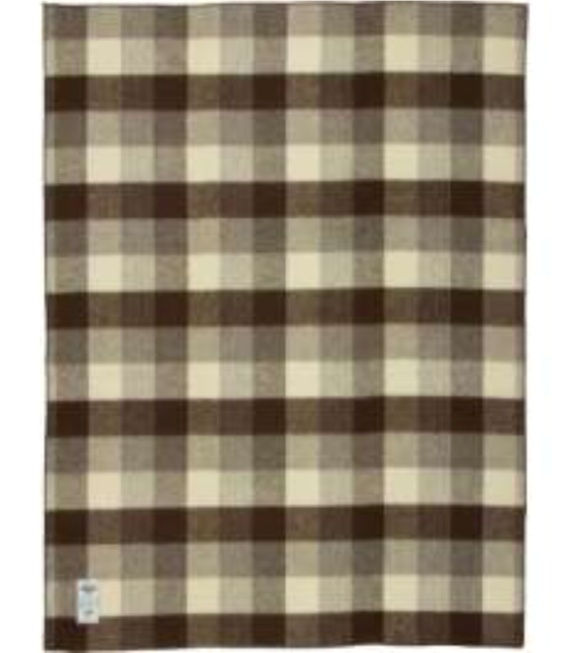
The Buffalo Check™ design has since become synonymous with the Woolrich trade brand. The iconic image of lumberjacks in the red and black checkered shirts later in the 20th century became fashion items for outdoor wear all year round. After it became a fashion accessory, it was not long before the buffalo check was rendered in beige shades, and this was marketed as the Woolrich Chambray Buffalo Shirt. When the Suffolk Blanket range came out after 2009, it also comprised a Woolrich Suffolk Buffalo Blanket with the original Buffalo Check™ in shades of beige (right).
La chemise à carreaux Suffolk or the Suffolk Plaid Shirt (often described as the Djab Suffolk Plaid Shirt) is produced by La Maison Simons in Canada (see right). This department store and fashion retailer is a family business based in Quebec. Peter Simons, born in Scotland in 1785, arrived in Canada in 1812, settling on a small farm near the city of Quebec. A son, John Simons, opened a small dry goods shop in 1840 at the age of 17, and from there grew the present department store and fashion house, usually just called “Simons”. His descendants still currently run the business.
Simons’ product brands include “Twik” created in 1966, and “Contemporaine”, established in 1971 and were aimed for an exclusive market. “Twik” was created for the ‘next generation’ of women offering denim and casual fashions at ‘fast fashion’ prices. The popularity of these product brands led to expansion into further brands, each targeting a different customer gender and product niche. In 2002 “Djab” was introduced as the male counterpart to “Twik” offering denim-focused casual street wear, described as for the ‘young, inspired by fast-moving trends, an impulsive and creative rebel’. It is not recorded why the name ‘Suffolk’ was chosen, but the fact that this shirt has the same red and black checks associated with lumberjacks (see Buffalo Check™ in last entry above) may suggest that Saint-Émile-de-Suffolk, a well-known timber and resort town in Quebec, may have influenced the decision rather than sleepy, leisurely, rural Suffolk in England.

The Suffolk Pink & Ligh t Blue Check Shirt (left), the Suffolk Light Blue & Orange Check Shirt and the Suffolk Light Blue & Lavender Check Shirt: all by “Proper Cloth” located on Broadway, New York, an on-line shop that specialises in ‘custom dress shirts’ for men. In 2008, Seph Skerritt, then a student at MIT’s Sloan Business School of Management was frustrated with the way he shopped for clothes, wasting time on trying garments in stores. Often he settled on an ill-fitting item just to get the drudgery over with. While on an internship in Shanghai, China, Skerritt had encountered the effortless way of having a tailor-made, custom-fit shirt. Why not improve on that with an online service that fitted your shirts by asking you questions, and then mail you the garments? Hence, in 2008, Seph Skerritt started “Proper Cloth”. The MIT Sloan School of Management is in Cambridge, Middlesex County, Mass. next to Suffolk County, and New York City is not too far from Suffolk County, New York State. So it is possible that this brand-name was subconsciously chosen because of the familiarity of the county name in this part of America.
And the Suffolk Check just keeps popping up on shirts. There is the Rhythm Suffolk Long Sleeve Shirt released in July 2017 (right). This is part of the Suffolk range of clothwear named after the Australian resort of Suffolk Park mentioned above (see Rhythm ‘Suffolk’ Clothwear).
Suffolk Fields Print

This is a pattern (right) that is widely used in the fashion industry for which Liberty London holds the design copyright.
The earliest version of the Suffolk Fields Print appears in an archival Liberty book from 1939. Revived during the 1970s and redrawn for the Liberty’s Flower Show quilting collection. This design was specifically for quilting, using Liberty’s soft Lasenby cotton base. It is a typical Liberty ‘ditsy floral design’ (‘ditsy’ is apparently another word for “scattered”. A ‘ditsy print’ is quite small in scale, and the design motifs are scattered at random rather than being ordered in a definable pattern.) It is suitable for a range of products, including bedspreads, cushions and cosies. It is a richly coloured design created by traditional screen-printing techniques. The name ‘Suffolk Fields’ was undoubtedly chosen for all the right reasons – conjuring up images of this wonderful county.
Liberty London (commonly known as Liberty’s) is a luxury departmental store housed in a Tudor-revival building in the West End of London. The store is filled with high-end fashion and luxury homeware, with its own fabric line, Liberty Fabrics. This is a design institution, world-renowned for its historic 50,000-strong print archive, and for its in-house studio where new artworks are painted and drawn by hand. Liberty London was founded in 1875 by Arthur Liberty (later Sir Arthur Lasenby Liberty (1843-1917)), a London-based merchant and the founder of Liberty & Co. He began selling Oriental imports, particularly from Japan. These were specifically decorative objects, rugs and fabrics. During the 1890s, Liberty built a strong relationship with many English designers, many associated with the artistic styles of the day, known as ‘Art Nouveau’. Arthur Liberty helped develop Art Nouveau through his encouragement of such designers.
Liberty London recognised the popularity of its fabrics and, around 1920, it was decided to handprint all the patterns in England. Today Liberty is known around the world for its close connection to art and culture; it is most famous for its bold and floral print fabrics. In 2010, Liberty was taken over by private equity firm BlueGem Capital in a deal worth £32 million. In July 2019 Bluegem sold its stake in Liberty London to a consortium led by Glendower Capital, a global private equity company based in London, in a deal worth about £300 million.
Suffolk Powder
This medicinal remedy was first reported in Chambers Cyclopedia 1753 as follows:
“Name of a medicinal powder, good for the bite of a mad dog. It received its name from a Countess of Suffolk who used it with great success. It is still kept as a secret in some private families, but seems to be only the ‘star of the earth’ or the ‘common buckthorn plantain’ dried and powdered, or this powder with some very trifling addition. This plant has been famous for its virtues in this case a great while among us, and Thomas de Grey, in his ‘Compleat Horseman & Farrier’ (1639), gives the method by which he had cured dogs by it with great success.” The ‘star of the earth’ is the herbaceous plant commonly called Geum or Avens. The Purging Buckthorn or Common Buckthorn (Rhamnus cathartica) is a widespread European native species, in the past used as a purgative, although its toxicity makes this a very risky herbal medicine and it is no longer used. The Avens plant is, however, still used as an herbal remedy.
Suffolk as a Product Brand Name
It seems that Suffolk evokes an image of pleasure, leisure and comfort, and it has been adopted as a brand name for many products that have little or no connection with any of the Suffolks. Similarly, many designers and manufacturers wish to create an image of “traditional” handiwork, and they produce a range of items that are called the “Suffolk Collection” on the basis that this rural county in England portrays fine, authentic traditional craftmanship. Quite often the manufacturers are not even located within the bounds of Suffolk which would at least have provided a tenuous link with the name given to their products.
Since our aim is to provide a comprehensive database of information regarding the name Suffolk, we feel that we should take cognisance of the types of product that use the name, and try to ascertain why that should be so. Particular interest will be taken of any product bearing the Suffolk brand name that is of a unique design, or is so widely known within its own field that it is referred to as a specific type in its own right. We are also conscious that this can be considered as an indirect form of advertising for that product, and we wish to emphasise that a mention on this website does not endorse any individual product or manufacturer, nor do we receive any remuneration for any such mention.
Suffolk Bridle: In the USA one particular type of equipment that appears to generate much comment in equestrian circles is the Suffolk Bridle. This is the brand name given to this particular item of equestrian equipment and, by extension, the name “Suffolk” is also given to a range of other accessories manufactured by Dover Saddlery. This company was founded in 1975 by Jim and David Powers, who were top ranked “English riding” champions on the US Equestrian team. Jim Powers was also a member of the 1972 US Olympic equestrian team. In the equestrian world a distinction is made between “classic riding” that is generally seen throughout the world, and “western riding” that is more closely associated with North America and Australia where riders typically spent long working hours in the saddle. In North America the “classic style” is referred to as “English riding”. The two disciplines differ in their equipment, particularly in the bridle and saddle. “English” bridles have closed reins that prevent them from dropping on the ground if a rider becomes unseated.
The Powers brothers aimed to bring their unique understanding of the “English style” horse tack and riding apparel to riders in North America, and they opened a saddlery shop dedicated to providing a broad selection of the best tack available. Their retail store opened in 1975 at Wellesley, Massachusetts. Dover Saddlery quickly expanded beyond its retail store location, opening further stores in other States, and in 2001 moved its headquarters to Littleton, Massachusetts. Dover and Wellesley are communities located in the southwestern part of the Greater Boston conurbation, and it would seem that the company name is derived from the community of Dover. Although neither towns are in Suffolk County, it is surmised that the brand name was adopted because of the proximity of that county and the general “Englishness” of its name.
In April 2015 the Powers Brothers sold Dover Saddlery to Webster Capital (later Webster Equity Partners) founded in 2003 as a private equity firm and based at Waltham, Massachusetts. Seven years later, in April 2022, the Chicago-based Promus Equity Partners, another private equity firm, bought Dover Saddlery with the intention of expanding the business even further.
Johnson & Murphy Suffolk Shoes: There is a range of shoe and boot styles bearing the name “Suffolk” distributed by Johnston & Murphy, a wholly owned subsidiary of Genesco Inc: Suffolk Plain Toe Boot, Suffolk Moc(casin) Lace-up, Suffolk Penny (a loafer or slip-on), and Suffolk Oxford Shoe. The company is based in Nashville, Tennessee, USA, and has speciality shoe outlets in the USA and 15 other countries. The manufacture of its branded products moved to independent, third-party contractors overseas in the late 20th century, first to Mexico, then India and finally to China because of the cheaper labour costs. Finally, in November 2017 Johnson & Murphy shut down their sole US factory in Tennessee. The Suffolk brand is still sold but now made in China.
The company has no links with any Suffolk. It is presumed that the style-name was adopted because of the connotation of quality and tradition associated with the name. It should also be noted that the name “Ipswich” was already associated with quality footwear in America (see Ipswich Shoewear Brand Names on the Ips Misc. page of www.planetipswich.com).
The original company was founded in 1850 by William J. Dudley, an English traditional shoemaker, born in Northampton, who established his shoe factory in Newark, New Jersey. Dudley teamed up with James Johnston in 1880 and, after Dudley’s death in 1882, Johnston went into partnership with another Newark businessman, William Murphy, in 1884. In 1895 the company passed into other hands but it was already a recognised brand, so the name Johnston & Murphy was retained. In 1951 Genesco (then General Shoe Corporation) purchased Johnston & Murphy. The Newark location was closed in 1957 and its operations were moved to Nashville, Tennessee, where Genesco had its headquarters. As a goodwill gesture the original company donated a pair of shoes to President Millard Fillmore in 1850. This started a tradition and since then Johnston & Murphy has custom-made a pair of shoes for every president.

The Tuffa Suffolk Country Boot: This brand name has become associated with a speci fic style of boot that has unique leg straps for a secure fit (see photo, right).Tuffa International Footwear is a family owned business specialising in the design, production and distribution of footwear and accessories, and the company is best known for its Suffolk Boot. The company started in 1997 and sell mostly in the UK, but have expanded into markets worldwide. It is based in Thetford, Norfolk, but has chosen to name its best selling product after the neighbouring county. It would appear that Suffolk yet again conjures up the image of a rural setting for countryside pursuits.
It seems that the “Suffolk” image has caught on to such an extent that other companies who have no connections with the county have used the name for their particular boots as well.

There is the Sperry Top-Sider Suffolk Boot: A waterproof boot mainly for the ladies, fashionable in the most unpleasant weather. Usually sold as the “Suffolk Women’s Waterproof Boot”. It is fully seam-sealed, waterproof leather with lug soles. A full-length side zipper provides on/off ease. The rubber lug outer sole pr ovides the ultimate traction on both wet and dry surfaces. It could be said that the Suffolk name was acquired from the county in which Boston is located; the history below makes clear the association with that county.
Sperry or Sperry Top-Sider is the original American brand of boat shoe designed in 1935 by Paul A. Sperry. Commonly known as ‘Sperrys’ or ‘Top-Siders’ (because they could be used on the top side of a boat), they were the first boat shoes introduced into the boating and footwear markets. The Sperry brand is owned by Wolverine World Wide and is headquartered in Lexington, Massachusetts.
While sailing on the Long Island Sound, sailor Paul Sperry slipped on the deck of his boat and fell overboard. He was able to pull himself back on board, but the experience drove him to develop a non-slip shoe. He noticed his dogs’ ability to run down an icy hill without slipping because of the grooves on its paws. Sperry cut groove patterns into a natural rubber sole and obtained a non-slip shoe. Being a Connecticut man, Sperry first offered the patent to the United States Rubber Company of Connecticut. That company turned him down. Sperry then offered the patent to the Converse Rubber Company in Boston, Massachusetts, which agreed to make blank rubber soles and return them to Sperry for assembly and sale. In 1939, the United States War Department specified Sperry Top-Sider as one of the official shoes of the Navy and it became the official footwear of the casual uniform of the United States Naval Academy. Paul A. Sperry sold the Sperry brand to the U.S. Rubber Co. in 1940. In 2012 it was sold to Wolverine.
Another sailor entrepreneur is Keith Musto. This British businessman competed at the 1964 Summer Olympics in Tokyo and won a silver medal in the Flying Dutchman class. As well the Olympics, Musto won medals at the 1963 and 1969 World Championships again in the Flying Dutchman class. After the Olympics he set up a sailmaking business in his home county of Essex. Eventually he concentrated solely on the production of specialist sailing clothing with his company Musto® Outdoor Clothing, established in 1965. The trouble was that, due to the summer bias of the sport, customers tended only to order sails in the early spring, leaving the rest of the year idle. To fill the void Musto went into clothing and accessories full time in 1982, and in 1987 he launched his Country Range for equestrian and shooting enthusiasts. Among the product brands is the Women’s Suffolk Gore-Tex® Boot. The Gore-Tex® lining is a waterproof, breathable fabric membrane made by a company of that name. At least the boot is made in Essex, the county next to Suffolk.
Toggi Suffolk Pull On Jodhpur Boots also known as Toggi Suffolk Horse Riding/Yard Boots (see right) is yet another equestrian product introduced within the last few years where the name has little association with the county. To be fair, most Toggi products are named after places, and there is also a “Norfolk Riding Shoe”.

Finest Brands International is the parent company of the Toggi Riding & Clothing Equipment brand. The parent company was founded in 1991 by a team of enthusiastic equestrians who came up with the idea to create and manufacture high quality and affordable rider apparel (riding boots, jackets and coats). The main instigator was John Ayres (died 2013) a co founder who was well-known in equestrian circles and who, with his wife, was already in the saddlery business and dedicated to rider safety through his Champion company (riding helmets). The Toggi brand was launched a few years after 1991. Presumably it adopted this name from the British slang words for clothes - “togs”, giving it an Italian sounding ending to indicate a certain quality often associated with the continental stylists. Toggi is the official supplier of performance clothing to the British Equestrian Team, 2016-2017. The headquarters of this organisation is based in Leeds, Wesr Yorkshire.
(It should be noted that “Toggi” was also the name of a Swiss chocolate brand. With the increasing success of the chocolate in the international markets in 1958, the company (Kägi) created a new brand name: Toggi, corresponding with the Toggenburg valley, where the company is located. However, that company reverted to Kägi, the family name, in 2013. )
Coach Suffolk Patchwork Bootie: A multi-textured, leather patchwork stitched together by hand to create these monochromatic black booties with stretch goring along the sides, and a pull-loop on the back.

Coach was founded in a Manhattan loft in 1941 as a family-run workshop with six artisans using skills handed down from generation to generation. In 1985, the original founders Miles and Lilian Cahn sold Coach Leatherware. Under different ownership, Coach was expanded from the relatively small company that it was in 1985 into the worldwide-known brand that it is today. It is a leading American design house of modern luxury accessories with its corporate headquarters remaining in mid-town Manhattan, New York City, on the site of the original workshop. The business changed its name from Coach, Inc. to Tapestry, Inc. in October 2017, although “Coach” still trades as a subsidiary of the parent company. Although there is of course the county of Suffolk on nearby Long Island, the name has presumably been given to this brand because of the usual association with comfort and leisure.

Schöffel Suffolk Ladies’ Shirts: As a specialist countrywear brand, Schöffel Country Clothing has chosen Suffolk as the rural county in England that best represents the typical quality and class of the English countryside in the promotion of their range of ladies’ shirts (see left). The company was founded by Georg Schöffel in 1804 at Schwabmünchen, Bavaria, in Germany, where it is still located, and it is at present run by the 6th generation of the family.

The Altuzzara Suffolk Silk-Fringed Blazer in white (shown right) and the Altuza rra Suffolk Fringed Crepe Blazer in black are two fashion accessories from the designer of that name. Born and raised in Paris of Asian parentage, Joseph Altuzarra has a multi-cultural background. After his college years in Paris, Joseph moved to New York to enhance his design ambitions. In 2008 Altuzarra was launched as a luxury women’s ready-to-wear and accessories brand based in New York City. Joseph has received numerous accolades for his work; in 2014 he was named the Womenswear Designer of the Year and in 2017, the Accessories Council’s Designer of the Year. By then it seemed inevitable that any designer of merit had to have a ‘Suffolk’ in his collection.
The name ‘Suffolk’ has become attached generally to outdoors activities, originally to equestrian and country pursuits and soon after the name became associated with camping, hunting, fishing and sailing pursuits. We show below a number of “outdoor garments” with ‘Suffolk’ as a brand name, but rarely do they have any connection with a place of that name.

Musto® Outdoor Clothing is mentioned above with reference to “Suffolk Boots”. Included in their Country Range for equestrian and shooting enthusiasts is the Musto Suffolk Lady’s Riding Coat and Musto Suffolk Coat. The riding coat (left) is extra-long, waterproof and windproof with a hood and shoulder cape to wear when riding, as well as leg straps to keep the long coat in place. The Musto Suffolk Coat is a spin-off from this for normal non-equestrian wear when at country pursuits.
This next collection goes under a number of different names by various fashion houses: Suffolk Waistcoat, Suffolk Padded Waistcoat, Suffolk Body Warmer, and Suffolk Gilet. A common misconception is that there is a big difference between these garments, and certainly their designers will maintain this. However, for the most part the names are interchangeable and relate to the same thing, although there are undoubtedly differences in the padding, pockets and other parts of the garment. A ‘waistcoat’ is basically a sleeveless, collarless upper-body garment usually worn over a shirt. A ‘gilet’ is also a sleeveless and collarless garment. The gilet originally had a more streamlined fit, sometimes with a kind of fur being added, and this body-hugging style is usually retained today when describing a garment as a ‘gilet’. The word is derived from the French (who are usually the first in style), and ultimately from Turkish ‘yelek’, a familiar garment in that part of the world.
The word ‘vest’ is also often used for this style of clothing, although in this case it is down to the usual distinction in the English-speaking world whereby the British and non-British usage of this term differs, and is geographical in context. In Britain, the garment referred to as a ‘waistcoat’ is in North America usually referred to as a ‘vest’. In Britain a ‘vest’ is generally used for only two articles of clothing: the undergarment and “high-visibility safety vests” worn outside all other clothing.
Compared to the normal style of waistcoats, the “Suffolk” generally seems to have deep pockets, often multi-pockets rather than the usual two, and the modern ones are zip fastened rather than having buttons, although this is optional. It rather depends on whether the waistcoat is going to be used for outdoor activities or whether it is just worn as a fashion statement. For outdoor wear they frequently have extra-padding for warmth.

The earliest use of the name “Suffolk Waistcoat” (right) seems to have originated with Dublin Clothing. Despite what the name might suggest, Dublin Clothing was actually formed in Melbourne, Australia, in 1979 and specialised in jodhpurs, although it has now grown to become one of the best known equestrian brands in the world, broadening its reach to include a full range of clothing. We have no idea why the names “Dublin” and “Suffolk” were selected, but do acknowledge that the Irish are renowned equestrians, and maybe we know a thing or two about horses with our Suffolk Punch.

As we mention above, this garment goes under a number of different names by various fashion houses, but one such designer is not taking any chances. The garment shown left is advertised as the “Multi Pocket Suffolk Padded Gilet Hunting Fishing Waistcoat Body Warmer”. Enough said.

South Suffolk Safety Vest: This high visibility vest (or waistcoat) is a New Zealand product originally manufactured with the New Zealand farmer in mind, and named after the ‘South Suffolk’ breed of sheep. This breed was developed in that country and is closely associated with the farming community (see Suffolk Sheep page). This product was soon marketed with the hunter and fisherman in mind, as well as the farmer. It is made of high quality Australian oilskin which is waterproof, lightweight and warm, with a high visibility outer fabric cover and reflective tape. The garment is marketed by Mountain Mac Apparel, a 100% owned New Zealand company, based in the small town of Waikanae, about 60 km (37 miles) north of Wellington on the southwestern coast of North Island. The company was incorporated in October 2014 by the local Goldsack family.

A jacket ca n be considered nothing more than a “sleeved waistcoat”, sometimes with a collar, so it should come as no surprise that Suffolk Jackets are similar in style to the Suffolk Waistcoats with large pockets and extra padding. There are at least four designers who have used the “Suffolk” name for their jackets, going under the names of the Outdoor Suffolk Jacket, Suffolk Waxed Jacket, Suffolk Quilted Jacket, and the Suffolk Antique Waxed Jacket. Apparently clothing that is described as “antique” refers to a style produced before the 1920s rather than the year of make. We show the Suffolk Antique Waxed Jacket (left) which is described as made with “a fabric that enhances a rugged and distressed look that is very masculine and only gets better with age”!
(See also The Suffolk Jacket & Suffolk Chef’s Jacket, above.)

Suffolk Shooting Socks: Made in Scotland from Merino wool and sold from a Lincolnshire farm, Suffolk Shooting Socks with matching Garters were launched in 2015 as a product of the Tom Lane brand. Jayne Ireland, the designer behind the Tom Lane brand of country clothing and accessories, runs her business from the family farm near Sleaford. “Tom Lane” is the name of the road that runs through the village and lends its name to the brand. We are not sure that “Suffolk” is that much of a ‘shooting country’ to lend its name to this product when compared to the Highlands of Scotland. But, who are we to complain about another association with our county?

The Suffolk Canvas Backpack by Forbes & Lewis (left) is another product that does not seem to have much to do with the county. Forbes & Lewis was launched in 2013, based in Exeter, Devon, England, a long way from Suffolk. The name of the company derives from the founders’ names, married partners Samuel Lewis Windridge and Katie Forbes. This in-house team of two emphasises that all their products, many of which are unisex, are utilitarian and stylish without fuss. Well, all Suffolk people can identify with being utilitarian, stylish and we never make a fuss. Not sure where the other description fits in though.

Suffolk Bow Tie: Another clothwear accessory where four different firms have used the county name for this type of necktie. In America we have the coloured patterned Suffolk Bo w Tie from Trumbull Rhodes (see image, right). Trumbull Rhodes, established in February 2014, is a trading name of the Barnegat Trading Company LLC (founded in 2008), located in Marblehead, Massachusetts. This organisation primarily operates in the Men’s and Boy’s Neckwear business. Hand crafted in America, Trumbull Rhodes uses the finest Egyptian cotton fabrics from Liberty of London. There is no connection with Suffolk but, as at 2018, it is one of the 30 different patterns which are utilised, all named after counties, towns and places in England, e.g. Norfolk, Essex, Falmouth, Henley, Mayfair, Piccadilly.

Another American company, R. Hanauer of Fort Mills, South Carolina, (established in 1985 by the owner Randy Hanauer) specialises in “handmade bow ties for gentlemen”, although it also makes neckties and cummerbund sets. This company marketed a Suffolk Pine Bow Tie (see image, left). We have no idea why this name was adopted, and know of no “Suffolk Pine” that is this colour, although “pine” as a pattern on ties and fabrics is common. It is essentially small repetitive images that are reminiscent of pine kernels (seeds) or pine cones. The same company also has a Blue Suffolk Medallions Bow Tie and a Blue Suffolk Medallions Necktie. In fashion parlance a “medallions” motif is when there is an image in the shape of a medal repeated in the design. The image (medallion) referred to has nothing relevant to the name ‘Suffolk’, but that doesn’t seem to matter to the fashion trade.

Designed exclusively by The Brothers at OTAA, the Suffolk Donegal Blue Wool Diamond Kid’s Bow Tie (image right) is described as having an “ebullient blue palette complemented by white alternating stitching to give a fresh outlook to your daily attire”. The Brothers at OTAA (Online Ties Accessories Australia) is a Melbourne company formed in 2011 by the brothers Fameez and Shaheen Haroon, who both quit their chosen career paths to start a men’s fashion accessories label, initially working out of their mother’s garage. ‘Donegal’ refers to a handwoven tweed manufactured in County Donegal, Ireland. Donegal has for centuries been producing tweed from local materials and is best known for a plain-weave cloth of differently-coloured warp and weft, with small pieces of yarn in various colours woven in at irregular intervals. Such fabric is labelled as ‘donegal’ (often with a lower case ‘d’) regardless of its provenance. Why Suffolk? Why not, everybody else is getting in on the act.

And this is one we really appreciate. The Liberty of London Suffolk Fields Dog Bow Tie by Moo Moo & Bear (see image, left). This is a Yorkshire based business handcrafting the finest collars, leads and accessories for the canine companion. Moo Moo & Bear’s collars are made from 100% cotton fabric with a nylon inner webbing which gives added strength and stability. The collar is finished with a high-quality plastic side-release buckle and metal hardware. Apparently Lolah Moo Moo and Minny Bear are two Miniature Schnauzers who seem to own a lady by the name of Nadia Sidebottom, the creator of quirky and contemporary dog collars and accessories. They live at Horsforth in West Yorkshire and have been in the business since March 2015. Yes, we checked that Nadia really exists and is known to Companies House, but cannot guarantee the relationship of Moo Moo and Bear, although they look like small dogs to us. (See article above on Suffolk Fields Print for that part of the name.)
And one that really comes from Suffolk - The Suffolk Fedora with Gamebird Feather. Despite our policy of not including products made in the county since the reason for its name is obvious, we think this deserves inclusion, not least because the name tickles us!

The Fedora is a hat with a soft brim and indented crown, typically creased lengthwise down the crown and pinched near the front and on both sides. This style of hat first came to note in 1882 when the famous French actress Sarah Bernhardt wore such a hat in the role of Princess Fédora Romazov, the heroine of the play Fédora. The hat became a popular fashion for women and the women’s rights movement adopted it as a symbol. Later, in the 1920s it became popular among men.
The Suffolk Fedora (right) features a cluster of natural feathers fastened behind a black, brown or other coloured band. The fedoras come in various colours: navy, brown, black, camel, fuschia, olive, etc and the coloured feathers are from traditional gamebirds and other large birds such as ostrich and peacock. Designed by the fashion house Hicks & Brown. Sisters Alice and Rosie Thorogood were born and raised on their family farm (Hicks Farm, near Sudbury) in Suffolk, England. The sisters initially had different careers in London, but both maintained their connection with the rural way of life, in particular the equestrian and country sporting worlds. Together Alice and Rosie would make clothes to wear themselves and for their family and friends. The idea of establishing a fashion label of their own came in 2014 at their local Suffolk Show. A couple of years later they returned to their Suffolk home where they established the design studio for Hicks & Brown, the farm providing the first part of the brand name (we do not know where the ‘Brown’ comes from). Their versatile clothing collections cater for both men and women, comprising jackets, gilets and waistcoats, as well as their distinctive and popular Suffolk Fedora Hats.

Lady Suffolk Hat: This made its appearance in 2018 from a New York atelier (the posh name for a workshop or studio, especially one used by an artist or designer). We trust that the name of this hat is not a reference to the famous mare mentioned elsewhere on this site, and rather alludes to the type of person expected to be seen at high society events. Indeed, this product is suggested as being best worn at Royal Ascot week. By definition the Lady Suffolk is a “Blush Pink Derby Hat with Silk Flower and Quill”. It is hand-made by Genevieve Rose Atelier of Manhattan, New York. Genevieve Foddy, the owner and founder of Genevieve Rose Atelier, was born in Melbourne, Australia. In 2010 she moved to London to study millinery at the London College of Fashion, where she developed mastery over the refined styles and techniques of British society millinery. In 2013 Genevieve moved to New York and established Genevieve Rose Atelier, specialising in impeccably hand-crafted hats, fascinators and European style wedding hair accessories.
Genevieve custom makes each piece entirely by hand in her Greenwich Village studio, using traditional, couture millinery techniques and beautiful materials. Her work has been seen on British society ladies, the Royal Family and at the New York and Paris Fashion Weeks, and is frequently seen in the pages of Vogue, New York Magazine, Bridal Guide and Brides Magazine. Her aim is to “encourage American women to adopt the British love of hats and special headpieces. In the UK, ladies take any formal occasion, such as a wedding, christening or garden party to wear a fabulous headpiece. The British are experts at the pomp and ceremony of formal and royal events, where there is a lot of tradition and etiquette about clothing in particular, such as royal females have to wear a head covering before 6 o’clock at an event, other ladies attending will follow suit, hence the popularity of light weight fascinators.”

Handbags: As part of their autumn/winter 2013 collection, the British fashion house Mulberry has brought out a range of women’s bags called the Suffolk. Described as a ladylike version of a doctor’s bag, the Mulberry Suffolk comes in two sizes, small & regular, as well as a variety of colours such as pheasant green, teal, yellow, emerald, pink, oak, midnight blue & black. They are available in different leathers, such as (printed) Hair Calf, Ostrich, Classic Calf and Shrunken Calf. Other features include soft gold components, postman’s lock closure, leather top handle with D-ring attachment, detachable & adjustable leather shoulder strap, hanging fob with hidden padlock, metal feet on base, suede lining, internal zip pocket & phone pocket, internal metal Mulberry fob. Mulberry Suffolk bags can sell for up to £5,000, although an average price is more in the region of £1,500. Why the name Suffolk has been used for this collection is not known.
The Mulberry company was founded by local boy Roger Saul and his mother Joan in 1971, in Shepton Mallet, Somerset, England. Roger Saul used a £500 21st birthday present from his parents to start Mulberry, which was named after the large tree that grew in the grounds of his old school. He built the company into an award-winning international brand. In 2000, although Mulberry was a strong company with a £30 million turnover, extra finances were needed in order to expand the business, particularly in the United States. A joint venture deal was agreed with Christina Ong of Singapore, one of the richest women in the world, and her company Challice. The Ong family invested £7.6 million in Mulberry intended to bankroll the group’s expansion in the USA and obtained 51% of the company’s shares. However, Roger and Christina Ong clashed over the agreement reached, with Roger accusing the Ongs of reneging on the deal. The upshot was a boardroom coup in 2002 which saw Roger Saul and his family ousted from the business. Mulberry is now under the control of the Challice company and has expanded into several different fashion brands and outlets. The company still owns and uses ‘The Rookery’, the Somerset factory established by the Saul family.

Another company to also use the name Suffolk for their handbag range are London Fog. The range includes the Suffolk Saddle Bag (below right), Suffolk Tote Bag (left), Suffolk Satchel & Suffolk Crossbody Bag, all of which come in a wide variety of colours.

The American company London Fog was established by Israel Myers in 1923 as the Londontown Clothing Company. It was initially based in Baltimore, Maryland, but moved most of its offices to Seattle, Washington in 2000. The company was bought by Iconix Brand Group in 2006. Other accessories by London Fog have used English place-names for their products, such as Chelsea, Knightsbridge & Oxford. No other connection has been found to link the company with Suffolk.
Vans ‘Suffolk Wallet’: Another one where we have no idea why the manufacturer should choose this name. Vans is an American manufacturer of shoes, clothing and related apparel, based in Cypress, California. Brothers Paul Van Doren and James Van Doren with two other associates opened their first Vans store under the name ‘The Van Doren Rubber Company’ in 1966 at Anaheim, California, manufacturing shoes and selling them directly to the public. From the outset, Vans aimed its products at the skateboard community. Skateboarders liked Vans’ sticky rubber sole on the shoes that made them so good for gripping a skateboard. Soon, Vans began to branch out to produce shoes and clothing for other sports, such as motor cross and surfing. In 1988 Paul Van Doren sold the Vans company and name for US$74.4 million.
The earliest reference we have found for the Vans ‘Suffolk Wallet’ is from 2012. It is a 100% polyurethane bi-fold wallet designed for the back pocket with numerous card slots, snap closure coin pocket and mesh ID window. Although sold world-wide, it is obviously for the American market since one review complained that “British notes do not fit into this wallet. You have to fold them to get them in at all.”
Earl of Suffolk Wallet: Its sales blurb says “Simple and sophisticated, the Earl of Suffolk Wallet is a patent genuine 100% leather construction in a polished black hue, making it perfect for everyday use”. We have no idea why it should be named after that person; maybe he gets royalties for the use of his title. But perhaps not, since similar wallets are named the Earl of Lincoln, Earl of Kingston and the Earl of Glasgow. These can all be purchased on-line from THE ICONIC.
THE ICONIC (always written in capital letters) is a Sydney-based, Australian on line fashion and sports retailer. The company was launched in 2011 and is one of Australia’s largest fashion, sports, beauty, kidswear and homewares destinations. The founders of the company were local boy Adam Jacobs and two German boys, Finn Age Haensel and Andreas Otto. After studying in their own countries, the three met up with each other at the Boston Consulting Group, a big management consulting company in Boston, USA, where they collaborated and exchanged ideas. They eventually decided to give up their steady jobs for a new experience. They started an on-line fashion retail shop in Sydney, Adam’s hometown. All three have since moved on to other ventures. Finn and Andreas went back to Germany to work on different projects, whilst Adam has recently started a new company called Hatch. THE ICONIC is now part of the international Global Fashion Group (GFG) established in 2014.
Suffolk Lavender Perfume: This is a perfume launched in London by the fragrance house Shay & Blue in 2013. It is described as an Aromatic Fougère fragrance for women and men. Fougère, meaning “fern-like”, is one of the main families into which modern perfumes are classified. “Aromatic Fougère”, a derivative of this class, contains additional ‘notes’ of herbs, spice and wood. With a scent of pine or fir, it is particularly popular as a fragrance for men in what is perceived as the aroma of the English countryside. Hence the name “Suffolk” is again used to evoke images of a peaceful, summer’s day in the country.
Lavender has been a staple of herbal lore for centuries, and is popular as an oil and fragrance used around the home to induce sleep, ease stress and relieve depression. The perfume itself is described commercially as: “Deep and intense, Suffolk Lavender is a natural scent blended with deliciously smoky incense, a sensual cluster of spices, and a hint of melon.”
Professionally, Suffolk Lavender is described as: “Top note is lavender; middle notes are incense and melon; base notes are praline, musk and pine tree”. ‘Notes’ are descriptors of scents that can be sensed upon the application of a perfume, and are separated into three classes; ‘top notes’, ‘middle notes’, and ‘base notes’ which denote the scents which can be sensed with respect to the time after the application of a perfume from the knowledge of the evaporation process. ‘Top notes’ for example are the scents that are perceived immediately on the application of a perfume.
From its founding in London in 2012 there has only been one creative team at Shay & Blue. Owner and creative director Dom de Vetta and perfumer Julie Massé. Dom de Vetta previously created fragrances for Jo Malone and Chanel while Julie Massé has worked with a number of fashion design and fragrance houses including Courreges, Giorgio Armani, Lalique and the Fine Fragrances department at Mane SA.

China/Tableware: Between 1966 & 1973, the Japanese tableware manufacturers Noritake produced a range of dinnerware with a pattern that they named “Suffolk” (Pattern no. 7549). The Suffolk pattern is described as gold & orange flowers with brown leaves on an ivory background (see photos left & below right).
So why “Suffolk”? In exclusive correspondence with Planet Suffolk, David Spain of the Noritake Collectors Society said “I know from conversations I have had with a few people at the Noritake Company that the pattern names, of which there are MANY, were picked for almost random reasons so I think it highly unlikely that there was any special reason for using “Suffolk” as a pattern name”.
Over the years, Noritake has indeed produced literally hundreds of different designs of tableware, so it may never be known for certain why the name Suffolk came to be used. The Suffolk design is now a collectors’ item.

Noritake Co. Limited is a tableware & technology company based in Nagoya, Aichi Prefecture, Japan, which originally grew out of a trading company founded in New York City by the Morimura Brothers in 1876. In 1904, members of this trading company established Nippon Toki Gomei Kaisha, the forerunner of the present company, in the village of Noritake, a small suburb near Nagoya, Japan. The aim of this company was to make tableware for the European & American markets. Since the late 1920s, consumers and collectors referred to the tableware as “Noritake” and the parent company wished to change its name to this. However, since Noritake is the name of a place, the company was prohibited from registering the name as a trade name until 1981, when it obtained official permission to change its name to the Noritake Co. Limited.
Between 1994-2004, as part of their English Country Cottages series, the Royal Doulton Company, under their Royal Albert brand, produced a china tea set (cup, saucer, side plate) named Suffolk. The shape of the cup is known as the Montrose (see photo, left). There were twelve counties represented in this series, the others being Cornwall, Cumbria, Devonshire, Hampshire, Kent, Norfolk, Oxfordshire, Staffordshire, Warwickshire, Wiltshire & Yorkshire.

The Royal Doulton Company was originally founded as a partnership between John Doulton, Martha Jones & John Watts in 1815 in Lambeth, London. In 1882 they acquired a factory in Burslem in the Potteries region of Staffordshire. The company was granted the Royal Warrant by King Edward VII in 1901, allowing the business to adopt the name Royal Doulton. The factory closed in September 2005 and was demolished. The company and brand names Royal Doulton and Royal Albert passed to subsequent owners and, since July 2015, have been owned by the Fiskars Corporation, a Finnish company (one of the oldest companies in the world having been founded in 1649). This operates as an integrated consumer goods company, with products relating to homeware and household goods, garden and outdoor activities, interior decoration and giftware.

Suffolk Shaped Mug: Dunoon Ceramics are a Staffordshire based family business that began producing Fine Bone China in 1974. They now produce a wide array of different shaped mugs, mostly with either Scottish (Jura, Lomond, Cairngorm etc.) or English (Richmond, Henley, Kent, Dorset etc.) place names. The Suffolk Shaped Mug has delicately sweeping curves, holds a capacity of 310 ml, has a height of 106mm & a rim diameter of 72mm (see photo, right). They come in a wide variety of decorative designs, many with flora, fauna or oriental themes.
In correspondence with Planet Suffolk, Dunoon Ceramics explained that “Suffolk was chosen for this shape of mug as it was a quintessential English county and our product was typical English Fine Bone China”.
Royal Suffolk: One of the most sough t after collectible dinnerware is the “Royal” line of the world famous Crown Devon Pottery in Stoke, England. The owners, S. Fielding & Co Ltd, produced an enormous quantity and range of domestic and ornamental earthenware over the life of the business. The Royal Devon was introduced in 1891 and proved extremely popular. This led to a wide range of other patterns named “Royals”: Royal Chelsea, Royal Clarence, Royal Stuart, Royal Essex, Royal Sussex, etc). The Royal Suffolk was introduced in 1898 with a backstamp of a lion on a crown. The design has purple and pink flowers on a cream background, trimmed with gold (see photo, left).

In 1870 Simon Fielding (who was not a potter) lent his life savings to three potters who had previously worked for Wedgwood. They established their firm, known as Hackney, Kirkham & Co, at The Railway Pottery in Sutherland Street, Stoke-upon-Trent, Staffordshire, for the manufacture of high quality ‘General Ware and Art Ware’. The company ran into debt in 1878 and it was Simon’s son, Abraham Fielding, who paid off the debts and took charge of the company, henceforth known as S. Fielding and Co. In 1891 Abraham Fielding enlarged the works, installed modern equipment and by 1892 the factory had seven of the largest kilns in the Potteries (the name of the district around Stoke).
The circular Crown Devon backstamp appeared on a number of patterns from the 1880s. This was a royal crown encircled by a band bearing the words Crown Devon. In 1882 the company introduced the vellum ware and this became the best selling product for the next 20 years. (Vellum or satin glaze is a finish with a medium reflectance, in between matt and gloss.) The “Crown Devon” name thus became associated with vellum-coloured earthenware painted with a floral decorating style. It was soon synonymous with Fielding Pottery. The Crown Devon name became so popular that the Railway Pottery was renamed the Crown Devon Pottery in 1911. It is not known why any of the names were adopted by the company. None of the principals were particularly associated with Devon, and even less with the other counties, towns and rivers used in their lines. It is intriguing that the county of Staffordshire nor Stoke were ever honoured in this way.
The last Fielding director retired in 1967 and the company passed into other hands. However, mounting losses caused by the economic recession and overseas competition led to the pottery closing in 1982. The products consequently are now more sought after than they have ever been.
Kitchenware and Relishes: The name Suffolk, when applied to kitchenware and food preparation, seems to bring to mind traditional, rustic settings. More than one manufacturer has used the term “Suffolk Collection” to cover various items found in the kitchen, each of which is described as “Suffolk”, e.g. Suffolk Storage Jar, Suffolk Teapot, Suffolk Jug, Suffolk Butter Box, Suffolk Sugar Bowl, Suffolk Casserole Dish, etc.
Within the county of Suffolk, England, Henry Watson’s Potteries at Wattisfield have been producing traditional terracotta earthenware since 1800, with its distinctive colour and texture. The terracotta tradition they follow has origins that stretch back more than 4,000 years. As the potteries are Suffolk based, the products are justifiably described as the “Original Suffolk Terracotta Collection”.
Another well-known “Suffolk Collection” in acrylic and wood kitchenware is that of David Mason Design. This company began with salt and pepper mills, and has since expanded into other areas of kitchen accessories. The first pepper mill with its grinding mechanism was invented in France in 1842. The present company has its roots in London where Cole & Mason was founded in 1919 by Julian Cowan and was a family run business. David Cowan established David Mason Design in London in 1962. Today the company is run from Chesterfield, England, by his two sons. As can be seen, there is no obvious connection with Suffolk, England.
Another interesting brand name is that of “Suffolk Mud”. This is one of the three brand names of the company Stokes Sausages Ltd at Rendlesham, Suffolk. Richard Sheepshanks and Peter Kerr set up this company as Essfoods Ltd in 2004, and changed its name in May 2013. Its policy is to provide an alternative to mass-market production. The aim is to produce in small batches, focusing on natural ingredients and traditional processes, free from artificial preservatives, colourings and flavourings, with animal welfare being high on the agenda by the avoidance of any battery-farmed produce. The products are made in a converted coach house in the heart of rural Suffolk, England, at Rendlesham, and cover a range of jams, mayonnaises, sauces, mustards, relishes, chutneys and dressings. The end products are all exotically named, and include: Suffolk Mud Bloody Mary Ketchup with Chase Vodka, Suffolk Mud Chilli Jam, Suffolk Mud Beetroot Relish, and so forth.
Some of the products have “Suffolk” in their name as well, such as “Suffolk Mud Suffolk Dressing” and “Suffolk Mud Suffolk Mustard”, although there is nothing really specific to the county other than the ingredients being grown in Suffolk. Another line is to combine their product with a well-known Suffolk alcoholic beverage. So we have names such as “Suffolk Mud Bramley Apple Sauce with Aspall Cyder” and “Suffolk Mud Cyder & Horseradish Mustard” in partnership with Suffolk’s Aspall Cyder. Then there is a partnership with St Peter’s Brewery at South Elmham to produce “Suffolk Mud Wholegrain Mustard with St Peter’s Honey Porter”, and “Suffolk Mud Farmhouse Chutney with St Peter’s Best Bitter” (originally just “Suffolk Mud Real Ale Chutney”).
“Suffolk Crown” is the brand name that is used on a range of bacon products: Suffolk Crown Sweetcure Back Bacon produced using a traditional “age-old Suffolk recipe gently smoked over beechwood”; Suffolk Crown Smoked Rashers Bacon, Suffolk Crown Smoked Back Bacon and the same either Unsmoked or Lightly Smoked. The name derives from the fact that the original producer, Lark Valley Foods, was located in Bury St Edmunds, Suffolk. The county of origin with the crown indicates a high quality product. Lark Valley Foods was founded in 1984 and soon gained a reputation for its quality bacon, particularly the “Suffolk Crown” brand. As a consequence it was acquired in 1998 by Direct Table Foods. Ownership subsequently passed to a Danish company in 1999 and then in 2016 to a German company. However, the “Suffolk Crown” brand still continues to be produced in the factory at Bury St Edmunds under the name of Direct Table Foods, which is now a subsidiary company of Tönnies Holding, a German family business in the meat industry.

“Suffolk Sea Salt” was the brand name and company name of the product derived from the sea (see image, right). Suffolk Sea Salt Limited was incorporated on 29 February 2012. This Ipswich business revived a traditional Suffolk industry as it was the first salt producer in the county for more than 100 years, the last operation being Southwold Salt Works, which shut down in 1900. Architect Robert Stephenson set up the business when he realised that the main ingredient for the product could be gathered for free. The salt was harvested from the sea water of the estuary of the River Orwell and collected at Levington Marina within quantity limits set by the local authorities. The water was certified independently for quality and the salt that was extracted checked for its purity. There were four people involved in this business, but it ran into difficulties and ceased trading in 2018, finally closing its doors on 26 February 2019.
Bridalwear: Another “Suffolk Collection” is that of bridal fashion designer Stephanie Allin. It is a mystery to us why Suffolk should so be represented. Stephanie Allin is an award winning bridal fashion designer of over 20 years. She is Welsh; each of Stephanie’s gowns is said to be handmade in Wales, not Suffolk, and the flagship shop is in Westminster, London!
Curtain & Fabric Designs: Chess Designs of Chesham in Buckinghamshire, England, is a family business founded in 1995 that has a “Suffolk Collection” of curtain designs. This is described as a traditional range of co-ordinating jacquards available in four patterns named after the Suffolk towns of Aldeburgh, Hadleigh, Melford and Sudbury. A jacquard is a fabric with an intricately woven pattern. The Aldeburgh is a vertically striped pattern, the Hadleigh has a stylized floral motif, whilst the Sudbury features a leaf design. All three come in a choice of four colours: red, mulberry, marine & blue. The fourth design, the Melford, features a Paisley style pattern, but has a slightly different colour range of red, aubergine, marine or blue.
Aldeburgh Hadleigh Melford Sudbury
But why should a company in the Chilterns name its product after Suffolk towns? The reason has as much to do with the part played by these towns in the history of weaving in England as with the warm image conveyed by Suffolk.
The southern part of Suffolk was very strong in the dense, woollen broadcloth industry as early as the late 12th century, and the market towns of Hadleigh, Long Melford, Sudbury and Lavenham were the chief manufacturers of this cloth (see The Wool Towns section on the Suffolk, England page). By the end of the 16th century the Suffolk broadcloth industry was in decline, but in the early 19th century Dutch and Huguenot weavers, with their lighter fabrics, moved away from London because of high taxation. They settled in these towns in Suffolk, where there was a source of labour already familiar with the weaving processes, thus bringing a revival of the traditional industry. We do not know why Aldeburgh should also be included as one of the four pattern designs since this was not a weaving town. However, it could be that Aldeburgh is better known to the outside world for its cultural association with the composer Benjamin Britten, and the musical festival he founded in that town.
Suffolk Rugs & Carpets: Another product name that, as far as we can tell, has nothing whatsoever to do with Suffolk. Several manufacturers and design houses have used this title for their products. None of the world’s Suffolks are particularly renowned for the production of carpets and rugs, and none of the companies concerned are based in a Suffolk. Nevertheless, carpets and rugs do have connotations of leisure and warmth, so we guess this is the reason why they are so named. It will be noted that, with one exception (Kingsmead Carpets), the following rugs and carpets are not actually made in the countries where they are largely sold (USA, Britain and Australia).
Probably the largest number of rugs produced with the county name are the Rizzy Home Suffolk Collection Area Rugs*. The producer’s brand name is “Rizzy Home” and their products are usually referred to as the Rizzy Suffolk Oriental Medallion Rug, the Rizzy Suffolk Oriental Floral Rug, the Rizzy Suffolk Abstract Rug, the Rizzy Suffolk Black Ikat* Rug and so on. Rizzy Home introduced the Suffolk Collection in 2016.
* An “area rug” in American English is a rug that is intended to cover only part of a floor. In general, an area rug is larger than a rug and neither, unlike a carpet, covers the entire floor. “Ikat” is a weaving style and dyeing technique deriving from the indigenous cultures of south-eastern Asia.
Rizzy Home is the North American arm of Rizwan Export House based in New Delhi, India. It remains a family business that began in 1950 when Bhullan Ansari, entered the wool business, buying from shepherds in India, and after hand-spinning the fibres, selling the yarn on to the rug weavers. His son, Illiya Ansari, evolved the company into the manufacture of handmade wool rugs in 1971 and began to export Indian rugs to the United States and Europe. From 1992 the grandsons, Rizwan and Shamsu Ansari, assumed control and the name “Rizzy Rugs” was adopted from the older brother’s first name. By 1997 Rizzy Rugs was the largest exporter of handmade rugs from India. In 2001 a division called Home Texco (textile company) was formed. In 2007 the Ansari brothers were the first manufacturers in India to create and export machine made area rugs. That same year they established the American operations, known as Riztex USA, in Calhoun, Georgia, renamed Rizzy Home in 2010.
An organisation trading under the name Royale Rugs has a Suffolk Collection which are said to be handmade by skilled weavers in India with a heavyweight 100% wool pile.
In the USA, the Calvin Klein Prairie Suffolk Rug is actually manufactured in India.
A New Suffolk Rug is sold by Nordic Home Interiors in Minneapolis, Minnesota, a direct importer/retailer for the “finest home-interior products from Scandinavia”. This rug is made by Everest Handicraft Industries Rugs; a company founded in 1999 by Mrs Ang Lami Sherpa in Kathmandu, Nepal, with a mission to promote handicraft products of Nepal.
Couriston, another New York company, sells the Couriston Easton Suffolk Area Rug which is stated to be “crafted in Belgium”. The ‘Suffolk’ is a particular pattern used on the rugs.
“Antrim Carpets (USA)”, based in Dalton, Georgia, is a leading importer and wholesaler of hand-loomed, broadloom carpet and custom area rugs, and it has a product named Suffolk Rug. However, none of their products are made in the USA (which is why the use of the country’s name in the company’s title is of some concern to Americans). We cannot tell where the “Suffolk Rug” is made, but we can be pretty certain that it is not Suffolk.
The Kingsmead Stoddard Suffolk Berber carpet is made by Kingsmead Carpets who offer a variety of colours, and it is designed for both domestic and office factory wear. The name comprises two manufacturing brands (Kingsmead and Stoddard), and a type of carpet (Berber), but has nothing to do with Suffolk. “Berber” ¬is a type of weaving based on the traditional handweaving of North African people who used handspun yarns made from the undyed wool of local sheep.
The brand names come from former companies that were involved in the carpet industry in Scotland. This industry flourished in the counties of Renfrewshire and Ayrshire to the southwest of Glasgow in the 19th and most of the 20th centuries. Stoddard & Co. was actually founded by an American entrepreneur, Arthur Stoddard (1810-82), who was born in Northampton, Massachusetts. He came to England in 1844 as a commercial agent and in 1853 moved to Elderslie in Renfrewshire, where he entered into partnership with a failing carpet manufacturer. Stoddard revived the business and in 1862 took over the company which soon became one of the big names in the carpet industry. Kingsmead began manufacturing in the Ayrshire town of New Cumnock in c.1967 and soon made a name for itself for the quality of its carpets.
Both companies were subject to several take-overs by other weaving companies, although they were retained as subsidiary companies because of their prestige. Both brands came under the same parent organisation in 1980 when the Guthrie Corporation (who had already taken over Kingsmead) acquired Stoddard. Kingsmead Carpets was then merged with Stoddard, thus bringing these two names together for the first time. Stoddard (with Kingsmead as a subsidiary) was launched as a separate company again in 1988, but it hit hard times at the turn of the century and had to sell off its subsidiaries before closing down completely in 2005. Kingsmead Carpets was bought by the Headlam Group in 2004 and, with the imminent closure of the Scottish factories, it relocated to its present factory at Tamworth, Staffordshire. In a reversal of fortunes, the Headlam Group bought the Stoddard name after that company’s demise, this time merging it into Kingsmead Carpets, thus the brand is now known as “Kingsmead Stoddard”.
Three “Suffolk Carpets and Rugs” advertised are actually the colour of the material. These are: Suffolk Rye Sensation Twist Carpet manufactured by Lancashire based Cormar Carpets; Classic Suffolk Heather Carpet by Burmatex in Ossett West Yorkshire; and Monaco Suffolk Stone Rug by Safavieh in New York. We know that the Suffolk paint manufacturer, Ingilby Paints in Glemsford, Suffolk, England, has a colour called “Suffolk Stone”. However, we have no idea where “Suffolk Rye” and “Suffolk Heather” come from. That they are colour descriptions is apparent from the advertisements which state this fact, and they may well be their own specific shades that have been invented by the manufacturers and given the ‘Suffolk’ name.
Lighting - Suffolk Table Lamp and Suffolk Floor Lamp: These two products are frequently advertised by different manufacturers, both in North America and Britain, and are described as “traditional Suffolk”. However, we cannot see why they are so described, where and when the design first originated or which particular manufacturer began this line.
Traditional Suffolk Table Lamp Traditional Suffolk Floor Lamp
They are defined as goose-neck lamps attached to an adjustable shaft to allow the user to position the height and angle of the light source without moving the item to be illuminated. The “Suffolk Lamp” is invariably finished in Antique Brass and is supplied with a cream fabric shade to give it this “traditional” look. The word “traditional” has to be taken with a ‘pinch of salt’ because it seems that this design first appeared in the 1920s in the USA, not Suffolk, England.
Before the advent of electricity, both floor and table lighting was possible by candle and, later, gas illumination. Fittings that could be adjusted by height were first introduced in France at the end of the 17th century, and the goose-neck design was a common feature; however, neither candle nor gas could illuminate whilst pointing downward, as seen with the “traditional Suffolk”. This had to wait for the incandescent bulb and electricity. The American Thomas Edison began the commercial exploitation of the electric bulb in 1880, and another American, Louis Tiffany, is credited with producing upright table lamps using incandescent bulbs from 1895 on a commercial basis. However it was not until electricity reached the majority of homes that table and floor lamps became a part of everyday life, and from the 1920s adjustable height lamps, such as the Suffolk, began appearing in the USA. It is presumed that some enterprising salesman decided (and we quote from an American advert): “this is reminiscent of the outstanding natural beauty of the Suffolk England countryside, and will add a touch of English to your home”.
Lighting - Suffolk Lantern: a lantern is a portable lighting device or mounted light fixture used to illuminate broad areas, usually outside. In North America three different lighting companies have given the brand name “Suffolk” to a range of lanterns that can be fixed to the wall, mounted on a post or hung from an overhead structure. These are variously known as the Suffolk Lantern, Suffolk Wall Lamp, Suffolk Post Lantern, Suffolk Hanging Lantern and Suffolk Mount Light.
Suffolk Hanging Lantern (Northeast) Suffolk Post Lantern (Hanover) Suffolk Wall Lantern (Acclaim)
The three companies are Northeast Lantern (founded in 1987) based at Exeter, New Hampshire; Hanover Lighting, New Jersey, a trading name of the world-wide Philips Group of the Netherlands; and Acclaim Lighting (founded in 2003) in Los Angeles, California. All three companies claim that their “Suffolk Collection” lanterns are in a traditional or classic style based on 17th century English craftsmanship with colonial characteristics. Each company has a specific style ranging from the lattice-work box lantern, to lanterns with differently shaped domes or tapered roofs. In Britain, such designs are just referred to as an “Outdoor Box Lantern” or “Outdoor Wall Light”. We know of no reason why such lanterns should be named after Suffolk, unless it is by association with the antique Suffolk Lantern Clock (see above) or the earlier Suffolk Table Lamps.
Furniture: There are “Suffolk Collections” to be found with several different major furniture suppliers in North America and Britain who are not connected with the place-name. As will be seen, the common factor is that ‘Suffolk’ implies craftsmanship, taste and tradition.
Kingsmill’s Suffolk Collection: In 1865 Thomas Frazer Kingsmill, an Irish immigrant, opened a dry goods store on the main street of London, Ontario, Canada. Kingsmill’s was one of the last remaining independent department stores in Canada, and it continued to be owned and operated by descendents of the founder up until its closure. The store had a Suffolk Collection of bedroom furniture (beds, dressers, wardrobes, chest of drawers). Their publicity for the Suffolk Collection states that it “recalls the halcyon days of the British Empire in its fine attention to detail and craftsmanship”. Shopping habits change and what was once London’s main shopping strip had already lost all the other large department stores. The great-great grandson of the original Irish founder decided to retire in 2014 and the store closed on 10 August 2014. It is now the site of the downtown campus of Fanshawe College; the campus opened in August 2018.
Neptune’s Suffolk Collection: Neptune Outdoor Furniture Ltd, established in 1963, are based in Winchester, England, and originally concentrated on producing outdoor furniture. The company provides the background to its ‘Suffolk’ brand name. “We were first inspired by a beautiful series of old English antique chairs. After careful research we discovered that these were first produced in a few workshops in the middle of Suffolk between 1790 and 1840. Our original chair has been a great success and has led us to further research the East Anglian tradition of furniture making. This saw the launch in 2001 of the full Suffolk Collection of tables, sideboards, dressers and occasional furniture, all incorporating the classic East Anglian look of pared back simplicity set to a perfect proportion. No adornments are needed here as the elegance is plain to see.” The company has recently launched a Suffolk Kitchen range to complement its Suffolk Collection.
Flexsteel Industries’ Suffolk Collection: This American Group has been making and importing furniture since 1893. They are currently one of the largest manufacturers in the industry, and their products are sold worldwide. The furniture part of the Group started in 1893 as the Rolph & Ball Furniture Company in Minneapolis to meet the demands of the westward pioneers. This company went through various name changes until in 1929 it was incorporated as Northome Furniture Industries, Inc. In 1948 the company acquired the Flexsteel Spring Corporation of Dubuque, Iowa, and in 1958 the company adopted this name for the Group. From one small factory in Minneapolis it grew into a nationwide multi-plant Group, selling its products through retail stores worldwide. It has absolutely no connection with any Suffolk. However, it did have a Suffolk Collection that comprised sofas, ottomans, armchairs, etc. made in leather, and is described as their “traditional” range with “craftsmanship a bonus”. This particular line is now described as Latitudes-Suffolk and is wholly 100% manufactured in China under subcontract from Flexsteel Industries. We have no idea of the origin of the “Latitudes” name.
Casual Elements’ Suffolk Collection: Based in Sacramento, California, Casual Elements is family owned and has operated since 1996. This firm specialises in hand-crafted, high quality garden and outdoor furniture using kiln-dried teak or mahogany wood. Its “Suffolk Collection” comprises a dining table set (table and chairs) and dining bench which has the “traditional farm house look with distressed finish” (‘Distressed finish’ means to have signs of ageing artificially applied.) Once again, we have the traditional, rustic and ancient associated with Suffolk.
‘Health Products’: Another use of the name ‘Suffolk’ can be found in a category of goods that come under the general heading of ‘Health Products’. These products claim to have therapeutic qualities, and once again the brand name conjures up the image of being desirable and beneficial to the user. Three such items follow.

The Kenroy Home Suffolk Indoor Table Fountain: Water rolls over a tiered, inclined face of the fountain which is bridged by an incense holder. This purports to appeal to the senses of sight, sound, and sm ell which have the effect of aiding relaxation and the relief of stress.
Tabletop water fountains are not new. They were quite fashionable in Victorian days and are known to date back to Classical times. Today, of course, they are powered by electricity. Kenroy Home is a decorative lighting and home décor design and marketing company in Jacksonville, Florida, that has been going since 1957. However, this product is no longer made.
As far as we know there is no connection with any Suffolk.

Suffolk Saddle Stool: In therapy this is a stool with a specially shaped seat designed to improve posture and relieve back pain. We have seen more than one supplier that uses the terminology of a “saddle stool” with the same claim to improve posture. The image shown here of the ‘Suffolk Saddle Stool’ is from Therapy 2000. This was “a company in the beauty and medical market” established by Philip Redman on 24 June 2003 based in Bromsgrove, England. It went into a voluntary liquidation because of insolvency in February 2017 and was finally dissolved on 27 June 2019.
Suffolk Rehab Chair: Kirton Healthcare Group have designed a special “rehab” chair which they have named the Suffolk (see photo, left).
With a highly mobile metal frame, foot rest, wheels, adjustable head & back rest & pressure relieving padding, the Suffolk has been created for stroke & head injury victims & the elderly, for use in specialist care & rehabilitation units, hospices & care homes.

Based in Haverhill in Suffolk, Kirton Healthcare were founded in 1980 & produce specialist seating & furniture, as well as shower, toilet & commode chairs for what they refer to as ‘challenging environments’. In May 2017 the company was acquired by the Direct Healthcare Group Ltd, based in Caerphilly, Wales. The chair is still made, now under the name of this company, and it is currently called the Suffolk Care Chair.

Whyte ‘Suffolk’ Road Bike: Jon Whyte came from the world of Formula 1 Motor Racing where, as the senior suspension designer at Benetton, he helped Michael Schumacher to win his first World Championship in 1994. That year the American bicycle manufacturer Marin, operating through ATB Sales in the UK, sought the help of Jon Whyte to produce a full-suspension mountain bike to meet the needs of the 1990s. At the time mountain bikes were “hard-tail”, i.e. having a front suspension fork without rear suspension. In 1995 the new design went into production and, hence, Jon Whyte is known as the “father of the full-suspension mountain bike”.
In 2000 Jon Whyte established his own UK based design facility at Cirencester in the Cotswolds where he lived, and launched the widely acclaimed PRST-1. Although Whyte retired in 2006, his research facility remains at Cirencester, and “Whyte Bikes” continues today as a well respected brand name in the bicycle world. Research and development is accomplished in the UK, the bicycles are manufactured in Taiwan, and then distributed to shops in the UK and the rest of the world. Whyte Bikes soon diversified and, as of 2015, their range of bikes includes trail, fold-up, road, terrain, commuter as well as mountain bikes.
Whyte name all their road bikes after places in London, e.g. Whyte Whitechapel, or counties in England. This seems to have been a practice copied from their association with Marin, since the latter name all their models after locations in Marin County, California. In 2014 Whyte introduced a range of disc-braked aluminium road bikes, among which was the Suffolk. The other two models were named the Sussex and Dorset. It appears that the Sussex and Suffolk have been named because these are considered good “cycling counties”. The other county names have a West Country bent: Dorset, Cornwall, Somerset and Devon.
The cycling world liked the bikes, but was less enthusiastic about the names. As one correspondent said: “On the subject of names, Suffolk and Sussex are pretty lame unless you live in them. I would be far more impressed if they had used Cumbria or Northumberland as these are suggestive of tough, challenging outdoor exploits rather than tractor drivers and commuting drones.” Those of us who live in the county can console ourselves in knowing that the Suffolk is the most expensive of the bikes.
The Suffolk Rear Pannier is yet another item named after Suffolk. To save you looking it up: “a pannier is a basket, bag, box, or similar container, carried in pairs either slung over the back of a beast of burden, or attached to the sides of a bicycle or motorcycle. The term derives from a Middle English borrowing of the Old French ‘panier’, meaning ‘bread basket’” (see photo, right).

This product is sold by Brooks England, a major bicycle saddle and accessories manufacturer. Brooks of England and Ortlieb of Germany got together in 2015 to produce the Norfolk (front) and Suffolk (rear) panniers. Although neither manufacturer has anything to do with these two counties, it is not difficult to imagine why these names were chosen. Norfolk and Suffolk are prosaic couplets that frequently go together, like Lancashire and Yorkshire, salt and pepper, and bread and butter. Both counties, being relatively flat, are considered excellent cycling country, hence their names are readily associated with this leisure pursuit. The Norfolk and Suffolk panniers are waterproof and practical bags, designed to meet the demands of cycle travel. Rather than being welded waterproof fabric, the panniers are made of a cotton-canvas-style material with a waterproof coating, and they are stitched, rather than welded.
Brooks England is based in Smethwick, West Midlands, England. It has been making leather goods since 1866, when it was founded in Birmingham. In the 1880s, the production of bicycle saddles began, the first saddle patent having been filed in 1882. This began when John Boultbee Brooks, a horse saddle manufacturer, turned to using a bicycle after his horse died, but found the wooden seat, as then used on bicycles, to be very uncomfortable. It remained a family firm until the Raleigh Bicycle Company bought Brooks in 1962. When Raleigh collapsed in 1999, Brooks was sold in 2002. It is now owned by Selle Royal Spa of Italy, today the world’s largest manufacturer of bicycle saddles.
Ortlieb Sportartikel GmbH is a German manufacturer of outdoor equipment based in Heilsbronn, Germany, which specialises in waterproof bags. Founded in 1982, it is a leading manufacturer of waterproof panniers for bicycles.

The Suffolk Track Top (also sold as the Suffolk Gilet) is a cycl ing accessory but is not related to the bike of that name. It is a creation of Road Rags Ltd based at Taunton, Somerset, in England. As the name of this company indicates, it was founded in 2011 by Vaughan Hobbs to provide cycling wear that was stylish, practical and comfortable for its enthusiasts. The Road Rags Suffolk Track Top, introduced in early 2016, is a seamless merino wool jersey with a full zip. The Merino wool used is bought from Italy and then manufactured into a seamless jersey in the Midlands. It is designed for both men and women and is also “great for skiing, fishing, golfing and the pub”. Nothing to do with ‘Suffolk’ other than the usual connotation of pleasure. Who are we to argue with that?

Suffolk Pasture Topper & Suffolk Sweeper Collector: John Graham has over 50 years experience in farming and farm machinery, with his own agricultural contracting business (J E Graham Ltd) located at his farm in Brundish, near Woodbridge in Suffolk, England. In 1999 John used this experience to design the Suffolk Pasture Topper (see photo, left). A Pasture Topper is a piece of machinery that is attached to the back of a tractor and is designed to cut the top off areas of long growth within pasture fields. It is used to keep pastures free from weeds and coarse grasses. It does not cut the grass as short as a mower would do. This helps establish a more even growth of the grass.

The success of the Topper led Graham to expand his range of pasture maintenance equipment to include a number of other implements, among them being the Suffolk Sweeper Collector for pastures and parks (see photo, left). This runs independently on four rubber wheels in order to follow the contours of the ground. There is an adjustable rake height and depth control. The purpose is self-explanatory and grass is rejuvenated by removing dead and loose materials, thus keeping paddocks and parks well maintained.
The product range name of ‘Suffolk’ emphasises both the rural nature of the equipment and the location of the business.

Suffolk Silversmiths: “Antique Suffolk Silversmiths trays” are often up fo r sale, and unscrupulous dealers state that they are “Victorian made in sterling silver by an English silversmith”. The facts are somewhat different. They are not “Victorian”, not “sterling silver” nor made by an “English silversmith”. In fact there has never been a company called “Suffolk Silversmiths”.
The Suffolk Silversmiths castle silverplate mark (see photo, right) was registered by the Gorham Manufacturing Company, one of the largest American manufacturers of sterling and silverplate, which operates from Providence, Rhode Island, in the USA. So, why “Suffolk”?

This story begins with the Alvin Manufacturing Company founded by William H. Jamouneau at Irvington, New Jersey, in 1886. This company manufactured fine sterling silver flatware (cutlery) and also hollowware (metal tea sets, bowls, trays, etc). In 1895 The Alvin Manufacturing Company relocated from New Jersey to Sag Harbor, Long Island , New York State, where it began manufacturing popular silverware based on historical patterns. In 1905 it introduced onto its sterling silver tableware a floral scroll pattern that was given the trade name “Suffolk” (see photo, above), after the county in New York State in which Alvin was located.

Alvin changed hands and names several times over its history, and in 1919 it became Alvin Silver Co. Alvin’s profitable historical reproductions brought it in direct competition with the prominent Gorham Company of Providence, Rhode Island. Gorham thus negotiated the purchase of Alvin in 1928 and changed the name to Alvin Corporation. The new owners retained t he “Suffolk” trade name and registered it as “Suffolk Silversmiths” with the castle silverplate mark (see right). They then began producing silver plated serving items under this mark from out of their Providence factory. There never was a separate company of that name, and articles were never made in sterling silver. Far from being “Victorian”, items with this mark basically date from the 1920s and 1930s, although 5 piece Suffolk Silversmiths silver plated tea and coffee serving sets continued to be produced into the 1960s.

Textron purchased Gorham in 1967. The silvermark was registered by Textron in 1969, but it was allowed to expire and was no longer used. Gorham ceased production under the Alvin name in c.1970, and it was subsequently purchased by several other organisations until it came to Lifetime Brands in 2007. This American company is a leading global provider of kitchenware and tableware products. The previous year, it had acquired one of America’s oldest and most respected brands, the Towle™ Silversmiths which traces its history back to a small colonial silversmith in 1690 Massachusetts. The Gorham patterns included the Suffolk name and this has now been revived under the Towle brand with the “Towle Silversmiths Suffolk 8 Piece Carving Set” (see photo, left).
Suffolkia: There is nothing much known about this particular item. It was a brand name of a blade produced by the company Carl Wittgens located in Solingen, Germany. Solingen is called the “City of Blades”, since it has long been renowned for the manufacture of fine swords, knives, scissors and razors. Solingen today remains the knife-centre of Germany. There is little known about the company founder himself. Carl Wittgens (1865-1932) was born and lived his whole life in Solingen. He was obviously a bladesmith who founded his own company some time before 1896. The company was small-time among the more famous knife manufacturers in Solingen and it specialised in pocket knives. It patented two lines: “Iroka” and “Suffolkia”. There is no clue as to why such names were chosen. “Iroka” is a surname common in Nigeria and it is also a Japanese word and a name given by them to girls. We can only speculate that “Suffolkia” derives from Suffolk, but cannot guess why a German producer should adopt it. Of the two lines, only “Iroka” proved profitable and “Suffolkia” was soon discontinued.
The only notable matter about the Carl Wittgens factory was that in 1953 it patented a pocket knife in the shape of a revolver. This never caught on and the company soon after changed to the manufacture of cutlery. Around 1955 the family sold the company and the factory was relocated elsewhere in Solingen by the new owners.
Suffolk Watches: As far as we can tell, there have been three occasions when companies have given the name ‘Suffolk’ to watches that they have made, yet none of the three companies have had any direct connection with Suffolk.
The first company did call itself the Suffolk Watch Company but it was only in operation for a few short months in 1901. It was based in Waltham, Massachusetts. This is in Middlesex County which we acknowledge is next to Suffolk County in Massachusetts. Its story begins in 1896 when The Columbia Watch Co. was founded by Edward A. Locke in Waltham. Locke was a successful businessman who had just arrived in the city and had already been involved in the manufacture of pocket watches. He was well aware of the prestige attached to a watch “made in Waltham” because of the dominance of the American Watch Company in this market. The latter company had been making watches in Waltham since 1851 and by the late 19th century a “Waltham watch” was understood to be a watch of a particularly high quality made by this company. In July 1898 the American Watch Co. began a series of injunctions against various jewellers and watch dealers selling Columbia watches because the watches were inscribed with the names “Waltham” and “Waltham, Mass.” Although “Waltham” was thus used in a geographical sense, the American Watch Co. argued that it had acquired a secondary meaning as a designation of watches of a particular class, and they sought an injunction to prevent other watchmakers from using this name. The court found in their favour in July 1899.

This ruling an d the fact that another older watch company in Illinois had the same name led to The Columbia Watch Co. being renamed. It was incorporated as the Suffolk Watch Co. in Maine on 19th December 1900. Events now moved fast. Since the court ruling had prevented the Suffolk watches from being known as “made in Waltham”, the financial future was now uncertain. In May 1901 the Suffolk Watch Co. was bought by the Philadelphia Watch Case Co., and on 29 June 1901 the Suffolk Watch Co. was dissolved.
Approximately 26,000 Suffolk watches were produced. The photograph left shows the face dial. Note that it only states “Suffolk USA” in accordance with the court ruling.
In the early 20th century Lady Suffolk was a brand name given to pocket watc hes and pendant watches made by the Swiss watchmaker Achille Hirsch (see photo, right). We presume that this name was adopted from the title of the English aristocratic Howard family (see Suffolk as a Title, above) because of the prestige that this would bring, rather than after the American trotting champion mare (see Lady Suffolk in the Horse Racing section, below). Many Swiss watchmakers are based at La Chaux de Fonds in the canton of Neuchâtel. Achille Hirsh & Co. was registered there in 1899. This company became one of the biggest producers of watches. In 1914 the company, called at that time Les Fils de Achille Hirsch, merged with the Compagnie des Montres Invar, by which time the Lady Suffolk brand had been discontinued. Today, this product brand commands good prices in the vintage watch market.
Daniel Wellington watches are designed in Sweden, manufactured in China and use a quartz movement made in Japan. The company name, however, derives from a “dapper British gentleman”, and it markets its products under the names of British towns and counties. This Swedish company was founded in 2011 by 26 year old Filip Tysander. In 2006, when Filip was backpacking through Australia, he met Daniel Wellington, a British gentleman of impeccable style who had a particular fondness for wearing vintage watches on old, weathered “NATO straps”*.
* It is difficult to provide a simple definition of a “NATO strap” and the reader is advised to refer to Wikipedia. Suffice it to say that in 1973 the British MOD pioneered a functional and hardwearing alternative to leather and metal watch straps that would remain secure, but where the strap could quickly be changed if required. The most notable feature of a NATO strap is its single-piece construction that passes underneath the watch; most other watch straps are composed of two separate pieces.
This made an impression on the young Swedish man and, when back home in Uppsala, after a spell in the fashion industry, Filip decided to create his own line of stylish, but cheap, watches. Filip felt it was important to make the watch thin and elegant which provides a classic quality look for the wearer. The watches were initially inspired after Filip met Daniel Wellington and the NATO straps were a fundamental element of the design that was decided on from the outset. These interchangeable straps come in half-a-dozen colourful nylons and a few leather options. In a range of colour combinations, each strap is interchangeable and the choice of which one to wear can suit any occasion and any mood. It soon became apparent that a watch with a minimalist dial and interchangeable NATO straps had a wide-ranging appeal.

Apparently giving a British name to the watch embraces this concept of elegance and suaveness, reinforced by th e brand styles being named after British locations. The ‘Suffolk’ was introduced in 2016 supposedly as a “limited edition”, but this may well be a marketing ploy to encourage sales. As noted elsewhere on this page, the county of Suffolk brings forth images of warmth, quality and well-being. The name is not inscribed on the watch, only the initials DW (with the D reversed) above the full company name below in smaller letters (see image, left).
Within five years this 26-year-old who could not afford a Rolex had built a $200 million watch empire. In February 2017, Daniel Wellington was named the fastest growing company in Europe. This success was brought about by having the watches made in China which keeps costs and the selling price low. The other factor in its success is that unlike other brands that aim to stay exclusive by selling to selective, quality outlets, Daniel Wellington will distribute to any retailers that want its product. Finally, the company uses social media to increase its brand exposure and broaden its customer reach. Daniel Wellington has more than two million followers on Instagram, thereby dwarfing competing watch brands.

Suffolk Parade Bracelets: Handmade bracelets, crafted from sterling silve r and made in the UK (see photo, right). Suffolk Parade is an exclusive on-line fashion brand that was launched in August 2016. Developed by Toby Dudfield, these products were designed and some made prior to there being a business or even having a name. The goal was to create a classic yet contemporary looking bracelet that focused on quality, individuality, chic minimal sophistication, grace and classic elegance, and also promoted the locality of the UK design. Then one day, Toby was walking down this street in Montpellier, Cheltenham, and the brand, Suffolk Parade, was born. Suffolk Parade is located in the area known as The Suffolks, within the very popular Montpellier district. This area was originally developed in the 1830s and many of the buildings have maintained their Georgian styling and classic, elegant feel (see The Suffolks, Cheltenham, on the Other Suffolks page).
Suffolk Parade Ltd was incorporated by Toby Dudfield in September 2015. He lives at the village of Berrow in Worcestershire, England, near to Cheltenham. Either he realised it was going nowhere or that he was just bored with the whole thing, Toby voluntarily dissolved the company on 8 December 2020. Toby is a young entrepreneur who studied Business Management at the University of Wales, Swansea. He is also involved in promoting Overeen single malt whisky in the UK, imported from the Old Hobart Distillery in Tasmania, Australia.

Suffolk Duck Dog Food: This is what it says: dog food primarily comprising of duck. Whether the duck had anything to do with Suffolk is immaterial because the name of the company that sells the product is The Suffolk Group. This is a family-run business based in Lowestoft, Suffolk. The full product name is “Akela 80:20 Suffolk Duck Grain-Free Working Dog Food” (see image, left). The 80:20 is the proportion of duck to fruit and vegetables in the composition of the foodstuff. The emphasis is on it being completely free of grain, thereby providing a better dietary supplement for working dogs. The trade name “Akela” comes from the fictional character in Rudyard Kipling’s Jungle Book stories. He is the leader of the pack of Indian wolves and is the mentor and protector of the lost boy Mowgli.

Suffolk Cottage is a name frequently given to residences in the county of Suffolk. As such, we do not usually record it on the Planet Suffolk website. However, we place this one on record because the name is used by a company outside the county. Sawyers Park Homes is an independent family run business involved in the construction and management of park homes. These are locations where a number of single level units are in a “park” with managers on each site providing for the maintenance and needs of the residents. They specifically cater for the semi-retired and retired. The company has seven basic models, one of which is the “Suffolk Cottage” (see photo, right). The advertisement states that it has the “appearance and feeling of a classic country cottage. Wood is the main feature of this home with stained beams to the ceiling and a large timber fireplace”. Sawyers Park Homes was incorporated in 2002; it is based in Kent and has five parks located in Kent and Essex.

Suffolk Garage is a timber ga rage in the Dutch style marketed by Garden Affairs Ltd in Trowbridge, Wiltshire (see photo, left). This company, established in July 2001 by Richard Squire, designs and installs high quality garden buildings: garden offices, summerhouses, studios, log cabins, gazebos, timber garages and garden sheds. The company’s range of timber garages have various names for the different styles, but there does not seem to be any commonality about these: Colorado, Indiana, Kentucky and Oklahoma (after American states); Cleveland, Kent and Suffolk (after English counties). The name “Suffolk” is also given to a style of garden shed and a style of garden store (barn) made by the company. The “Dutch style” refers to the roof having four eaves on all sides which better protects the upper part of the walls from rain and snow. There seems no particular reason to connect this style specifically with Suffolk in England, although buildings reflecting Dutch influence are found in Suffolk, New York, because the adjacent territory had previously been under Dutch colonial control.

Suffolk Urn is t he name given to a style of funerary (cremation) urn manufactured by Border Concepts, Inc. in Charlotte, North Carolina, USA (see image, left). This company was formed in 1990 and is an independent garden centre that designs and makes its own garden and lawn pottery. The practice of cremating bodies and preserving the ashes in a container has been around since 7000 BC. The Suffolk Urn is made of a fibreglass and clay composite and is 9 inches in height. There are four styles, three of which have been given names of localities around Hampton Roads in Virginia: Portsmouth, Suffolk and Newport (after Newport News). The fourth style is Wickford which presumably is named after that place in Rhode Island. We do not know why the designer chose these names, but it does seem that there may have been a connection with that area of Virginia.

Another company in the USA has the same name of Suffolk Urn for the receptacle shown right. The company is Campania International based at Pennsburg, Pennsylvania. It was founded in 1983 and describes itself as the premier designer, manufacturer and distributor of fine garden articles to independent garden centres throughout the United States and Canada.
We had to look up th e definition of an “urn” when we came across this Suffolk Urn by Victoriaville (pictured below). The definition is that “an urn is simply any container that holds cremated ashes. As long as the remains fit into the urn, there are no regulations or requirements concerning how large or small or what shape the urn should be.

”This is a metal urn made of stainless steel, ready for engraving an image or commemorative inscription on the sides. The height, length and width can vary, but the general specifications are 7 x 4 inches (length and width) and 9 inches height.
Victoriaville is a town in central Quebec, Canada, and the company concerned takes its name from the town. Victoriaville & Co. is a fourth-generation family business that employs hundreds of people in Canada, the United States, and the United Kingdom. It was originally founded as a lumber mill company in 1907 by J.E. Hébert who received financial support from Joseph-Adélard Dumont, the latter becoming a formal partner in 1939. In 1945 the company was renamed Victoria Industries and diversified into the manufacture of furniture using the timber from the mill. In 1948 J.A. Dumont decided to commit the company exclusively to the funeral industry and it was renamed Victoriaville Caskets Ltd.
From 1975, by a number of acquisitions and mergers, the company expanded its business to become the third largest casket manufacturer in North America and one of the most important distributors of funeral products. In 2002 Alain Dumont became the CEO and he consolidated the Group’s operations under the name of Victoriaville Funeral Supplies Inc. In 2017 it acquired J & R Mfg., the only privately-owned funeral merchandise company in New York City (since 1923), which provided a valuable base for further expansion. The Group now became J & R Victoriaville & Co.

Suffolk Fairies is a product that we include with some reluctance because we can anticipate the comments of our Norfolk neighbours. Be as it may, this is a well-known product line with regard to “outdoor garden décor”. The product comprises little fairy statuettes from 3 to 18 inches in height, each of which are given a personal name, such as Chloe, Olivia, Peter Suffolk Fairy. The occasional “fairy name” such as Candytuft Suffolk Fairy appears, and there is the ever popular Dreamer Suffolk Fairy (see image, right). These have become collectibles of which there are at present 24 statuettes, including a set of 6 Suffolk Fairy Pot Plant Sitters. These hand-crafted resin garden fairies are individually finished with an antique bronze patina. The advertising material states that “each Suffolk Fairy has its own character and personality, and can be placed amongst the plants and rocks outside or inside a home, where they add magic to any room.”The major purveyor of these collectibles is a company known as Efairies Com, a privately owned, single location business in Lakewood, State of Washington, USA, where it has a gift shop. This company is categorised under Mail Order General Merchandise and was incorporated in 2003.Credit for the concept is given to the fine art sculptor Trevor Kenny who designed the first statuettes, and because he lives in Suffolk, England, the fairies “bear the name of that beautiful place in the British Isles”. We will not disagree with the latter part of this promotional description.
The Efairies Com business closed down in 2021.
Click here to sign the Guestbook
Suffolk Jaguar SS100 and Suffolk XK C-type Jaguar

The Suffolk Jaguar SS100 sports car has been cr eated as a visually exact reproduction of the legendary Jaguar SS100.
The original Jaguar SS100 was designed in 1935 by William Lyons and built between 1936 and 1940 by SS Cars Ltd of Coventry, England. Although only 314 of this 2-seater sports car were ever made, it is widely accepted as the high point of English sports car design prior to the start of World War 2. The “100” refers to the theoretical maximum speed of the car as being 100 mph. As was the trend at the time, an animal name was thought appropriate for this model, with “Jaguar” being chosen. After the war, the use of the initials SS was thought of as having Nazi connotations, and the company became Jaguar Cars in 1945.
Due to the small number produced, original SS100s are such collectors’ items that they change hands for millions of pounds. And for this reason, several replica and re-creations of the Jaguar SS100 have been manufactured since the 1960s. The best known and most accurate of these being the Suffolk Jaguar SS100.
Based in Woodbridge, Suffolk, England, the firm Suffolk Sportscars has been producing the replica Suffolk SS100 since 1990. The brainchild of company owner Roger Williams, more than 200 have been manufactured, and have been exported all over the world. The Suffolk SS100 is thought of as being the most visually and dimensionally accurate of all replicas of the original on the market and, with its painstaking attention to detail, has become so popular that it has been accepted by Jaguar enthusiasts, specialist classic car registers and the Jaguar Company itself, as acceptable for entry into races and events as the “Suffolk Jaguar”.

As well as the SS100, Suffolk Sportscars also manufacture the Suffolk XK C-type Jaguar. Launched in 2006, this is a faithful replica of the Jaguar XK120-C, a racing sports car originally built and sold from 1951 to 1953 (the “C” standing for “Competition”). The cars were a success in the racing world, most notable at the Le Mans 24 hours race; winning there both in 1951 and 1953. As only 53 C-Types were ever manufactured, they, like the SS100, have also become collectors’ items and sell for extortionate sums of money; one auctioned in America in August 2009 fetching $2,530,000.
Both the Suffolk Jaguar SS100 and the Suffolk XK C-type Jaguar were built to a specific customer order, or they could be supplied in component packages for self assembly.
Unfortunately, on 10 August 2020 Suffolk Sportscars went into liquidation mainly because Jaguar Land Rover, who own the copyright on the original models, began legal action for copyright infringement against Suffolk Sportscars and others who had used images of the cars without paying royalties. Suffolk Sportscars owed just over £850,000 of whom the largest creditor was Roger Williams, who had ploughed £575,000 of his own money into the company, which he will not be able to get back.
Whitehall ‘Suffolk’ Tobacco Smoking Pipe
We deal with general information regarding tobacco pipes relevant to the Whitehall ‘Suffolk’ in the first part of this article, and then proceed to outline the evolution of the two names by which it was known.
The majority of pipes sold today, whether handmade or machine-made, are fashioned from briar. Briar is cut from the root “burl” (US terminology; in the UK referred to as “burr” – a knot in the wood) of the tree heath (Erica arborea), which is native to the rocky and sandy soils of the Mediterranean region. Briar is particularly well suited for pipe making since it is hard, has a natural resistance to fire, an inherent ability to absorb moisture and does not affect the aroma of pipe tobacco.

Collecting smoking pipes is a hobby and like most hobbies the enthusiasts w ill portray an in-depth knowledge of the style of pipe and its shape, which will differ dependent upon the supplier, the brand name, the maker and country of origin of the briar. As such the brand name and country of origin are marked on the stem of the pipe as a stamp of authenticity, as shown in this photograph of a ‘Handmade Suffolk Algerian Briar Tobacco Smoking Pipe’. Pipe brands are generally believed to have specific character or qualities that affect the flavour of the tobacco.
Pipes fall into two broad categories that are defined by the course of the smoke channel (shape). These are simply straight or bent. However, there are more variations on shapes and styles than can be imagined. In addition, since pipes are hand-crafted, the value of individual pipes (which may look the same to the observer) will vary according to any one aspect that could be different in its supplier, materials, type (or style), shape, brand name, specific model, imprint, colour, banding, finish, the craftsman (maker) and country of manufacture.
The name ‘Suffolk’ has, therefore, been applied to several different models sold by the Whitehall Company, some of which are shown here. The name of the country in which it is made is important to the collector.

IIn the 1960s and 1970s Whitehall was a major distributor of tobacco smoking pipes in the U.S.A. and the ‘Suffolk’ was a very popular make. The irony is that these were “American” pipes usually made in England from imported Italian or French briar. Whitehall Products Co. was an American firm, but nearly everything else was derived from Europe, and from England in particular. The names ‘Whitehall’ and ‘Suffolk’ seem to be quintessentially English. It has to be said at the outset that the sources do not know with any certainty exactly when the names first appeared and how they originated.
The ‘Whitehall’ name is said to have come from The Civic Company Limited of London. This was formed in 1921 out of the Imperial Tobacco Co which was located in Hammersmith, London. The Imperial Company itself was formed in 1901 in response to an aggressive takeover raid in Britain by American Tobacco and involved the pooling of tobacco retail outlets. In 1902 Imperial purchased the Salmon & Gluckstein retail empire, which included a section that finished briar pipes, originally made in France, for sale in Britain. It is this unit that in 1921 became The Civic Company Limited. In 1928 it merged with other companies as part of Cadogan Investments. The book “Who Made That Pipe?” by Herb Wilczak & Tom Colwell (1997) shows ‘Whitehall’ as an English made product by Civic/Ben Wade. It seems that more than one pipe manufacturer used the name ‘Whitehall’, including Civic in the 1920s and 1930s, and Ben Wade in the late 1950s and early 1960s.
‘Whitehall’ is a world famous name as the centre of government in Britain. As a common and well known place name it cannot be protected as a trade mark.

Nevertheless, ‘Suffolk’ as a brand name for a tobacco pipe is stated to be a “North American brand sold by Whitehall Products in the USA and Tyler & Co in England”. The various sources indicate that ‘Whitehall’ was a great name in American pipes and tobacco, and that the pipes were made usually by Ben Wade and some by Civic Co in England from briar gathered in the south of France and Algeria, although one line was from Gasparini in Italy from briar harvested in Tuscany and Greece. The pipes were made specifically for sale in the U.S. market. However, as we indicate below, the facts do not exactly fit this picture.
The name ‘Whitehall’ in America is first recorded in 1936 as a brand name for pipe tobacco manufactured by the Christian Peper Tobacco Company of St Louis, Missouri. At the end of the 19th century, St Louis was the largest processor of chewing and pipe tobacco in the United States. Christian Peper, born in Germany, was a pioneer tobacco merchant who began his tobacco business in St Louis in 1852. The latter company had acquired or started the brand name of ‘Whitehall’ of its own accord in 1936.
Tyler & Co is recorded as a “tobacco manufacturer” in 1899 in Nottingham, England, and was later based at the intersection of Bank Street and Snig Hill in Sheffield. It was still going in the 1940s and 1950s, but the firm folded in the 1960s. Its location may be pertinent to the fact that it is said to have sold the ‘Suffolk pipe’ in England. Presumably these were made by Ben Wade at Leeds. The cities of Leeds and Sheffield are only 36 miles from each other.
Bloch Brothers began selling pipes in 1948. In 1952 they acquired Christian Peper Tobacco Company and the ‘Whitehall’ name came with it. It seems that this name was then used for the Bloch Brothers pipe division at Wheeling, West Virginia, and this year was when the ‘Whitehall’ name became associated with tobacco pipes and the city of Wheeling. It cannot be determined when the brand name ‘Suffolk’ first came into use by Whitehall, but it does not seem to have pre-dated 1960. In 1969 Bloch Brothers was bought by the General Cigar and Tobacco Company who placed the Wheeling factory under the control of its subsidiary Helme Products, a New Jersey manufacturer of pipe and chewing tobacco.
It is with Helme Products that the Whitehall ‘Suffolk’ pipe is most associated. This is why some sources mistakenly indicate that the ‘Suffolk’ pipes came from Helmetta in New Jersey. That location was the headquarters of Helme Products. Whitehall Products Co. was a division of Helme Products and it marketed the ‘Suffolk’ pipe from Wheeling. It ceased pipe sales in 1975 when the division was closed down. However, old stock is known to have been sold up to and including 1980.
Ben Wade is one of the great names in English pipe making. This family company was founded by Benjamin Wade in 1860 in Leeds, Yorkshire, England. He was renowned for his high quality hand-made tobacco smoking pipes, and the family carried on this tradition after his death in 1929, continuing the company under his name. The company continued to hand-carve the finishing to the basic pipe mould, and it is possible that the name ‘Suffolk’ was introduced by them as a new design around 1960. However, it could be that the brand-name ‘Suffolk’ was suggested by their client in Wheeling, West Virginia, since this was where the marketing policy was dictated, and it was already known that this county name evoked images of relaxation and warmth.
Herman G Lane, a New York City pipe manufacturer, wishing to expand his product base, bought both Ben Wade of Leeds and Charatan of London pipe brands in 1962. In 1965 he closed the factory in Leeds and moved manufacture to London. So this was the end of Ben Wade pipes stamped “Made in Leeds, England”. However, using the well esteemed name of Ben Wade, Lane Ltd started the fabrication of entirely machine-made pipes at Charatan’s Prescott Street factory in London. The stamping now read “Made in London, England” or just “London”. Nothing was left from the quality of the pipes once made in Leeds.
The situation got worse for pipe-collectors as the manufacturers were only too eager to make a profit out of a reputable name. In 1971 a young Danish pipe-maker, Preben Holm, because he was having difficulty in establishing his hand-carved pipes in the American market, approached Herman Lane. It did not take long before both parties realised that Preben Holme would be able to sell his pipes at a very much higher price under the Ben Wade name which was now owned by Lane Ltd. Within a very short time Ben Wade pipes, carved in his very own personal style in Denmark, but now of a much higher quality, were being sold by Lane Ltd in far much larger quantities than Preben Holm had ever dreamed of. Although they were marked “hand made in Denmark”, this did little to assuage the feeling among collectors that the Ben Wade name was being purposely manipulated for pure profit. This led to the degradation of the Whitehall ‘Suffolk’ pipes to a second-class brand and a decline in sales, such that production ceased in 1975. The Ben Wade brand continued to be produced until the untimely death of Preben Holm in 1989 at the age of 41.
In reality the popular “American” Whitehall ‘Suffolk’ tobacco smoking pipe only lasted around 15 years; it was not made in America; its reputation of being hand-carved by the Ben Wade company was only true for 5 of those years; it was only made in England for 11 years; and for 6 of those years it was not even hand-carved. The briar out of which it was made, however, was undoubtedly from the Mediterranean.
Suffolk Maid
Butterworth & Son is a family run business originally specialising in tea and coffee. The family’s interest in tea can be traced back to the end of the 19th century when Harry Butterworth was a tea dealer in the Manchester area. His grandson, Robert Butterworth Snr, founded the present business in 1976 at Bury St Edmunds when he developed a blend of tea that was suitable for the hard water conditions found in this part of East Anglia. A few years later when Butterworth’s was well established, a strong and full-flavoured blend of tea was produced called Suffolk Special Blend, and soon after another one was made carrying the county name, Suffolk Gold Blend (see images, below).

As public demand grew for Butterworth quality so other products of local interest were added and in 1988 two brands were created to ensure distinctiveness and products of a traditional flavour: Old Colonial and Suffolk Maid. The latter name was deliberately chosen as an allusion to “Suffolk Made”. Butterworth & Son sell many varieties of tea under the Suffolk Maid name: Breakfast, Earl Grey, Peppermint, Russian Caravan (see below) to name a few. In addition to the two blends of tea mentioned above, the name ‘Suffolk’ is also to be found in the Suffolk Regiment’s Malabar Chutney (see below). This is a spicy tomato chutney recalling the regiment’s days in Imperial India. It is specially prepared by hand in the UK from natural ingredients made by traditional methods.

Another notable feature of Suffolk Maid is that it continues the tradition of placing tea cards in its packaging. This is covered in the following article.
“Suffolk” Cigarette and Tea Cards
In order to stiffen the cigarette packaging to protect the product, American tobacco companies used to insert trade cards into the packs. These were also used to advertise their other cigarette brands. In 1875 the Allen and Ginter tobacco company began the practice of depicting actresses, baseball players, Indian chiefs, and boxers on their cards. These are considered to be the first cigarette cards. This was an astute marketing strategy as sales of cigarettes increased when customers attempted to collect complete sets of the individuals depicted. Other tobacco companies soon followed suit and the practice spread to the UK and elsewhere.
Individual cigarette cards within a set of similarly themed cards did include pictures of Suffolk features. There are many examples of these, particularly with regard to the Suffolk Regiment (included in “Uniforms of the Territorial Army” and “Territorial Regiments” J ohn Player & Son); the Suffolk Punch in “Types of Horses” (John Player & Son); “Marine Series” (Clarke’s Cigarettes) includes HMS Suffolk; the Ancient House, Ipswich, and Abbot’s Bridge, Bury St Edmunds, both appear in “British Royal and Ancient Buildings” (Westminster Tobacco Company). However, there was one company that produced a couple of sets specifically devoted to Suffolk. This was from the firm of W A and A C Churchman of Ipswich. This had started as a small pipe tobacco manufacturer in 1790, but by the end of the 19th century cigarettes were the largest part of its output. In 1912 the company issued two sets containing 50 cards in each set devoted to: West Suffolk Churches and East Suffolk Churches. These were photographs shown in a sepia tone (see image of Hasketon Church, part of the East Suffolk set, right). In 1922 a further set of 50 cards depicted the Rivers & Broads of Norfolk & Suffolk.

In 1939 as war broke out across Europe, Britain experienced significant paper and board shortages. This meant that issuing cigarette cards became untenable and so production in the UK ceased. Although there were sporadic attempts to revive the practice after the war, cigarette cards were never issued on any significant scale again.
However, from 1954 until 1999, packets of Brooke Bond tea included illustrated cards, usually 50 in a series, which were collected by many children. Other tea manufacturers also adopted this practice. In 1993 Robert Butterworth Snr, a keen local historian and traditionalist as well as an avid collector of picture cards, put together a set to be included in every packet of tea sold. This first set depicted historic scenes of Bury St. Edmunds. A second set of 18 colour picture cards was produced in 1999 depicting historic battles and uniforms of the Suffolk Regiment throughout the ages. With children becoming more immersed in computer-based technology, the novelty of collecting tea cards wore off. The major tea producers stopped adding them to their packaging some years ago, but Butterworth’s Suffolk Maid has kept faith with the tradition. Most of the sets are on topics relating to the county, but five of them are specifically named Suffolk, as outlined below with the number of tea cards in the set shown in brackets:
The History of the Suffolk Regiment (18) issued 1999.
Suffolk Steam Railways (12) issued 2006; a further (6) issued 2009.
Suffolk Regiment Land Rover Series (6) issued 2011.
A re-issue of the 1912 Churchman sets was made in colour:
East Suffolk Churches (25) issued 2015.
West Suffolk Churches (25) issued 2016.
The London to Ipswich 1909 Machine Wagon Low Loader transporting a stuffed giraffe for Ipswich Museum is particularly striking (part of the Suffolk Steam Railways series). The giraffe was carefully angled to pass under overhead obstacles. The giraffe is still on display in the museum - see image below.
"Suffolk" Playing Cards
Until the latter part of the 18th century playing card backs were left plain white. The problem with this was that card backs became accidentally (and sometimes deliberately) marked. This enabled the player opposite to determine the card that was held. Card manufacturers began to print repeating geometric patterns of stars or dots on the reverse of the cards to minimise this problem. Advances in colour printing in the 19th century led to more decorative backs to be produced. At first the backs displayed advertising material, but c.1900, with the advent of better photography and responding to the rise of tourism in Europe, Swiss card manufacturers began producing packs with scenic photographs on the reverse of the cards. Obviously the same photograph had to be displayed on each card of a normal 54 pack. However, this did allow for “sets” to be produced, thereby encouraging people to collect several packs for display rather than actual use.

This became the basis of Waddington’s ‘Beautiful Britain’ playing cards which depicted scenes of seaside and country resorts. The first ‘Beautiful Britain’ series was introduced in August 1924, subsidised to begin with by the Great Western Railway. The Great Western Railway withdrew their sponsorship in 1925, but the series continued to be subsidised by the London and North Eastern Railway until 1929. This series included a set of the ‘LNER Lowestoft Railway Harbour’ scene in Suffolk, c.1926.
Zazzle is an American online marketing business that allows designers and customers to create their own products with independent manufacturers, as well as to use images from participating companies. Since 2013 it has offered 10 playing card packs, each pack having a different topic from Suffolk in England on the reverse. These are:
Ploughing Scene in Suffolk (painting by John Constable, c.1824)
Cottage in a Cornfield, Suffolk (painting by John Constable, 1833)
The Entrance to Fen Lane, Dedham, (painting by John Constable)
Lowestoft, Suffolk (painting by William Daniell (1769-1837))
The Orford Ness Lighthouse, Suffolk (painting by William Daniell)
The Suffolk Hunt – Gone Away (painting by John Frederick Herring Snr (1795-1865))
The Suffolk Hunt – Going to Cover (painting by John Frederick Herring Snr)
Two are portraits of Suffolk personalities:
Major John Dade (1726-1811) of Suffolk, (painting by Thomas Gainsborough c. 1755)
Sir William Drury, of Hawstead, Suffolk (1527-79) (artist unknown)
Suffolk Sheep (watercolour)
The first nine above are produced by Bicycle Playing Cards, a brand name of the US Playing Card Co., the leading manufacturer of playing cards. In December 2019, this company became a subsidiary of Belgian card manufacturer Cartamundi.
‘Suffolk Sheep’ is produced by On Demand Technologies, Kansas (see examples below).
The Suffolk Hunt – Going to Cover Suffolk Sheep
It is relatively easy to produce a set of 54 cards (the usual 52 plus 2 Jokers) with the same illustration on the reverse since this would provide no information to the player sitting op posite. However, it would se em more difficult to produce a set with a separate image on each card. Nevertheless, this is possible by placing the image in the centre of the front (face) of the card. Neil MacLeod Prints & Enterprises Ltd at Port Glasgow has introduced county sets of playing cards that feature 54 different fine art illustrations of a famous or picturesque location in each of the counties. The “Suffolk Playing Cards” pack is shown in the photograph left with three familiar images of Suffolk places on the front. We do not have any images of the actual Suffolk playing cards, but the image of Tower Bridge from the London set (right) shows how this is done.
Another interesting set is the “Suffolk Tudor” Olde English playing cards, produced by Lady Heather Hall, a calligraphist (someone skilled in decorative writing). Apparently she came across some cards found in Hinderclay, Suffolk, England. Their similarity to other known cards from the period and their proportions suggested that they dated from early in the 16th century. With fragments from several surviving packs to guide her, she has reproduced a set of cards representing the late Tudor period. These were issued in 2015 (see image, right). The fronts are individually crafted, with the backs left blank (white), as was the practice of that time. It should be pointed out that Lady Heather Hall is a member of the Society for Creative Anachronism. This is an organisation that stages historical re enactments and is dedicated to researching and re creating the arts and skills of pre-17th century Europe. The members take medieval titles, hence the “Lady Heather Hall”, and are located in “kingdoms” and “cantons”. She is in the Canton of Foxvale in the Middle Kingdom, which equates in modern terms to Aurora, Illinois, about 35 miles west of Chicago.
The Suffolk Dartboard
There seems to have been, at one time, a dartboard used in Suffolk, England that differed from the standard dartboard in common use today.
Although the standard or “London” dartboard is now used throughout the British Isles, as well as much of the rest of the world, regional variations are or were quite common. Some, such as the Yorkshire Board, the Lincoln Board & the Irish Board are still in use today. Others such as the Norfolk, Rochester & Staffordshire boards have fallen into disuse. It is into this latter category that the Suffolk Board falls.
In Life and Tradition in Suffolk and North-East Essex, published in 1976, Norman Smedley states: “The Suffolk darts board differs, or did, from the regular pattern in the arrangement of the numbers”. What order the numbers were in, or how widespread the use of this dartboard was, I have so far been unable to ascertain.
There is a possibility that this could be another name for the Ipswich Fives Board (see Ipswich Fives Darts Board (aka Wide Fives Dart Board) on www.planetipswich.com)
If anyone knows anything more about this subject, please let me know at info@planetsuffolk.com
Why not sign the Guestbook?
Suffolk Steel Quoits
The game of quoits, in which iron or steel rings are thrown at a stake in the ground, can be traced back to medieval times & is known to have been played to varying sets of rules throughout Britain. Over the course of the centuries, many of these games died out, with only a few areas still retaining their own versions of the game. Today there are basically two versions of the game still in existence, the Northern Game & the Long Game. As the name suggests, the Northern Game is played in the north of England & uses a shorter pitch than the Long Game. The Long Game survives today, in differing forms, in Scotland, Wales & Suffolk. Whereas the Welsh & Scottish games are played with heavy quoits weighing up to 10lbs, those used in the Suffolk game are lighter & the rules & size of the pitch differ to make Suffolk Steel Quoits a unique game, & the only version of the Long Game still extant in England.
Suffolk Steel Quoits is played on a pitch 18 yards long with a 3 ft square clay quoit bed enclosed in a wooden frame at each end. The clay needs to be of a consistency that allows the quoits to embed themselves in at an angle. Within the quoit bed, a metal pin or hob is set flush with the clay, around which is marked a circle 18 inches in diameter. The quoits used in the Suffolk game must not exceed 7¼ inches in diameter & weigh no more than 7¼ lbs. Each player throws two quoits in turn; the aim being to land nearest to the pin. The quoit nearest the pin scores one point, & if both of a player’s quoits land nearer the pin than those of his opponent, he scores two points. Any quoit that encircles the pin is known as a “ringer” & scores an extra two points. Any quoits landing outside the 18 inch circle, or that land upside down, don’t count. Once an end is complete, the players then turn & throw at the quoit bed at the other end. Where the Suffolk game differs from the others is that quoits that land cleanly over the pin are removed immediately prior to the next throw, as are quoits that land upside down or are inclined in a backwards direction. The first player to reach 21 points is the winner,or in league matches 31 points.
The earliest cup competition, the Suffolk Challenge Cup, was first contested in 1888, and leagues were established in the early years of the 20th century.
Although Suffolk Steel Quoits is an outdoor, & therefore predominantly summer game, an indoor version of the game evolved during the twentieth century. This version of the game, played mainly in pubs, involved the throwing of small flat rubber rings at a Suffolk Quoits Board (see picture, left) from a distance of eight feet. The board features five scoring zones, plus a central ‘bullseye’ worth ten points. These boards are now quite rare, but occasionally turn up at auctions.
A variant on the Suffolk Quoits Board is the Suffolk Caves Board, which is said to have been invented by the licensee of the Black Boy pub in Bury St Edmunds during the early years of the twentieth century. The main difference between the two boards seems to have been that the Suffolk Caves Board had depressions into which the quoits had to land.
Thanks to Mark Shirley for the photo. See pub-games.blogspot.co.uk
Destination Suffolk – Board Game
The board game Destination was invented by Rachel Lowe from Portsmouth, England, and was first published by RTL Ltd in 2004. The first edition was Destination London!. Subsequently, many other versions of the game have been published, featuring many places within the UK such as Portsmouth, Birmingham, Sheffield, Cardiff, as well as international locations like New York, Paris and Dublin, plus national editions for Great Britain, Scotland, Ireland and South Africa. A Harry Potter version of the game, called Destination Hogwarts, has also been produced, as well as an edition based on the 2012 London Olympics. There is even a Destination Christmas! version.
The game is for 2 to 6 players, and suitable for age 8 to adult. The aim is for players, as taxi drivers, to acquire money by navigating around the various locations on the board. The game begins with each player being given seven destination cards and two fuel cards, the latter each being sufficient to get the player to one destination. The strategy of the game is for the players to plan a logical route in order to take them past a garage, in order to acquire more fuel cards on the way to visiting their seven targeted landmarks. Players can also push their opponents back to the taxi rank, be forced to the garage, or lose their licence. The first player to visit all their destinations and return to the taxi rank receives £250 bonus, at which point the game comes to a close and the winner is the player with the highest earnings.
Each edition of the game has 40 local landmarks. The places featured on the Destination Suffolk edition were voted for by listeners to BBC Radio Suffolk and include Framlingham Castle, Kentwell Hall, Gainsborough’s Statue, Lakenheath Fen, University Campus Suffolk, Brandon Country Park, Ness Point, Landguard Fort, West Stowe, Lavenham, Sizewell, Newmarket Racecourse, Pin Mill, Sutton Hoo, Felixstowe’s Spa Pavilion, Southwold, Hoxne, The Nutshell Pub at Bury St Edmunds, the Scallop on Aldeburgh Beach, Spring Road Viaduct in Ipswich, and Blundeston Prison.
Interestingly, whereas most of the regional/national editions of the game are suffixed with an explanation mark (Destination London!, Destination Bournemouth & Poole!, Destination Dublin! etc.) the Suffolk version omits this and is simply Destination Suffolk.
RTL Games Limited was founded in November 2003 and its initials stand for Rachel Tanya Lowe. She is a British serial entrepreneur who, among other ventures, in 2010 founded the lifestyle brand She Who Dares UK. The company produced perfume, jewellery and accessories for women. Rachel was appointed a Member of the Order of the British Empire (MBE) in 2009 for her services to business in promoting enterprise in schools, colleges, and universities. RTL Games was dissolved in November 2013.


The history of the Suffolk Watch Company and its connection to American pocket-watch manufacturing is particularly interesting. The discussion also shows how geographical names and branding influenced early watch businesses. Historical details like these add another dimension to collecting vintage and pre-owned luxury watches, where provenance and brand history can be important.