

Suffolk County, Massachusetts, USA - part 2
- Luke Pantelidou
- Nov 6, 2025
- 44 min read

Updated: Dec 16, 2025

Suffolk County is situated on the Atlantic coast of Massachusetts in New England, USA. To the north it is bordered by Essex County, to the south by Norfolk County & to the west by Middlesex County. To the east is Massachusetts Bay & here Suffolk has a water boundary with Plymouth County to the southeast. Suffolk comprises the towns & cities of Chelsea, Revere, Winthrop & Boston; the latter being the county seat as well as the state capital. In area, Suffolk covers 59 square miles of land & 62 square miles of sea.
Population:- The population at the 2020 census was 797,936.
How to get there:-
By Road: From the north, take Interstate Highway 95 south, then Interstate Highway 93 south. From Providence, RI & the south, take Interstate Highway 95 north, then Interstate Highway 93 north. From the west, use Interstate Highway 90.
By Rail: Boston has three intercity rail stations. From the south & west, trains terminate at South Station, many having also stopped at Back Bay. Trains arriving from the north terminate at North Station. Amtrak services also run daily; connecting Boston with Washington DC, New York, Baltimore, Portland, Philadelphia, Chicago & Virginia. A commuter rail system also serves the local area.
Boston’s General Edward Lawrence Logan International Airport is located in East Boston, Suffolk County.
Time Zone: Eastern Standard Time (GMT -5 hrs). Daylight saving time in summer +1 hr.
Order of contents on this page: (Click on the links below)
Buildings:
People:
Boston Athenæum
Boston Athenæum, one of the oldest independent libraries in the US, was founded in 1807 by members of the Anthology Society; itself established two years earlier by contributors to The Monthly Anthology and Boston Review magazine. Initially planned as a reading room, under the first librarian William Smith Shaw, the member’s vision expanded to include a library & a gallery of sculptures & paintings, plus collections of coins & curiosities. In 1809 the Athenæum acquired its first premises at Rufus Amory House, adjacent to the King’s Chapel Burying Ground, before moving to Pearl Street in 1822, where a lecture hall & gallery were added. In 1823 the King’s Chapel Library & the Theological Library were deposited in the Athenæum. Four years later an art gallery was established & the first annual exhibition was held.
In 1849 the Athenæum moved into its current premises on Beacon Street; built specifically for its purposes & designed by architect Edward Clarke Cabot. Originally the first floor held the sculpture gallery, the second housed the library, with the third being taken up by the paintings gallery. However, after 1876, when annual exhibitions ceased, the library took over the whole building. In 1914 two further floors were added, & between 1999 & 2002 the building underwent major renovation work.
Boston Athenæum was declared a National Historic Landmark in 1966. Its collection currently includes more than half a million volumes, & today the Athenæum functions as a member’s library, as well as providing, amongst other things, a newspaper & magazine reading room, a children’s library & exhibition galleries. The building also houses many old & rare maps, books, manuscripts & archival materials as part of its Special Collections. It also hosts lectures, readings, musical performances & other events. The first floor & exhibition galleries are open to the public. All other floors are open to members only, although pre-booked Art and Architecture Tours are conducted for the public.
John F. Kennedy Presidential Library and Museum
Located close to the Boston campus of the University of Massachusetts and the Massachusetts Archives in the Dorchester neighbourhood, the John F. Kennedy Presidential Library and Museum is the nation’s official memorial to the 35th President of the United States.
The original site proposed for the building, facing the Charles River, was chosen by Kennedy himself in October 1963; only one month before his assassination. After Kennedy’s death, architect Ieoh Ming Pei was chosen by the Kennedy family to design the building. Many years of setbacks due to funding issues, disagreements & local opposition followed, however, before building work would commence, & by then a new 9 ½ acre site had been chosen at Columbia Point in Dorchester.
Construction work finally began in August 1977. The main body of the building consists of a 125 ft tall triangular tower alongside a large cube shaped glass & steel pavilion. On 20th October 1979, the library & museum was officially dedicated by President Jimmy Carter & members of the Kennedy family.
As well as being the official repository for original papers & correspondence from the era of the Kennedy Administration, the archives contain more than 400,000 still photographs, films & audio recordings dating from the nineteenth century up until the 1980s. The museum includes many gifts to John & Jackie Kennedy from visiting heads of state, other dignitaries & private citizens, as well as a display highlighting Jacqueline Kennedy which includes many items of clothing. Other exhibits focus on various aspects of the Kennedy regime, including the Space Programme, the Campaign Trail, the Cuban Missile Crisis, the Oval Office & the Attorney General’s Office.
Museums of Suffolk County
Museum of African American History: Located on Joy Street in the Beacon Hill neighbourhood of Boston, both the African Meeting House & the adjacent Abiel Smith School form the Museum of African American History. The Museum is dedicated to preserving the contributions of African Americans in New England from the colonial period through to the nineteenth century. For further details see the Boston African American National Historic Site & Black Heritage Trail section, above.
Boston Children’s Museum: Situated at Children’s Wharf on the Fort Point Channel, Boston Children’s Museum is the second oldest children’s museum in the USA. The aim of the Museum has always been the education of children through activities & interaction. Opened in 1913 & originally located at the Pinebank Mansion in Jamaica Plains, the museum moved to Burroughs Street in 1936, where it remained until relocation to its present site in a former wool warehouse in 1979. During the early days, various other branches of the museum opened in the city, mainly in schools. A branch of the museum was open at the Barnard Memorial Building on Warrenton Street between 1919 & 1926.
Permanent exhibits today include the Art Studio, the Gallery, Construction Zone & the Science Playground, plus a climbing structure known as New Balance Climb. The museum also includes an authentic Japanese house where visitors can learn about Japanese life, culture & art, plus Johnny's Workbench where children are able to work with hand tools & natural materials.
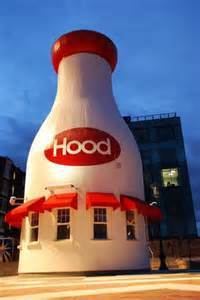
In front of the museum stands the Hood Milk Bottle (see photo, right); a 40 ft tall replica bottle that serves as an ice cream stand and snack bar. Built by Arthur Gagner in 1934 as an ice cream stand. It originally stood on the banks of the Three Mile River on Winthrop Street, & became one of the first fast-food drive-in restaurants in the United States. Gagner sold his giant bottle in 1943 because the shape of milk bottles in the USA had changed to a square squat style, dating the large round bottle, & by 1967, like glass milk bottles themselves, the giant bottle was abandoned by the then owners. It stood empty & neglected for a decade when Hood and Sons was persuaded to buy the rotting structure, renovate it & give it to the Children’s Museum. Hood is the biggest dairy in New England & was founded in 1846. In 1977 it was cut into three sections & moved by barge to the museum. If it were real, it would hold 58,000 gallons of milk.
Boston Fire Museum: Established in 1983, the Boston Fire Museum can be found in the old firehouse at 344 Congress Street in Boston. Run by volunteers, the museum is dedicated to the history of fire fighting. Antique fire apparatus include a hand-drawn, hand-operated Ephraim Thayer pumper dating from 1793 & an American LaFrance Ladder Truck from the 1860s. The museum also houses many other items of fire fighting equipment & fire alarms.
Built in 1891, the building known as Congress Street Fire Station is of unique architectural design. It closed as a firehouse in 1977 & has since been granted National Historic Landmark status & has been included in the National Register of Historic Places. Boston Fire Museum is open on Saturdays only.
Boston Tea Party Ships & Museum: Located on Congress Street Bridge, the Boston Tea Party Ships & Museum takes in the Old South Meeting House, Griffin Wharf & two restored ships - the Eleanor & the Beaver - to tell the story of the events of December 1773. The museum includes a tour with live actors & interactive exhibits. The museum has on display the Robinson Half Chest; one of only two known surviving tea chests from the Tea Party.
Bunker Hill Museum: Located on Monument Square, across the street from the Bunker Hill Monument (see Boston National Historical Park section, above), this museum tells the story of the battle of Bunker Hill & the history of Charlestown. Included is a 360 degree mural depicting the battle.
Captain Lemuel Clap House: Situated at 199 Boston Street in Dorchester, a house is known to have existed on the original site since 1633, although the house in existence today was rebuilt & enlarged by Lemuel Clap in 1767. The house was purchased by the Dorchester Historical Society in 1945 & moved to its current location from Willow Court in 1957. The house contains items from the Society’s historical collection & is listed on the National Register of Historic Places. (See also William Clapp House, below)
Commonwealth Museum: Situated in the State Archives Building on Morrissey Boulevard, this museum tells the story of the Commonwealth of Massachusetts & its people. On display in the Treasure Gallery can be found one of the 14 original copies of both the Declaration of Independence & the Bill of Rights, plus the 1629 Charter of Massachusetts Bay, the 1691 Charter of the Province of Massachusetts Bay, & the Constitution of the Commonwealth of Massachusetts from 1780, as well as other unique royal charters, all housed in climate controlled cases.
Deane Winthrop House: Located on Shirley Street in the town of Winthrop, the house is open to visitors by appointment (see also Winthrop section, above).
Dillaway-Thomas House: See Roxbury Heritage State Park in the Other Parks & Reservations of Suffolk County section, above.
Gibson House Museum: Built in 1860, this house is situated on Beacon Street in the Back Bay district of Boston. Designed by Edward Clarke Cabot, the house is in the Italian Renaissance style, with an exterior of brownstone & red brick. The house passed through three generations of the Gibson family before opening as a museum in 1957. It was declared a National Historic Landmark in 2001. The museum serves as a record of upper-middle-class American life during the decades from the Civil War up until the First World War.
Governor Bellingham-Cary House: Situated on Parker Street in Chelsea. (See Chelsea section, above)
Harrison Gray Otis House: There are three houses in Boston that all bear this name. For convenience they are known as the 1st, 2nd & 3rd Harrison Gray Otis House. All were built by architect Charles Bulfinch for the businessman, lawyer & politician of that name (1765-1848). Born in Boston, Otis served as US Attorney for the District of Massachusetts in 1796, Member of the US House of Representatives (1797-1801), President of the Massachusetts Senate (1805-06 & 1808-11), US Senator for Massachusetts (1817-22) & Mayor of Boston (1829-32).
It is the 1st Harrison Gray Otis House, built in 1796 & located on Cambridge Street, that is now owned by the Historic New England organization & open as a museum. It is listed on the National Register of Historic Places & has been designated a National Historic Landmark.
The 2nd Harrison Gray Otis House, a Federal-style mansion on Mount Vernon Street, Beacon Hill, is also on the National Register of Historic Places. The 3rd & largest Harrison Gray Otis House was built in 1806 & is situated on Beacon Street. It is now occupied by the American Meteorological Society.

Isabella Stewart Gardner Museum: Located in the Fenway/Kenmore neighbourhood of Boston, the Isabella Stewart Gardner Museum houses a collection of paintings, sculptures tapestries, furniture & decorative art from around the world. It was established by art collector & philanthropist Isabella Stewart Gardner (1840 -1924) & opened in 1903. Designed by Gardner & architect Willard T. Sears, the museum is modelled on the Renaissance palaces of Venice & was originally known as Fenway Court. The building surrounds a glass-covered garden courtyard, the first of its kind in America, which is today used for displays (see photo, left).
As well as art exhibitions, both historic & contemporary, the museum also hosts family & community programmes, concerts & lectures.
James Blake House: Owned by the Dorchester Historical Society. See Dorchester in the Neighbourhoods of Boston section, above.
Longyear Museum: Founded by philanthropist Mary Beecher Longyear (1851-1931), Longyear Museum is located on Boylston Street in Chestnut Hill, around five miles from central Boston. The museum is dedicated to the work of Mary Baker Eddy (1821-1910), founder of the Christian Science movement. The museum opened in 1937 & was initially housed in Mrs. Longyear’s former home in nearby Brookline, before relocating to its present location in 1999.
Loring-Greenough House: Designated a Massachusetts Landmark and a Boston Landmark, Loring-Greenough House is the last surviving eighteenth century residence in Sumner Hill, in the Jamaica Plain neighbourhood. It can be found on South Street. It was built in 1760 as a country residence & farmstead for British naval officer Commodore Joshua Loring. Loring (1716-1781), abandoned the house just prior to the American Revolution. After serving as a hospital following the Battle of Bunker Hill, the house was eventually acquired by Ann Doane in 1783, who married David Stoddard Greenough, & whose family lived here until 1924. It was then bought by the Tuesday Club (until 1993 a ladies’ only club & now a community group), who offer tours of the house. Exhibits include an extensive collection of decorative & fine art from both America & Europe. The two acres of landscaped grounds are also open to the public.
Mary Baker Eddy Library: The Mary Baker Eddy Library is a library, museum & repository of the papers of author, poet, & religious leader Mary Baker Eddy. It is one of several buildings in Christian Science Plaza on Massachusetts Avenue, Boston. The museum is housed in a section of the building originally built for The Christian Science Publishing Society, of which Mary Baker Eddy was the founder. (See also Longyear Museum, above)
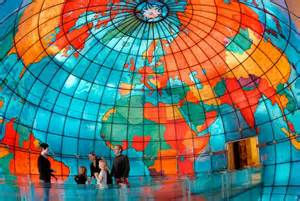
One of the main attractions of the museum is the Mapparium (see photo, right); a three-story tall, inverted globe consisting of 608 stained-glass panels depicting a political map of the world as it was in 1935. Visitors can walk via a glass bridge to the centre of the globe, from where the entire world can be viewed. LED lights have now been installed inside, which, together with a composition of words & music entitled A World of Ideas, illustrates how the world has altered since the globe’s creation.
McMullen Museum of Art: Officially named The Charles S. & Isabella V. McMullen Museum of Art, this museum opened in 1993 & is located in Devlin Hall, part of Boston College’s main campus in the Chestnut Hill area of the city. The Museum holds an extensive permanent collection of works from the sixteenth to the twentieth century, & has a significant collection of Gothic and Baroque tapestries. Amedeo Modigliani, Françoise Gilot, John LaFarge & Frank Stella are among the well known artists represented at the Museum.
Metropolitan Waterworks Museum: Situated on Beacon Street, the Metropolitan Waterworks Museum is on the site of the original Chestnut Hill Reservoir and Pumping Station. The museum opened in 2009 & tells the story of Boston’s water system. It comprises the Great Engines Hall, which houses three historic, steam-powered pumping engines, plus a two storey glass enclosed pavilion which features the Overlook Gallery. A walking tour can also be made of Chestnut Hill Reservoir.
The Chestnut Hill Pumping Station supplied Boston with water from 1894 until 1978, when the supply shifted to the Quabbin Reservoir. Chestnut Hill Reservoir is still a backup source of water for the city today, however.
Museum of Fine Arts: Located on Huntington Avenue in the Fenway/Kenmore neighborhood is the Museum of Fine Arts; one of the nation’s largest museums. Founded in 1870, the museum moved to its present location in 1909 & houses works by impressionist & post impressionist artists Cézanne, Degas, Gauguin, Manet, Monet, Renoir & Van Gogh, as well as works by American artists such as Church, Copley, Homer & Sargent. There is also an extensive collection of Chinese paintings, plus the largest collection of Japanese art in the world outside Japan.

Museum of the National Center of Afro-American Artists: The High Victorian Gothic style house on Walnut Avenue in Boston known as Abbotsford was built in 1872. Designed by architect Alden Frink for the prominent industrialist Aaron Davis Williams, the house is built entirely of Roxbury puddingstone & was later purchased by the City of Boston for use as a school, before being bought by the National Center for Afro-American Artists in 1976. The house is now on the National Register of Historic Places. The museum is dedicated to black visual arts heritage from around the world, through such media as painting, sculpture, graphics, photography & decorative arts. In the museum grounds can be found the sculpture Eternal Presence created by John Wilson (see photo, left).
Museum of Science: The Museum of Science is located on a plot of land that spans the Charles River known as Science Park. Originally known as the Boston Society of Natural History from its founding in 1830, the museum used temporary premises for its exhibits until the opening of the New England Museum of Natural History in Boston’s Back Bay area in 1864. After the Second World War, the Society acquired the lease of the land now known as Science Park, with the new museum opening in 1951. There have been many expansions since that time. When theThe Computer Museum in Boston closed in 1999, some of the exhibits were transferred to the Museum of Science. Some of the other numerous exhibition halls to be found at the museum today include: The Charles Hayden Planetarium, established in 1951; Mathematica: A World of Numbers... and Beyond; Seeing is Deceiving, an exhibit on optical illusions; New England Habitats; Energize! - featuring displays on renewable energy technology; Modeling the Mesozoic; The Mugar Omni Theater - which uses state-of-the-art film technology to project larger-than-life images onto a five-storey-high domed screen;a walk through Butterfly Garden.
All together, the museum boasts more than 700 interactive exhibits. Today the museum attracts more than 1.5 million visitors annually.
Nichols House Museum: Designed by the architect Charles Bulfinch & built by politician Jonathan Mason in 1804, the Nichols House Museum on Mount Vernon Street in Boston is named after landscape architect, writer & suffragist Rose Standish Nichols (1872–1960), who lived here from 1885 until 1960. After her death, the house was converted into a museum, with the turn-of-the-century period rooms offering a glimpse into domestic life in Boston during the late nineteenth & early twentieth centuries.
Old South Meeting House: Located at the junction of Washington and Milk Streets in the Downtown Crossing area of Boston, the Old South Meeting House is a church that has been designated a National Historic Landmark. The museum, which opened in 1877, relates the story of the church since its construction in 1729. (See also Boston National Historical Park section, above, & Samuel Adams section, below)
Old State House Museum: This historic building at the junction of Washington and State Streets is now part of Boston National Historical Park (see above).
Paul Revere House: Operated by the Paul Revere Memorial Association, the house is part of the Boston National Historical Park (see above). It stands on North Square & was built in 1680 on the site of the Second Church of Boston’s parsonage. The museum contains several pieces of furniture believed to have belonged to the Revere family. (See also Paul Revere section, below)
Pierce-Hichborn House: Situated adjacent to the Paul Revere House is the three storey Georgian style house known as the Pierce-Hichborn House. Also run by the Paul Revere Memorial Association, the name of the building derives from the builder, Moses Pierce, & Nathaniel Hichborn, a later owner who was Revere’s cousin. Dating from around 1711, the house is one of the earliest surviving brick structures in Boston.
Pierce House: Listed on the National Register of Historic Places since 1974, the Pierce House is a First Period building on Oakton Avenue in the Dorchester neighbourhood of Boston. Built around 1683, the house was home to ten generations of the Pierce family, & tells the story of a New England family over a period of more than three centuries. One member of the family, Colonel Samuel Pierce, was involved in the fortification of Dorchester Heights during the American Revolution. The house is open to visitors on selected dates only.
The Paul S Russell, MD Museum of Medical History and Innovation: Located on the Massachusetts General Hospital main campus at North Grove Street in Boston, the Paul S Russell, MD Museum of Medical History and Innovation opened in April 2012. With 8,000 square feet of floor space, the museum’s exhibits cover a wide range of subjects relating to medical history, healthcare, & laboratory & clinical research. Also open to visitors is the rooftop garden with views over Boston, plus the Ether Dome; a surgical amphitheatre which was the site of the first successful public surgery using ether as an anaesthetic. (See also Warren Anatomical Museum, below)

Shirley-Eustis House: Built between 1747 and 1751 as the summer home of William Shirley (1694–1771), Royal Governor of the Province of Massachusetts Bay, the Shirley-Eustis House is situated in Shirley Street in the Roxbury neighbourhood of Boston. The Georgian mansion is the only remaining house in America built by a British Royal Colonial Governor (see photo, right). After being used by the Massachusetts Sixth Foot Regiment during the Siege of Boston in 1775, the house passed through a succession of owners, before being acquired by Congressman William Eustis, Secretary of War under President James Madison during the War of 1812, & the first Democratic-Republican Governor of Massachusetts from 1823-25. After his death in 1865 the house was sold & subdivided into lots, before finally being abandoned around 1911. Two years later, however, the Shirley-Eustis House Association was formed by William Sumner Appleton. The house was awarded National Historic Landmark status in 1960. After extensive restoration work during the 1980s, the house opened to the public in 1991, with the Association receiving the Boston Preservation Alliance Award for “The best small-scale historic restoration in the city of Boston” in that same year.
The house is open to visitors from Thursday to Sunday during the summer.
The Sports Museum of New England: Founded in 1977, the Sports Museum of New England (often simply referred to as the Sports Museum) is now located in the TD Garden in Boston’s West End, having moved from its original location in Cambridge. The museum celebrates sports teams in Boston, such as the Boston Bruins (ice hockey), Boston Celtics (basketball), Boston Red Sox (baseball) & New England Patriots (football), as well as events such as the Boston Marathon. Also featured are several life-sized sculptures of local sporting heroes, plus a collection of sports memorabilia & curiosities. (See also Neighbourhoods of Boston section, above)
USS Constitution Museum: Housed in a restored shipyard building at the foot of Pier 2 at Charlestown Navy Yard is the non-profit, privately run USS Constitution Museum. The museum relates the history of the ship nicknamed “Old Ironsides” and the people associated with her. (See also Boston National Historical Park section, above)
Warren Anatomical Museum: Now located at the Countway Library’s Center for the History of Medicine, in Shattuck Street, Boston, the Warren Anatomical Museum is named after one of the most renowned American surgeons of the nineteenth century, John Collins Warren (1778-1856). A founding member of Massachusetts General Hospital, as well as being a surgeon there, Warren was one of the pioneers of using ether as an anaesthetic. He also taught Anatomy & Surgery at Harvard Medical School from 1809-47; firstly as an adjunct professor, before becoming a full professor, professor emeritus & dean. He was also a founder of the New England Journal of Medicine, the first issue of which appeared in 1812.
When Warren resigned from Harvard in 1847, he donated much of his personal teaching and research collection to the University, which gave rise to the establishment of the Warren Anatomical Museum. Many other eminent surgeons & physicians have since contributed items to the collection.
The museum was originally situated in North Grove Street, Boston; opening for study in 1847, then to the public in 1861. It moved with the Medical School to Boylston Street in 1883, then to the Longwood Campus in 1906, where it remained until 1998. Curatorial responsibility passed to the Countway Library’s Center for the History of Medicine in 2000; the collection now being exhibited on the library’s fifth floor.
The museum collection today numbers more than 15,000 items & artifacts including medical instruments & machines, anatomical & pathological preparations, anatomical models & other medical memorabilia.
West End Museum: As the name suggests, this museum is located in the West End neighbourhood of Boston, on Staniford Street. Established by the The Old West End Housing Corporation (OWEHC), the museum opened in 2010. It is dedicated to the collection, preservation & interpretation of the history & culture of the West End.
William Clapp House: The William Clapp House dates from 1806. The house is named after the son of Captain Lemuel Clap*, whose house is also in Boston Street, Dorchester (see above). William Clapp House is now the headquarters of the Dorchester Historical Society & contains items from their collection, including nineteenth century furniture.
A keen horticulturalist, William Clapp (1779-1860) is known to have developed several varieties of pear, including Clapp’s Favorite; developed in 1820 & still produced to this day.
*Please note, the above spellings are correct. Lemuel Clap is spelt with one ‘p’, William Clapp with two
William Hickling Prescott House: An historic house located at 55 Beacon Street in the Beacon Hill area of Boston, William Hickling Prescott House is also sometimes known as Headquarters House. Designed by architect Asher Benjamin, the house is a one half of a double townhouse built in 1808. It is named after William Hickling Prescott (1796-1859) an American historian and Hispanist (a scholar specialising in Hispanic culture) who resided here from 1845-59. During this time English novelist William Makepeace Thackeray, famous for his novel Vanity Fair, is known to have been a house guest.
Although severely visually impaired, Prescott became one of the most eminent historians of the nineteenth century. His published works include The History of the Reign of Ferdinand and Isabella the Catholic (1837), The History of the Conquest of Mexico (1843) & A History of the Conquest of Peru (1847).
Designated a National Historic Landmark in 1964, the house was added to the National Historic Register in 1966. The museum is run by The National Society of the Colonial Dames of America, an organization of women who are descended from an ancestor “who came to reside in an American Colony before 1750, and whose services were rendered during the Colonial Period”.
Ye Olde Union Oyster House
Ye Olde Union Oyster House is situated in Union Street, Boston & is one of the oldest restaurants in continuous service in the United States, having been established in 1826. It serves traditional New England food with the emphasis being on seafood.
The building is known to have been built before 1714, & had at one time been occupied by Hopestill Capen's dress goods business, as well as being where printer Isaiah Thomas published his newspaper The Massachusetts Spy from 1771. Exiled future king of France Louis Philippe I (1773 – 1850) is known to have lived on the second floor of the building in 1796.
As a restaurant, it opened as Atwood & Bacon Oyster House on 3rd August 1826. It is said that the toothpick was first used in the United States at the Union Oyster House; the first picks being imported here from South America. John F Kennedy, as well as other members of the Kennedy family, frequented the restaurant. The “Kennedy Booth”, JFK’s favourite booth, has been dedicated in his honour.
Please don't forget to sign the Guestbook
Cheers Beacon Hill (The Bull & Finch Pub)

Formerly known as the Bull & Finch Pub, Cheers Beacon Hill is a bar & restaurant located on Beacon Street in the Beacon Hill neighbourhood close to the Boston Public Garden. Shots of the exterior were used by the NBC television comedy sitcom Cheers, which ran from 1982 to 1993. The interior was not used, however, & the inside bears no resemblance to the bar seen in the series.
The Bull & Finch Pub opened in 1969 on the “garden level” (i.e. with the windows at ground level) of the Hampshire House Hotel. It was officially renamed Cheers Beacon Hill in 2002.
Cheers was created by James Burrows, Glen Charles, and Les Charles & ran for 270 episodes over 11 seasons from 1982. It was produced by Charles/Burrows/Charles Productions, in association with Paramount Network Television for NBC. The show is set in the Cheers bar in Boston & revolves around the staff & a group of locals who frequent the bar. It starred, amongst others, Ted Danson, Shelley Long, Woody Harrelson, Rhea Perlman, Norm Peterson & Kelsey Grammer (The latter, as his Cheers character Frasier Crane, would later star in the spin off series Frasier, which ran from 1993 to 2004).
Although almost cancelled due to low ratings during its first series, Cheers eventually achieved national success; earning a top-ten rating in the US during 8 of its 11 seasons. It has now been successfully syndicated worldwide. Altogether, Cheers earned 28 Emmy Awards & 5 Golden Globes, as well as being ranked 18th on TV Guide's 50 Greatest TV Shows of All Time in 2002.
Benjamin Franklin
One of the founding Fathers of the USA, Benjamin Franklin was born to Puritan parents in Milk Street, Boston in January 1706. Sometimes referred to as “The First American” due to his tireless campaigning for colonial unity, Franklin is today famous as a printer, writer, inventor, scientist, politician & statesman. The young Benjamin attended school only until he was ten, then became an apprentice in his brother James’s printing business. At the age of seventeen he left his apprenticeship ran & away to Philadelphia. After working for a printing house there for a while, Franklin spent some time in London, England, before returning to Philadelphia in 1726. In 1728 he became publisher of the The Pennsylvania Gazette.
In 1730, Franklin entered into a common-law marriage with Deborah Read (the bigamy laws preventing them getting married, even though her husband had deserted her). They had two children, as well as bringing up Franklin’s illegitimate son.
In 1733, Franklin began writing & publishing Poor Richard's Almanack, under the pseudonym Richard Saunders; a yearly publication that ran until 1758, with as many as 10,000 copies of each issue being printed. The Almanack contained a calendar, weather & poetry, as well as astronomical & astrological information.
As an inventor Franklin was responsible for many innovations still used today; such as swim fins or flippers & bifocal glasses. He also produced a metal-lined fireplace named the Franklin Stove & developed a new version of the musical instrument known as the glass armonica (or harmonica), which uses a series of glass bowls of differing sizes to produce musical tones by means of friction.
Franklin was fascinated by ocean currents &, along with his cousin Timothy Folger, was responsible for naming & charting the Gulf Stream. He was also intrigued by electricity, & in 1750 proposed an experiment in which he theorised that flying a kite in a storm would produce lightning, thus proving that it was electrical. This led to him inventing the lightning rod.
As a politician, Franklin was first elected as a councilman in Philadelphia in 1748, then to the Pennsylvania Assembly in 1751. In 1753 he was awarded honorary degrees by both Yale & Harvard.From 1757 onwards, Franklin spent much of his time in Great Britain, representing the Pennsylvania Assembly as a colonial agent; during which time he was awarded honorary doctorates from both Oxford & the University of St Andrews.
In May 1775, with the American Revolution having just started, Franklin returned to Philadelphia, where the Pennsylvania Assembly chose him as their delegate to the Second Continental Congress. Three months later, after the establishment of the United States Post Office, he was named as the first Postmaster General. The following June he was appointed as a member of the Committee of Five that drafted the American Declaration of Independence.
From December 1776, Franklin became United States minister to France; a position he held until 1785. He also held the post of United States Minister to Sweden for the years 1782-83. Upon his return to America, he was unanimously elected as the 6th President of the Supreme Executive Council of Pennsylvania.

Benjamin Franklin died on 17th April 1790 in Philadelphia & was buried in Christ Church Burial Ground.
More than 20 counties in the USA, as well as many towns & municipalities, are named after him, as are Mount Franklin in New Hampshire & two mountains ranges in Texas & Alaska. Several landmarks around his adopted home city of Philadelphia are named in his honour, such as the Benjamin Franklin Bridge & the Franklin Institute, as well as numerous schools, colleges & institutes around the country. There is even a Franklin crater on the Moon.
In Suffolk County, Massachusetts, his statue stands on the site of the first Boston Latin School; America’s oldest public school (see photo, right). Also in Boston is the Benjamin Franklin Institute of Technology.
William Franklin (c.1730 -1814), the only surviving and acknowledged illegitimate son of Benjamin Franklin, was the last Colonial Governor of New Jersey (1763 - 76). Unlike his father, William Franklin was a steadfast Loyalist throughout the American War of Independence. Following imprisonment during the war, in 1782 William went into exile in Britain, and lived in London until his death. He was never reconciled with his father.
Samuel Adams
Born in Boston in September 1722, Samuel Adams was a statesman & political philosopher who became a leader of the American Revolution & one of the Founding Fathers of the United States.
Born into a Puritan family, Adams attended Boston Latin School before entering Harvard in 1736; graduating in 1740 & obtaining a master’s degree three years later. He then became a businessman, but soon decided to concentrate on a career in politics. He became tax collector to the Boston Town Meeting in 1756 & was elected clerk of the Massachusetts House of Representatives in 1766; becoming an influential figure in opposing the taxes that the British Government were trying to impose on the colonies through such measures as the Sugar Act of 1764 & the Stamp Act of 1765. The latter resulted in riots in Boston, which some historians have blamed Adams for inciting, whilst others dispute this. Although the Stamp Act was repealed, the British Parliament passed the Townshend Act in 1767, which established taxes on certain goods entering the colonies. Once again, Adams played a central role in the resistance to these measures; organising, through the Boston Town Meeting, an economic boycott & writing the “Massachusetts Circular Letter” urging the other colonies to do the same. The British Colonial Secretary, Lord Hillsborough, retaliated by instructing colonial governors to dissolve any assemblies that supported the boycott. When the Massachusetts House refused to comply, the Customs Board found that they were unable to enforce trade regulations, which resulted in the sending in of British troops to Boston in October 1768.
From then on Adams worked tirelessly to end the occupation of Boston by the troops; publicising the colonists opposition in numerous letters and essays in journals & newspapers, during a period that saw much unrest & culminated in the Boston Massacre of March 1770.
With the repeal of theTownshend Act in 1770, a period of relative economic improvement brought about a period of calm. This “quiet period” as it is known, came to an end in 1773 with the passing of the Tea Act; brought in by the British Government to help the struggling East India Company. This sparked protests across the colonies, with Adams at the forefront of the movement. On 29th November, Adams called a mass meeting (initially scheduled to be held in the Faneuil Hall, but moved to the larger Old South Meeting House due to the high turnout) at which he introduced a resolution urging the captain of the Dartmouth (which was anchored in Boston Harbor waiting to unload its cargo of tea) to send the ship back without paying the import duty. The Governor of the Province of Massachusetts, Thomas Hutchinson, refused to allow the ship to leave Boston without paying the duty. After two more ships, the Eleanor and the Beaver, had arrived in Boston, a further meeting of up to 7,000 people in the Old South Meeting House on 16th December resulted in the ships being stormed in the famous Boston Tea Party. Adams’ role in this is uncertain, with some commentators alleging that he prearranged the whole event, whilst others claim that it was a more spontaneous reaction. Whichever is true, afterwards Adams is known to have publicised & defended the actions; arguing that this was the only option the people had open to them to defend their constitutional rights. The British responded with what became known as the “Intolerable Acts” or “Coercive Acts”; a series of punitive measures designed to punish the colonists. When Parliament also passed the Massachusetts Government Act in 1774, which rewrote the Massachusetts Charter, Adams again urged a boycott of all British goods.
Adams & four other delegates were chosen by the Massachusetts House to attend the First Continental Congress; an inter-colonial congress held in Philadelphia in September 1774, which Adams himself had been instrumental in organising, & at which unity among the thirteen colonies was promoted. It was during this congress, on 16th September, that Paul Revere brought the Suffolk Resolves to Philadelphia (see Suffolk Resolves section, above), which were endorsed the following day. Adams was to serve on the Congress from its inception until 1781.
Whilst attending the Provincial Congress in Concord, Massachusetts in April 1775, Adams & fellow delegate John Hancock realised that it was too dangerous to return to Boston prior to journeying to Philadelphia again for the Second Continental Congress, & decided to stay in Lexington. On the night of 18th April, with the British forces approaching, Paul Revere made his famous ride through the night to warn Adams & Hancock of the troops approach. The pair escaped, but the ensuing Battles of Lexington & Concord the following day signaled the start of the American Revolutionary War.
Adams served on many military committees during the War, & was instrumental in guiding the Continental Congress towards the Declaration of Independence in 1776. He was also the Massachusetts delegate appointed to the committee to draft the 1777 Articles of Confederation; an agreement among the thirteen colonies that legally established the United States of America as a confederation of sovereign states, which was finally ratified in 1781.

Adams retired from the Continental Congress in 1781 & returned to Massachusetts, where he continued to be involved in politics & served on the Boston Town Board &, from 1782 - 1788, in the State Senate; serving as its president for much of this time. He was instrumental in getting Boston to provide free public education for children, as well as promoting Puritan values & ideals. In 1789 he was elected Lieutenant G overnor of Massachusetts. He became acting Governor in 1793 after the death of John Hancock, & was elected Governor for four consecutive terms of office from 1794 onwards. In the 1796 US presidential elections he was put forward as by the Republicans as Thomas Jefferson’s prospective vice president, although, ironically, his cousin John Adams was to win the election & become second President of the USA. In the following year, 1797, Samuel Adams retired from politics.
Twice married, with six children by this first wife (although only two survived to adulthood), Samuel Adams died in Cambridge, Massachusetts in October 1803 & was interred at the Granary Burying Ground in Boston. His statue today stands outside Faneuil Hall in Boston (see photo, left).
In 1985, The Boston Brewing Company established the Samuel Adams brand of beers in his honour. Products include Samuel Adams Boston Lager & Sam Adams Light, as well as many seasonal beers such as Samuel Adams Octoberfest, Samuel Adams Old Fezziwig Ale & Samuel Adams Bonfire Rauchbier.
Dr Joseph Warren
Joseph Warren was born in 1741 in Roxbury, Boston. He attended Roxbury Latin School, before enrolling at Harvard. After graduating in 1759 he taught for a while at Roxbury Latin School, before going on to study medicine, which he began practising in 1764. He also married in 1764, & had four children with his wife Elizabeth, who died in 1773.
In the 1760s he joined the Freemasons, eventually becoming Grand Master of the Lodge of St. Andrew. During this period he also became involved in politics; associating with future leading figures of the American War of Independence, such as Samuel Adams (see above) & John Hancock. In the late 1760s, he wrote several articles for the Boston Gazette under the pseudonym “ A True Patriot”. These angered the governor, Francis Bernard, who attempted, unsuccessfully, to charge Warren & the publishers with libel. After the Boston Massacre of March 1770, Warren was a member of the Boston committee that assembled a report on the incident. In 1774 he wrote the poem “Free America” set to the traditional British tune, “The British Grenadiers”.
During the build up to the war, Warren was appointed to the Boston Committee of Correspondence; the shadow government organized by the Patriot leaders of the on the eve of the American Revolution. He wrote the first draft of the Suffolk Resolves (see above) in 1774, & was subsequently appointed President of the Massachusetts Provincial Congress; the highest position in the revolutionary government.
On 18th April 1775, on the eve of the Battles of Lexington and Concord, Warren received information that the British troops were setting out to destroy munitions that the Patriots had stored in Concord, & to arrest Adams & Hancock. Warren, one of only two Patriot leaders left in Boston, enlisted Paul Revere (see below) & William Dawes to ride from Boston & raise the alarm. The following day, 19th April, he left Boston to coordinate & lead the militia in the first skirmishes of the American Revolutionary War.
During the Siege of Boston, Warren helped to recruit & organise American soldiers. Although he insisted as serving as a private, he was appointed a Major General by the Provincial Congress on 14th June 1775. He was killed by the British 3 days later, on 17th June, during the Battle of Bunker Hill, when British troops stormed Breeds Hill. He was initially buried where he had fallen, but his body was exhumed ten months later & reburied in the Granary Burying Ground. His remains would be relocated twice more during the nineteenth century; firstly to St. Paul’s Church in 1825, then finally to Forest Hills Cemetery in 1855, where his grave can be seen to this day.

Warren’s death is immortalised in the oil painting The Death of General Warren at the Battle of Bunker's Hill, June 17, 1775 by John Trumbull (see left). There are two statues of him in Boston; one in the exhibit lodge adjacent to the Bunker Hill Monument, the other in the grounds of the Roxbury Latin School.
Many places across the USA have been named in Warren’s honour, with counties in at least fourteen states bearing his name, together with many towns & townships. He has also given his name to Fort Warren on Georges Island at the entrance to Boston Harbor. Five US navy ships have been named after him; the first a schooner in the year of his death, the latest a World War II transport ship.
Paul Revere
Paul Revere, famous for his midnight ride to warn the American patriots of the advancing British troops at the beginning of the American War of Independence, was born in Boston in December 1734. His father, a French Huguenot whose original surname was Rivoire before he anglicized it, passed on his trade of silversmith to Paul, his eldest surviving son. After serving as a second lieutenant in an artillery regiment during the Seven Years War (1756-63), Paul returned to Boston & his silver shop, where he became renowned as a skilled engraver. From around 1768 he also practiced as a dentist. Around this time he became friends with many political activists; producing a number of political engravings, including one of the Boston Massacre of March 1770. He also became a member of the Sons of Liberty; a pre-independence group of American patriots who formed to protect the rights of the colonists. After the Boston Tea Party in 1773, Revere began working for the Boston Committee of Public Safety as a messenger, which took him to such places as New York & Philadelphia.
Revere’s fame came about on the night of 18th -19th April 1775, the day before the battles of Lexington and Concord. Instructed by Dr Joseph Warren (see above), one of the patriot leaders, he & William Dawes rode separate routes through the night from Boston to Lexington to warn John Hancock and Samuel Adams, two other prominent patriots, of the approach of the British troops. Along his route, Revere warned others, who themselves spread the message throughout the towns & settlements. After reaching Lexington, Revere & Dawes, together with a third man, Samuel Prescott, joined up to ride to Concord, where the patriot’s store of weapons & ammunition was stashed. These warnings helped the patriots successfully fend off the British army in the battles that followed.
During the war years, Revere was stationed in Boston & became a Major of infantry in the Massachusetts militia, later rising to the rank of Lieutenant Colonel of artillery. After the war, he opened a hardware store & later established an iron & brass foundry in North Boston; casting many church bells & supplying fittings for the Boston shipyards. In 1801 he opened America’s first copper mill at Canton.
Twice married, with 16 children, Paul Revere died in May 1818 at the age of 83 & is buried in the Old Granary Burying Ground in Boston.
It wasn’t until more than 40 years after his death that Revere’s role in the American Revolution became well known. Then, in 1861, Henry Wadsworth Longfellow published his poem Paul Revere's Ride, which has since become one of the most famous poems in American history. Although based on known events, Longfellow’s poem does contain many inaccuracies, some of which are now accepted as fact; one example being that Revere is given sole credit for the night’s ride, with no mention of Dawes or Prescott.
Many places today bear Revere’s name, including the city named after him in Suffolk County. Paul Revere House, which he owned from around 1770 -1800, is located at 19 North Square, Boston, & is nowadays operated as a museum by the Paul Revere Memorial Association.
Click here to sign the Guestbook
Ralph Waldo Emerson
Born in Boston, Suffolk County in May 1803, Ralph Waldo Emerson was an essayist, lecturer & poet, as well as being a leading figure in the Transcendentalist philosophical movement that developed in the 1830s in New England.
Emerson’s father, a Unitarian minister, died when he was eight years old, after which he was raised by his mother & his aunt Mary Moody Emerson; the latter exerting a powerful influence on him. He attended Boston Latin School, before going to Harvard in 1817. After graduation, he moved for health reasons briefly to South Carolina then Florida, before returning to Massachusetts & working as a schoolmaster in a school established by his brother William. Following this he enrolled at Harvard Divinity School. In 1827 he married his first wife, Ellen, & two years later he was ordained & took up the post as a junior pastor in Boston’s Second Church. By the time his wife died from tuberculosis in 1831, however, Emerson was beginning to doubt his own beliefs, & after disagreements with church officials, he resigned in 1832.
Emerson toured Europe in 1833 where he visited Italy, Switzerland & France, before moving on to England. There he met William Wordsworth, Samuel Taylor Coleridge & the Scottish writer & historian Thomas Carlyle; the latter having a strong influence on him. After returning to Massachusetts, he became a lecturer; giving the first of around 1,500 lectures – “The Uses of Natural History” - in Boston in November 1833. Thereafter he lectured on a variety of different subjects, developing ideas such as individuality, freedom, & the relationship between the soul & the surrounding world.
In 1835, Emerson married his second wife, Lydia, by whom he had four children. They lived in what is now known as Ralph Waldo Emerson House in Concord, Massachusetts. It is now a National Historic Landmark & museum.
Emerson’s essay Nature, his first published work, appeared in 1836. In this he formulated the concept of the Over-Soul; a supreme mind shared by all humanity, which allows an individual to disregard external authority & to rely on direct experience. Around this time he, together with Henry Hedge, George Putnam & George Ripley, established the Transcendental Club, a meeting place for those frustrated with the general state of American culture & society at the time, and in particular, the state of intellectualism at Harvard University & in the Unitarian church. The key belief of Transcendentalism is that society & its institutions, especially organised religion & politics, are corrupting influences on an individual, & that a person can only truly flourish when self-reliant & independent.

The Transcendental Club organized official meetings until 1840, after which the members continued to correspond & attend each other's lectures. Finding a lack of publications willing to publish their essays, the club began publishing its own periodical The Dial in 1840, with the first issue containing an introduction by Emerson. The Dial ran until 1844.
In 1837 Emerson delivered his speech “The American Scholar” to the Phi Beta Kappa Society at Cambridge, Massachusetts, in which he declared literary independence in the United States & urged Americans to create a writing style of their own, free from European influence. In the following year he gave what became known as his “Divinity School Address” at Harvard Divinity School, which questioned Biblical miracles, & for which he was denounced as an atheist.
From 1844 onwards, Emerson began lecturing for the abolition of slavery, & is known to have entertained revolutionary abolitionist John Brown at his house during the latter’s visit to Concord. In 1862, during the Civil War, he spoke at the Smithsonian Institution in Washington DC, & the following day was invited to meet Abraham Lincoln at the White House. He would later speak at a memorial service held for Lincoln in Concord in 1865.
During later life, Emerson’s health began to fail & he suffered from memory loss from the late 1860s onwards. In spite of this he visited Europe & Egypt with his daughter in 1872, although from then onwards his lectures & speeches became fewer, & by 1879 he had ceased making public appearances altogether. He died on 27th April 1882 & was buried in Sleepy Hollow Cemetery, Concord, Massachusetts.
Emerson Hall at Harvard is named in his honour, & in 2006 the Harvard Divinity School established the Emerson Unitarian Universalist Association Professorship. In 1940, Emerson appeared on a US postage stamp in the Famous Americans series, which also included other authors, poets, inventors etc. such as Walt Whitman, Henry Wadsworth Longfellow, Louisa May Alcott & Alexander Graham Bell.
Emerson published his first collection, Essays: First Series in 1841, which included the famous essay “Self-Reliance”. Three years later Essays: Second Series came out, which included works such as “The Poet” & “Experience”. Other collections of his work would follow, such as Nature; Addresses and Lectures (1849), Representative Men (1850) & The Conduct of Life (1860). Collections of his poetry were also published, including Poems (1847) & May Day and Other Poems (1867). Two of his best known poems are Concord Hymn, written in 1837, which concerns the Battle of Concord during the American War of Independence; & Brahma, dating from 1856. The latter was inspired by Emerson’s interest in Indian philosophy, & in particular the Vedas & the Bhagavad Gita, which Emerson discovered around 1845 after he began reading the works of French philosopher Victor Cousin.
Edgar Allan Poe
Author, poet & literary theorist Edgar Allan Poe was born in Boston, Suffolk County in 1809. At a young age, after his mother died, Poe was adopted by a family from Richmond, Virginia. He travelled to Britain with his adoptive family, the Allans, in 1815 & remained there for five years; attending school in Scotland & London. Upon the family’s return to America, he briefly attended the University of Virginia. During a short stint in the army, he produced his first published work in 1827, a collection of poems entitled Tamerlane and Other Poems; the authorship of which was credited simply “by a Bostonian”. The original poem Tamerlane was 403 lines long, but a shortened version of only 223 lines appeared in his second book Al Aaraaf, Tamerlane, and Minor Poems, published in 1829. The poem Al Aaraaf is the longest of Poe’s published poems & is based on stories from the Qur'an. A third volume, simply entitled Poems, appeared in 1831.
After the latter’s publication Poe turned his attention to prose; writing his only play, The Politian, as well as having several short stories, poems & book reviews published. During this period he worked as an assistant editor for the Southern Literary Messenger in Richmond. He married his cousin, Virginia Clemm in 1835, although she was only 13 years old at the time. In 1838, his only complete novel, The Narrative of Arthur Gordon Pym of Nantucket, was published. In 1842, Poe moved to New York, becoming editor, & later owner of the Broadway Journal. In 1845 his poem The Raven appeared in the New York Evening Mirror. This received much popular & critical acclaim & did as much as anything to make Poe’s name famous. A book, The Raven and Other Poems, soon followed. His Broadway Journal, however, failed in 1846 & a year later his wife died of tuberculosis.
Poe himself died two years later, after being found wandering the streets of Baltimore in a delirious state. He was taken to Washington College Hospital, where he died on 7th October 1849. There has been much debate about the cause of his death; theories ranging from cholera to rabies, syphilis to heart disease, alcoholism or even murder. He is buried in Old Westminster Burying Ground, Baltimore.

Poe’s work is generally regarded as part of the American Romantic Movement. Terms sometimes used to describe his writing include “gothic” & “dark romanticism”. He is considered in some quarters as the inventor of detective fiction & also as a leading light in the emergence of the science fiction genre. Other famous works include the short stories The Fall of the House of Usher (1839), The Murders in the Rue Morgue (1841) & The Pit & the Pendulum (1842). He also wrote essays on literary theory such as The Philosophy of Composition (1846) & The Poetic Principle (1848).
A plaque now marks Poe’s birthplace on Carver Street, Boston (see photo, right).
Robert Lowell
The Poet Robert Traill Spence Lowell IV was born in Boston, Suffolk County in March 1917. A descendant of Mayflower passengers James Chilton & his daughter Mary, Lowell was born into one of Boston’s most prominent families, his ancestors including; William Samuel Johnson, a signer of the United States Constitution; Jonathan Edwards, the famed Calvinist theologian; Anne Hutchinson, the Puritan preacher and healer; Thomas Dudley, the second governor of Massachusetts, as well as the poets Amy Lowell and James Russell Lowell.
Lowell attended Harvard College for two years before moving to Kenyon College, Gambier, Ohio where he studied under the poet & essayist John Crowe Ransom. He received an undergraduate degree in classics in 1940, after which he took a graduate course in English literature at Louisiana State University, where he studied under Robert Penn Warren and Cleanth Brooks.
With the outbreak of the Second World War, Lowell, as a conscientious objector, spent several months in prison; firstly in New York, then in Danbury, Connecticut. He would later become active in the civil rights movement & oppose the war in Vietnam.
Lowell is considered to be one of the founders of the confessional poetry movement; a genre in which the intimate, and sometimes unflattering, information about the writer’s life is highlighted. Lowell’s first book of poems, Land of Unlikeness, was published in 1944. It would be his second book of poetry, Lord Weary’s Castle, however, which would see him receive wide acclaim, & for which he would be awarded the Pulitzer Prize in 1947. He was appointed the sixth Poet Laureate Consultant in Poetry to the Library of Congress from 1947 to 1948. Other collections of poems include The Mills of the Kavanaughs (1951), Life Studies (1959), Near the Ocean (1967) & Notebook 1967-1968 (1969). In 1964 he also wrote a trilogy of plays entitled The Old Glory. In 1973 he published a trilogy of books (History, For Lizzie and Harriet , & The Dolphin, the latter winning the 1974 Pulitzer Prize) which primarily dealt with world history from antiquity up to the mid-twentieth century, although poems about his friends & family are also included. His last volume of poetry, Day by Day, appeared in 1977.
Lowell was married three times, all three of his wives being writers; Jean Stafford, Elizabeth Hardwick & Lady Caroline Blackwood. He suffered for many years with manic depression & spent many periods of his adult life in mental hospitals. He died of a heart attack in New York City in September 1977.
Lowell’s Collected Prose & Collected Poems were published in 1987 & 2003 respectively, the latter featuring most of his major works. The Letters of Robert Lowell was published in 2005.
His best known poems include “The Quaker Graveyard in Nantucket” (1946), “Waking Early Sunday Morning” (1967) & “Epilogue” (1977).
Sylvia Plath
Poet & writer Sylvia Plath was born in Jamaica Plain, Suffolk County on 27th October 1932, with the family moving to Winthrop in 1936. At the age of eight, Plath had her first poem published in the Boston Herald’s children’s section.
Plath attended Smith College in Northampton, Massachusetts from 1950 to 1955, where she edited The Smith Review. The publication of her short story “Sunday at the Mintons” in Mademoiselle magazine led to her being awarded the position as guest editor of the magazine during the summer of 1953. During her time at Smith it is estimated that she wrote more than 400 poems.
In August 1953 Plath made her first suicide attempt, by taking an overdose of pills. After spending several months in psychiatric care, she had recovered sufficiently to graduate with honours from Smith College & won a place at Newnham College, Cambridge, England on a Fulbright scholarship.
It was whilst in England that Plath met the English poet Ted Hughes (1930-98), who would later become Poet Laureate. They married in June 1956 in London, before moving back to America the following year; at which time Plath began teaching at Smith College. In 1958 the couple moved to Boston, where Plath went to creative writing seminars given by poet Robert Lowell. After travelling around the USA & Canada, the couple returned to England in 1959, & the following year, after the birth of her daughter, Plath published her first collection of poems, entitled The Colossus. Her second child, a son, was born in January 1962, after which Plath & Hughes separated when she discovered that he was having an affair.
There followed a spell of great creativity, in which she wrote much of the poetry that she was to become famous for posthumously. In 1963 her only novel, The Bell Jar, was published in the UK under the pseudonym “Victoria Lucas”. (It was eventually published under her own name in 1967, & not published in the US until 1971). Plath described the book as “an autobiographical apprentice work which I had to write in order to free myself from the past”.
Throughout her life Plath had suffered on & off with depression, which manifested itself in several suicide attempts. On the morning of 11th February 1963, Sylvia Plath was found dead of carbon monoxide poisoning in the kitchen of her London flat. She is buried in St. Thomas a’ Beckett’s churchyard in Heptonstall, West Yorkshire (closer to Ted Hughes’ birthplace). The headstone has been regularly vandalised over the years, by attempts to remove Hughes’ name; as some feel that he was responsible for her death.
In 1965, the collection of her poems entitled Ariel was published, which really established her reputation. Two further collections, Crossing the Water & Winter Trees, appeared in 1971. The Collected Poems was published in 1981. Other works include Letters Home: Correspondence 1950–1963 (1975) & The Journals of Sylvia Plath (1982). She was posthumously awarded the Pulitzer Prize for poetry.
Donna Summer

LaDonna Adrian Gaines, better known as singer, songwriter & “Queen of Disco” Donna Summer, was born in Boston, Suffolk County, on the last day of 1948. One of seven children, she was raised in the Mission Hill neighbourhood of the city. Her first involvement in music was in church choirs, after which she sung in school musicals & became influenced by the Motown sound whilst attending Jeremiah E. Burke High School. In Boston she joined a psychedelic band called Crow, who relocated to New York City in 1967 where they tried, unsuccessfully, to gain interest from record labels. After the band split, Donna auditioned for the musical Hair, & although she failed to get the part in New York, was offered the role in the Munich production. In Germany she starred in several musicals, before moving to Vienna, Austria, where she joined the Vienna Volksoper (Vienna People’s Opera) & toured with a vocal group named Family Tree. In 1968 her first single was released, a German version of Aquarius from the musical Hair, which appeared under the name Donna Gaines. Two further singles appeared in 1971 & 1972. In the following year she married Helmuth Sommer, & the couple had a daughter in that same year. Donna would thereafter use her husband’s surname, but would Anglicise it to “Summer”. The marriage, however, would only last until 1975.
In 1974, Summer met German-based producers Giorgio Moroder & Pete Bellotte in Munich. This led to Donna’s first album Lady of the Night being released later that year. The album spawned two hit singles in Holland & Belgium. Her big breakthrough came in the following year, however, with the release of the Love to Love You Baby single; a disco orientated song that included explicit lyrics & erotic moaning, which caused controversy in some quarters. Although shorter versions were produced for radio play, the full 17 minute version became the first disco hit to also be released in an extended form. The single, released on the Casablanca label, reached No. 2 on the US Billboard Hot 100, although some radio stations refused to play it. An album of the same name was released in early 1976, which went on to sell over one million copies.
Further albums followed, under the guidance of the Moroder/Bellotte production team, including A Love Trilogy & Four Seasons of Love (both 1976), I Remember Yesterday (1977) & Bad Girls (1979). The compilation album On the Radio: Greatest Hits Volumes I & II was also released in 1979. Her song Last Dance, from the Bad Girls album, won her the 1979 Grammy Award in the Best Female R&B Vocal Performance category. She would go on to win four more Grammys, as well as six American Music Awards throughout her career.
Although Summer had several minor hit singles after the success of Love to Love You Baby, her second US top ten hit didn’t come until 1977’s I Feel Love, from the I Remember Yesterday album. This ground-breaking single, which also reached number one in the UK, is widely regarded as the start of Electronic Dance music. The following year, her version of the Jimmy Webb ballad, MacArthur Park became her first US No.1. In 1978, Summer met singer-songwriter, producer & arranger Bruce Sudano. The couple married in 1981 & subsequently had two daughters.
After a move to Geffen Records, Summer continued to release albums throughout the 1980s, including The Wanderer (1980), She Works Hard for the Money (1983) & All Systems Go (1987).The partnership with Moroder & Bellotte, however, had ceased with the Quincy Jones produced Donna Summer album of 1982. During the 80s, Summer’s music moved away from the strict disco format of her earlier work to embrace other musical genres, such as pop, rock, R&B & gospel. 1989’s Stock Aitken & Waterman produced Another Place and Time album, released on Warner Bros. Records in Europe & Atlantic Records in North America, spawned the single This Time I Know It’s for Real, which would be Summer’s last Top 40 US hit single, although future releases would continue to feature regularly in the dance charts. Although having a huge following within the gay community, Summer became embroiled in controversy during late 1980s, when she is alleged to have suggested that AIDS was a divine punishment from God. She always denied making any such comments, however.
Away from music, Summer began painting during the later 1980s; some of her work, in the Expressionist style, selling for several thousand dollars. In the mid 1990s, she made guest appearances in two episodes of the American sitcom Family Matters.
Apart from compilations, Summer only released two studio albums in the 1990s; Mistaken Identity (1991) & Christmas Spirit (1994). The latter would be her last album until the release of Crayons in 2008. In 1992, however, she was honoured with a star on the Hollywood Walk of Fame. Despite the lack of albums, Summer still brought out the occasional single, such as Melody of Love (Wanna Be Loved) (1995), You’re So Beautiful (2004) & I Got Your Love (2005). Her last release was the 2010 single To Paris With Love, although in interviews given that year she reported that two new albums were in the planning stages.
In 2004 she was inducted into the Dance Music Hall of Fame. In December 2009, backed by the Norwegian Radio Orchestra, Donna performed at the Nobel Peace Prize Concert in Oslo in honour of US President Barack Obama.
Donna Summer died of lung cancer at her home in Englewood, Florida on 17th May 2012. She was buried in Harpeth Hills Memory Gardens Cemetery in Nashville, Tennessee.
Many covers versions of Summer’s songs have been recorded over the past four decades by such diverse acts as Diana Ross, Whitney Houston, Dolly Parton, Bette Midler, Bronski Beat, David Soul, KC & the Sunshine Band, Jamiroquai, Curve, Emmylou Harris & Kylie Minogue.
The Kennedy Family
East Boston was the original American home of the ancestors of the famous Kennedy family, who came to political prominence during the twentieth century; culminating in John F Kennedy’s election as the 35th President of the USA.
Patrick & Bridget Kennedy, who had immigrated from New Ross, County Wexford in Ireland, set up the first family home on Meridian Street, East Boston; later moving to nearby Monmouth Street.

Their son Patrick Joseph Kennedy (1858-1929. See photo, right) bought three saloons in East Boston from money he’d saved working as a stevedore on Boston docks. As his wealth increased he diversified into other business ventures, which eventually allowed him to buy a house at Jeffries Point, East Boston for his son & two daughters. He also had a successful political career as a Democrat; representing 2nd Suffolk District in the Massachusetts House of Representatives from 1884 to 1889, followed by three, two-year terms representing 4th Suffolk District in the Massachusetts State Senate from 1889 to 1895.
Patrick’s son, Joseph Patrick “Joe” Kennedy Sr. (1888-1969) was also a prominent member of the Democratic Party, as well as serving as US Ambassador to the United Kingdom between 1938 & 1940. He married Rose Elizabeth Fitzgerald, the daughter of Mayor of Boston John Francis Fitzgerald; although by the time of the birth of their first child in 1915 (Joseph Patrick Kennedy Jr.), the family had left Suffolk County & moved to the town of Brookline in neighbouring Norfolk County, where most of their nine children were born. Three of their sons would later become world famous politicians:
Best known is their second son, John Fitzgerald “Jack” Kennedy (1917-63), commonly known as “JFK”, who served as a member of the US House of Representatives & the US Senate for Massachusetts, before becoming President of the USA in 1961. He was infamously assassinated in Dallas, Texas on 22nd November 1963. The John F. Kennedy Presidential Library and Museum (see separate feature, above) on Columbia Point in the Dorchester neighbourhood of Boston is named in his honour.
The seventh child of Joseph & Rose; Robert Francis “Bobby” Kennedy (1925-68), served as the US Attorney General between 1961-64, before becoming a U.S. Senator for New York from 1965. Whilst running for President, he too was assassinated; on 6th June 1968 in Los Angeles, California. His own son, Joseph Patrick Kennedy II (born 1952) was a member of the US House of Representatives for Massachusetts during the period 1987 to 1999.Joseph & Rose’s youngest son, Edward Moore “Ted” Kennedy (1932-2009), was born in Suffolk County (at St Margaret’s Hospital in the Dorchester Neighbourhood of Boston). He served for forty seven years as US Senator for Massachusetts, making him the fourth longest serving senator in United States history. He died of a brain tumour in August 2009.
One of Joseph & Rose’s daughters; Eunice Kennedy Shriver (1921-2009), was founder of the Special Olympics in 1968; the world's largest sports organization for children & adults with disabilities, with the Special Olympics World Games being held every two years & alternating between summer and winter.
Although neither raised nor resident in Suffolk County, this generation of Kennedys continued to have close links with Boston, & therefore by definition with Suffolk. Ted Kennedy, especially, often made reference to the family’s roots in East Boston.
There are also two connections between the Kennedy family & other Suffolks of the world:
During the Second World War, John, Robert & Edward’s older brother, Joseph Patrick Kennedy Jr., was killed whilst serving as an American bomber pilot in England, in an operation codenamed Aphrodite. On 12th August 1944, the US Navy BQ-8 in which he & Lt. Wilford J. Willy were flying, exploded & disintegrated over the Blyth estuary, Suffolk, killing both occupants. Wreckage landed near the village of Blythburgh, although their bodies were never recovered.
In September 1953, future President John F Kennedy married Jacqueline Lee Bouvier, who had been born in the town of Southampton in Suffolk County, New York. (See the Jacqueline Kennedy Onassis section on the Suffolk County, New York page for a full biography).
Click here to sign the Guestbook


Comments