

County of Suffolk, England - part 2
- Luke Pantelidou
- Nov 3, 2025
- 39 min read


Strange But True:
Events:
Sport:
University:
Transport:
People:
For lots more photos of Suffolk, England, go to the Photo Gallery
“The Rendlesham Forest Incident”
The “Rendlesham Forest Incident” is the name that has been given to a series of strange occurrences which are supposed to have happened over a period of several nights in late December 1980, in an area of forest close to RAF Woodbridge, which at that time was a US Air Force base. The incidents were witnessed by many US Air force personnel, including several high ranking officers. Some investigators allege that the sequence of events was a series of UFO sightings, or even encounters with alien beings. In fact, within UFO circles, the incidents are sometimes referred to as “Britain’s Roswell”; a reference to the supposed discovery of a crashed flying saucer & alien bodies in Roswell, New Mexico in 1947. Sceptics, on the other hand, point to much more mundane explanations, such as the sight of Orfordness Lighthouse through the trees (some five miles away), meteorites, stars, or a fireball out at sea. More sinister explanations that have been put forward include speculation that the incident was actually the result of tests on secret US aircraft that went wrong & crashed, that a Soviet satellite came down in the forest, or even that a nuclear missile was involved. A further school of thought is that the whole thing was a hoax; although perpetrated by whom & for what purpose remains unclear.

The incidents are supposed to have taken place on Forestry Commission land just east of the East Gate of RAF Woodbridge in an area of mainly coniferous plantation s, interspersed with deciduous woods & heathland, known as Rendlesham Forest (see Nature Reserves section, above); approximately twelve miles east of Ipswich & only five miles from Woodbridge (see photo, right). The nearest villages are Butley & Capel St Andrew. There is some confusion over the dates on which the incidents occurred, with different sources giving the early hours of 25th, 26th,27th,28th or 29th December. One of the key pieces of evidence, a memo from Deputy Base Commander Colonel Charles Halt, puts the initial incident as taking place around 3am on the 26th, which is now the date commonly excepted at which events began. It is also generally accepted that the incidents occurred over three nights.
On the first night, three US servicemen went out into the forest after a security patrol reported seeing lights amongst the trees. Their reports suggest that a craft with flashing lights & symbols on it was seen to land within the forest, & that at least one serviceman approached & touched the craft. After this encounter, the craft took off silently & disappeared from sight. At daybreak, burn marks on nearby broken tree branches were found, together with evidence of three impressions in the ground, said to have been made by the craft’s landing gear. Sceptics suggest the latter were made by rabbits or other animals. Radiation readings later taken at a supposed landing site found in the forest revealed that levels were higher at the actual point of contact with the ground than they were in the surrounding area (whether this was the site from the first night’s events or a different site is unclear).
On the second occasion (which was probably two days later, in the early hours of the 28th), Colonel Halt, along with at least twenty to thirty other servicemen, saw & followed a UFO which zig-zagged through the trees before hovering over a farmer’s field adjacent to the forest. Animals, both wild & domestic, were reportedly acting strangely in the area & a strange fog was said to be permeating certain sections of the forest. Accounts differ as to what actually happened, but the object was described as red & yellow & appeared to be throwing off sparks. Suddenly it split into several bright lights, with some of these sending out thin beams of light that seemed to be scouring the forest floor & the parts of the Air Force base. Eventually the lights ascended & the men returned to base. More activity is said to have taken place the following night (28th into 29th December), when around forty men were present. On this occasion, a large pyramid shaped craft was observed in the forest. Alien beings are said to have been observed & it is alleged that Wing Commander Gordon Williams approached the craft & was seen to actually converse with the occupants. Once more, other strange lights were seen hovering amongst the trees. According to at least one witness, the craft was still on the ground at the time when the men were ordered to return to base.
What are we to make of all this? The British Ministry of Defence have always said that there was no threat to Britain’s security, & the fact that much of the information has never been made public has led to allegations of a cover up from some quarters. Many US servicemen (including Colonel Halt) have come forward & vouched for the truth of the events over these three nights. Would all these individuals really have been fooled by the light from Orfordness Lighthouse (which can be seen on any night), or stars shining through the trees?
Whether Suffolk really was visited by extra-terrestrials over the Christmas week of 1980; whether natural phenomena can account for all the strange events that are alleged to have happened; or whether the UFO incidents are an elaborate cover-up story concocted to throw researchers off the scent of what was actually a far more sinister event in Rendlesham Forest, may never be known for certain.

Many books have been written about the subject, such as Sky Crash: A Cosmic Conspiracy by Brenda Butler, Dot Street & Jenny Randles (1984) & You Can't Tell the People: The Definitive Account of the Rendlesham Forest UFO Mystery by Georgina Bruni (2000). Several TV documentaries have been made, including London Weekend Television's Strange But True? in 1994 & History Channel's UFO Files: "Britain's Roswell" in 2005. There are also numerous websites in existence that document & analyse the evidence.
Although the Great Storm of October 1987 caused an enormous amount of damage to Rendlesham Forest, many of the locations associated with the alleged incidents can still be identified, & are marked as part of a three mile UFO Trail through the forest. The trail starts at the Rendlesham Forest Centre, on the B1084 Woodbridge to Orford road.
The Suffolk Show

Founded in 1856, the Suffolk Show is an agricultural event that was established by the Suffolk Agricultural Association, & which has been held annually ever since. It was established by the amalgamation of the East Suffolk Agricultural Association; who had held their first show at Wickham Market in 1832, & their West Suffolk counterparts; who had commenced their own show in the following year. After the merger, the Suffolk Show was held at various locations throughout the county until 1960, when it acquired a permanent site of approximately 300 acres at Nacton, just outside Ipswich. Originally known as the Suffolk Showground, the site is now known as Trinity Park, the name deriving from the three native Suffolk breeds; the Suffolk Punch, Red Poll Cattle & Suffolk Sheep. A statue of the trinity stands at the park entrance on Felixstowe Road (see photo, above). The site now incorporates the Trinity Park Conference & Events Centre, which hosts both indoor & outdoor events throughout the year, such as weddings, parties, business meetings, antiques fairs & caravan rallies.
The Suffolk Show itself takes place on a Wednesday & Thursday, usually in the first week of June. Whilst it is still primarily a show for exhibiting livestock, it has now diversified into a day out for all the family, with trade stalls, activities, exhibitions, entertainment & displays. The show now attracts upwards of 80,000 visitors each year over the two days.
Suffolk County Cricket Club

Cricket has been played in Suffolk since at least 1743, with Suffolk playing their first county match against near neighbours Norfolk at Bury St Edmunds in August 1764. A county organisation has been in existence since 1864, although it wasn’t until 1904 that the county played their inaugural game in the Minor Counties Championship (competed for by county cricket clubs that don’t have first-class status). This first competitive match was against Norfolk & took place at Lakenheath. Suffolk competed in the competition for ten years, followed by a twenty year absence; not returning to Minor Counties action until 1934. Two years prior to this, in 1932, the present Suffolk County Cricket Club was formed.
In 1946, Suffolk won the Minor Counties Championship for the first time; winning a challenge match against Buckinghamshire at High Wycombe after having finished second in the league table. The championship has been won on three further occasions since then; twice outright, in 1977 & 1979, & once shared jointly with Cheshire in 2005. On 27th August 2007, Suffolk CCC won the Minor Counties Cricket Association Knock-Out Cup in their first ever game at Lord’s; beating Cheshire by 35 runs in the final.
Since its formation in 1983, Suffolk have played in the Eastern Division of the Minor Counties Championship. They play their home fixtures at the following grounds throughout the county:
Victory Ground, Bury St EdmundsOld London Road, CopdockThe Park, ExningRansomes & Reavell Sports Club Ground, IpswichWamil Way, MildenhallWoodbridge School, Woodbridge
Former first class cricketers who have represented Suffolk include:
Former Hampshire batsman & left arm spin bowler Phil Mead, who represented Suffolk during 1938 & 1939. He also played for England on 17 occasions between 1911 & 1928.
Leg spinner Robin Hobbs, who joined Suffolk from Essex in 1975, before returning to first class cricket with Glamorgan in 1979. He represented England between 1967 & 1971.
Batsman Derek Randall, who joined Suffolk in 1994 & played for the county until 2000, after retiring from a first class career spanning more than 20 years with Nottinghamshire. He played 47 test matches & 49 one day internationals for England.
Former Gloucestershire, Yorkshire & Sussex batsman Bill Athey, who played for Suffolk during 2001 & 2002. He played 23 test matches for England, plus 31 one day internationals.
Jamaican born fast bowler Devon Malcolm, who represented Suffolk in 2004 & 2005, after a first class career with Derbyshire, Northamptonshire & Leicestershire. He also played for England in both one day internationals & test matches.
Apart from the full Minor Counties side, Suffolk County Cricket Club also promotes representative cricket at every level within the county, from under 10’s through to over 60’s sides, as well as women’s cricket.
University of Suffolk

Until 2007, Suffolk was one of only three English counties not to have a university (Herefordshire & Wiltshire being the others). In September of that year, however, this changed with the opening of University Campus Suffolk (UCS); a collaboration & partnership between the University of Essex, the University of East Anglia & local government.
The main hub of UCS is the newly built Ipswich Campus on the Waterfront (see photo, left), officially opened by Prince Edward, Earl of Wessex in June 2009. A few minute’s walk away is the newly relocated Suffolk New College in Rope Walk. Other centres are located at Bury St Edmunds, Lowestoft, Otley & Great Yarmouth (the latter being across the county boundary in Norfolk!).
On 1st August 2016 University Campus Suffolk became an educational institution with the fully-fledged status of a university and was renamed the University of Suffolk.
Railways
Attempts to bring rail travel to Suffolk can be dated back to the mid 1820s. In December 1824, The Times published a proposal to build the Norfolk and Suffolk Railroad from London to Norwich via Chelmsford, Colchester, Ipswich, with branches to Harwich, Bury St Edmunds, Great Yarmouth & Kings Lynn. This may or may not have been the same venture as the Norfolk, Suffolk and Essex Railroad, which was reported in January of 1825 as taking a similar route. The chairman of the latter company was reported as being Lord Teynham, & further press articles from October & November of 1825 suggested that surveying was nearing completion, & that application was being sought from parliament to approve this project. For whatever reason, however, these ventures failed to get off the ground.
A proposal to form a company known as the Ipswich and Suffolk Railway was made at a meeting in February 1825 at the Shire Hall in Ipswich. This was chaired by Rev. Dr. John Chevallier of Aspall Hall, Suffolk, who would later be a leading player in the creation of the Eastern Union Railway (EUR) in 1843. These plans, which would have seen a line linking Ipswich with the Suffolk town of Eye & Diss in Norfolk, however, also failed to reach fruition.
The first rail lines to be built on Suffolk soil were the Colchester to Ipswich & the Ipswich to Bury St Edmunds lines, both of which were built by subsidiary companies of the EUR, & were opened in 1846. A further stretch of line was opened from a new junction on the Ipswich to Bury line at Haughley in 1849, which linked to Norwich. (For further details of lines with Ipswich in their name, see the Railways section on the Ipswich, England page of www.planetipswich.com).
The building of the first section of what would become the East Suffolk Railway was started in 1851 as the Halesworth, Beccles & Haddiscoe Railway. The line was built by the civil engineering partnership of Peto, Brassey and Betts, & as the name suggests, ran from the Suffolk town of Halesworth in the south, via Beccles, to the village of Haddiscoe just over the border in Norfolk. The East Suffolk Railway, which was a subsidiary of the Eastern Counties Railways (ECR), was incorporated in July 1854 & took over from the Halesworth, Beccles and Haddiscoe Railway once the route opened on 4th December 1854.
In 1859 the line was extended northwards from Haddiscoe to Great Yarmouth. The line was also extended to Woodbridge in the south, where it met up with the newly built EUR line from Woodbridge to Ipswich (although once rivals, the ECR had, in 1854,taken over the running of the EUR, even though the two companies continued to operate separately & weren’t formally amalgamated until 1862). 1859 also saw the opening of a branch line connecting Beccles with Lowestoft, as well as other branch lines to Framlingham, Snape & Leiston; the latter being extended as far as Aldeburgh in 1860. A branch line from Westerfield to Felixstowe opened in 1877, with a narrow gauge line connecting Halesworth with Southwold opening two years later.
One hundred years after its completion, the Beccles to Great Yarmouth section was closed in 1959, making Lowestoft the new northern terminus, & resulting in the East Suffolk Line now operating entirely contained within the county.
Many of the other branch lines extending from the East Suffolk Line have also since closed:
Southwold in 1929 (although the The Southwold Railway Trust, established in 2006, is planning to reopen the line).
Snape in 1952.
Framlingham in 1963.
Aldeburgh & Leiston in 1966, (although the line is still partly in use for nuclear flask trains serving Sizewell power station).
In 1904 the Mid Suffolk Light Railway opened its newly built line from Haughley to Laxfield. Known locally as ‘The Middy’, the line’s original terminus was adjacent to, but separate from, the main junction with what was now the Great Eastern Railway (GER) at Haughley, although from 1925 this was closed & all services were diverted to the main line station. The 19 miles of track opened to freight traffic in 1904, with a passenger service commencing in 1908. A further extension of the line, to meet up with the East Suffolk line at Halesworth was started, but never completed; with around one mile of track being laid beyond Laxfield to the village of Cratfield, which ran a freight service for a few years before falling into disuse in 1912. A junction at Kenton was also intended to serve a branch line running southwards to Westerfield near Ipswich. Two miles of track was laid in the direction of Debenham, before this project was also abandoned due to lack of funds.
In 1924 the line lost its independence when it became part of the London and North Eastern Railway. It became part of British Rail in 1948 & closed in 1952, with the last trains running on 26th July of that year.
In 1990 the Mid-Suffolk Light Railway Society was formed. This society of volunteers runs the Mid-Suffolk Light Railway Museum, which is situated on the site of Brockford and Wetheringsett Station, & tells the story of the line, with exhibits including locomotives & rolling stock, plus many other artifacts & archive photographs. Currently around a ½ mile of track has been restored, with more being planned in each direction in the future. The Mid-Suffolk Light Railway is the only steam preservation railway currently operating in Suffolk. (See also The Middy Bar in the Hotels & Hostelries section on the Suffolk Misc. page).
The Norfolk and Suffolk Joint Railway (NSJR) was a company set up in 1898 by the Great Eastern Railway (GER) and the Midland and Great Northern Joint Railway (MGNJ). The company remained independent until nationalisation in 1948, when it became part of British Rail.
Consisting of two separate sections, only a small length of the coastal section of the Norfolk and Suffolk Joint Railway was actually in Suffolk. This line ran from Great Yarmouth in Norfolk, to Lowestoft Central Station, with two other Suffolk stations en-route; Corton & Lowestoft North. The other, Norfolk, section of the NSJR ran from North Walsham to Cromer. The Suffolk section of the line opened in 1903 & continued until November 1970. None of this line survives today.
Other branch lines in Suffolk:
A branch line to Hadleigh from Bentley, between Colchester & Ipswich, opened in September 1847, & operated passenger services until 1932, with freight services continuing until the line finally closed in 1965.
The Mellis and Eye Railway (M&ER) was a short branch line which opened in April 1867. The single track line ran from Mellis, on the Ipswich to Norwich line, two miles to Eye. Opened in April 1867, the line closed in February 1931.
The Long Melford-Bury St Edmunds branch line opened in August 1865 & almost completed 100 years of service, before finally closing for freight transport in April 1965.
Built by the Bury St Edmunds and Thetford Railway (B&TR), the line from Bury to Thetford in Norfolk opened in March 1876, & was bought by Great Eastern Railway two years later. It closed in June 1960.
The Sudbury Branch Line, also known as the Gainsborough Line, opened in 1849. It is still in use today & runs from the junction with the Great Eastern Main Line at Marks Tey in Essex to Sudbury in Suffolk. The line was originally the southern section of the Stour Valley Railway, with a northward continuation of the line being opened in 1865 from Sudbury, via Long Melford, Cavendish, Clare & Haverhill in Suffolk, before passing into Cambridgeshire & terminating at Shelford near Cambridge. The Sudbury to Shelford section closed in March 1967.
Haverhill was also the northern terminus of the Colne Valley and Halstead Railway (CVHR), which ran from Chappel and Wakes Colne station in Essex. The line opened in stages, finally reaching Haverhill in May 1863. Passenger services ceased in 1961, with freight traffic finally ending in 1965.
Newmarket’s first station opened in 1848, as the northern terminus of the Newmarket and Chesterford Railway, which ran 15 miles from Great Chesterford in Essex. The line became one of the first railway closures in British history when it closed in 1851. The continuation of the line from Newmarket to Bury St Edmunds was completed in 1854, however, by the Eastern Counties Railway, who had bought out the the Newmarket and Chesterford Railway Company. This line now forms part of the main Ipswich to Ely line.
From April 1885 the Suffolk town of Mildenhall was served by the Cambridge to Mildenhall Railway.
Built by the Great Eastern Railway, the Suffolk section of the 20 ¾ mile track closed in June 1962, with line closing completely in 1965.
The Suffolk towns of Brandon & Lakenheath are now served by the Breckland Line, which runs from Norwich to Ely. Opened on 30th July 1845, the line to Brandon was the meeting point for two companies that opened their tracks on the same day; the Norfolk Railway which operated the eastbound service, & the Eastern Counties Railway line that ran westwards into Cambridgeshire.
As well as the East Suffolk Railway & the Norfolk and Suffolk Joint Railway, Lowestoft was also the eastern terminus for the Norfolk Railway’s link from Reedham in Norfolk. Originally opened in 1847, it is now part of the Wherry Line service to Norwich.As well as being on the East Suffolk Line, Beccles was at one time also the eastern terminus of the Waveney Line, which ran westward to Tivetshall in Norfolk. Opened in stages, the line meanders over the River Waveney, & therefore the county boundary, in three separate locations. The Suffolk section of the line, linking Beccles to Bungay, opened in 1863; the connection from Bungay to Harleston in Norfolk having opened three years earlier. Passenger services ceased in 1953, with the line closing for freight traffic in 1966.
Cardinal Thomas Wolsey
Thomas Wolsey was born in Ipswich between 1471 & 1475. After studying at Magdalen College, Oxford, he was ordained as a priest in 1498 & became Royal Chaplain to King Henry VII in 1507. He became Almoner to the newly crowned Henry VIII in 1509, & from thereon his rise to prominence, both in the church & in the Royal court, saw him become the most powerful man in England; becoming both Archbishop of York & Lord Chancellor. His eventual fall from favour happened in 1529, when he was unable to get Henry’s marriage to Catherine of Aragon annulled by the Pope. He was arrested in 1530 & accused of treason, but died at Leicester before coming to trial.
For a more detailed biography of Ipswich’s most famous son, go to www.planetipswich.com.
Thomas Cavendish
Known as “The Navigator”, the explorer & privateer Sir Thomas Cavendish (1560 -1592) was born in Trimley St. Martin near Felixstowe, Suffolk. His ancestors were originally from the village of Cavendish in the west of Suffolk (see The Wool Towns section, above). After attending Corpus Christi College, Cambridge, he became a member of parliament for Shaftesbury in Dorset at the age of just 24. In the following year, 1585, he sailed with Sir Richard Grenville’s expedition to Virginia.
Having returned to Britain, Cavendish began to make plans for his own venture; a circumnavigation of the globe, in the wake of Sir Francis Drake who was the first Englishman to achieve this feat. This was the time of war between Spain & England, & a major incentive for Cavendish was to raid Spanish ports & ships en-route (with the approval of the English Parliament).
Setting sail from Plymouth in July 1586 with 123 men in three ships –Desire, Content & Hugh Gallant – their route followed closely that of Drake’s nine years earlier. The master of the Desire was Thomas Fuller from Ipswich, & another Ipswichian, the merchant Thomas Eldred, was also part of the expedition (see also Thomas Eldred section on the Ipswich, England page of www.planetipswich.com). After reaching the Cape Verde Islands, Cavendish headed west to Argentina, where he established Port Desire (Puerto Deseado); a spur of land at the mouth of the harbour is still known as Punta Cavendish.
After heading south & navigating the Straits of Magellan, they emerged into the Pacific Ocean in February 1587, before heading north up the coast, sinking or capturing nine Spanish ships in the process & looting several settlements as far north as the Gulf of California. Having intentionally sunk one of his ships (Hugh Gallant) the two remaining vessels, now heavily laden with gold & other plundered goods, set sail across the Pacific; the Desire arriving in Guam in January 1588, but with the Content being lost en-route. After stops at various islands in the Philippines & Indonesia, Cavendish & his remaining crew, which now numbered less than 50, arrived in Plymouth via the Cape of Good Hope in September 1588. Their circumnavigation of the globe in two years & 49 days was nine months faster than Drake’s. After triumphantly sailing up the River Thames to London, Cavendish was knighted by Queen Elizabeth I.
In August 1591, Cavendish set sail again for South America, but lost many of his crew in a battle with the Portuguese in Brazil. He died during the return journey across the Atlantic in May 1592.
Matthew Hopkins - Witchfinder General
Although there had been witch trials & executions before, the seventeenth century was to see the greatest period of persecution of witchcraft in English history. This reached its zenith during the years 1645-47. The leading figure in the persecution of witches in the eastern counties of England was Matthew Hopkins, the self-styled Witchfinder General.
From the time of the reign of Elizabeth I (1558-1603), laws against witchcraft & the practitioners in the art of ‘magic’ had been getting gradually more draconian, with the punishment for being found guilty being increased to the death penalty in most instances.
The 1640s were a time of great political, religious & social upheaval in England, with the Civil War being waged between the Royalist (Cavalier) supporters of King Charles I, & the Parliamentarians (Roundheads). Underlying this was the concern of the Protestant Church of England, & in particular the Puritans, that the King was moving the church away from Calvinism & back towards Catholicism. Much of the subsequent persecution of so-called witches can be put down to the religious intolerance that was stirred up by this unrest (the Parliamentarians/Puritans actively promoting the myth that the Royalists were in league with the devil). Superstition also played a huge part in the selection of suspected witches, such as laying the blame for natural events like death, disease & crop failure on anyone (man or woman) who seemed slightly strange or different. The blame, however, more often than not fell on elderly women who usually lived alone, often as outcasts, with a cat or other animal which was thought of as her ‘familiar’ or demonic spirit; in other words what we would now call the stereotypical witch.

It was into this fiercely anti-Catholic society, around the year 1620, that Matthew Hopkins was born; the son of local Puritan vicar James Hopkins in the south Suffolk village of Great Wenham. Very little is known about his early life, other than that in the early 1640s he moved south across the River Stour & bought the Thorn Inn in Mistley, Essex with money inherited from his father. It is also possible, although hard evidence is lacking, that he worked as a lawyer’s clerk in Ipswich around this time.
The first known witchcraft case in which Hopkins is known to have been involved, concerned an elderly widow named Elizabeth Clarke of Manningtree, Essex in March 1645. In this he assisted Manningtree resident John Stearne in the interrogation & torture of the accused, until they not only obtained a confession, but were also subsequently able to extract the names of five other women from the district who were also later to stand trial as witches.
For the next two years, Hopkins & Stearne set forth zealously to find & send to trial as many witches as they could; scouring the countryside for anyone thought to be dabbling in the Dark Arts. Initially moving into Suffolk, their campaign took in such towns as Ipswich, Bury St Edmunds & Sudbury, as well as many smaller villages throughout the county such as Copdock, Hintlesham, Rattlesden, Long Melford, Aldeburgh & Yoxford. Thereafter, they spread their net further afield into Norfolk, Cambridgeshire, Huntingdonshire & Northamptonshire. Usually, they would stay in a town or village only long enough to get a confession & set up legal proceedings, before moving on, leaving the local magistrates to prosecute their unfortunate victims. For this service they received a fee from the community. Although torture was illegal, methods used to extract a confession included; pricking the flesh of the accused (to see if they felt pain); swimming (to see if they sank or floated; the latter outcome proving their guilt); walking (in which the unfortunate victim was forced to keep walking backwards & forwards for days on end); starvation & sleep deprivation.
Bury St Edmunds was the scene of one of the most notorious cases over which Hopkins presided. It took place in August 1645 & involved the accusation & trial of almost 200 suspects, many of whom were hanged for their alleged crimes, including the elderly Royalist clergyman John Lowes.
The case of Mary or ‘Mother’ Lackland of Ipswich is unusual in that it was one of the few instances in England of a witch being burned to death, as opposed to the more usual method of hanging. One of the allegations against Mary Lackland was that she was guilty of killing her husband; an act of petty treason for which the punishment was burning. She was put to death in September 1645. (see also The Ipswich Witch by David L Jones on the Ips Misc. page of www.planetipswich.com)
Stearne & Hopkins’ reign of terror, however, lasted only two years. With the setting up of a parliamentary commission to monitor trials, & with the clergy & other community leaders questioning the methods of obtaining confessions, magistrates became less inclined to bring the accused to court. Furthermore, as time went on, an increasing number of the accused that did reach the courts were being acquitted on the grounds that the evidence against them was flawed, or even completely fabricated.
Eventually, having been almost continually on the road for two years, Hopkins returned to Manningtree in ill health. There, in May 1647, he published the pamphlet The Discovery of Witches, in which he defended his methods. By this time, the backlash against him was in full swing & there were even calls from some quarters to have him tried as a witch himself. He died in August of that same year from consumption. His partner in crime, John Stearne, carried on with his campaign until the autumn of 1647, before retiring to his home in Lawshall in Suffolk (south of Bury St Edmunds). He died in 1670. Altogether it is thought that Hopkins & Stearne were responsible for around 100 executions throughout the East Anglia region, with countless others probably dying in custody due to the abuses suffered, the methods of torture used, & disease brought about by the unsanitary conditions of the prisons.
Thomas Gainsborough
Portrait and landscape painter Thomas Gainsborough was born in Sudbury, Suffolk in May 1727. At the age of thirteen, his father allowed him to go to London to study art, where he first trained under engraver Hubert Gravelot; also being influenced by William Hogarth & Francis Heyman.
After marrying Margaret Burr, the couple moved back to Sudbury around 1748, where he began concentrating on portraits; having previously favoured landscape painting. It was here that he painted one of his most famous works, Mr & Mrs Andrews. In 1752, Gainsborough, his wife & two daughters, moved to Ipswich, where commissions for portraits began to increase.
After seven years in Ipswich, the family moved to Bath in 1759, where he became influenced by the work of Van Dyck & Rubens. From 1761 onwards he began to send work to the Society of Arts exhibitions in London. Now concentrating on well-known or notorious characters for his portraits, his fame increased & he became one of the founding members of the Royal Academy in 1769; submitting works to their annual exhibitions until 1773, & again from 1777 until 1783.

In 1774, Gainsborough moved to London & set up a studio in Schomberg House, Pall Mall. In 1780 he painted portraits of King George III & Queen Charlotte, thereafter becoming the Royal Family’s favourite artist. In 1784 he finally broke his association with the Royal Academy & began exhibiting his works at Schomberg House.
Thomas Gainsborough died in May 1788 & is buried at St. Anne's Church, Kew.
As well as his famous portrait work such as Mr and Mrs Andrews (1748/49) & The Blue Boy (1770), Gainsborough also painted a number of landscape views of Suffolk.
Gainsborough’s House, situated at 46 Gainsborough Street, Sudbury is now a museum & art gallery which exhibits many of his works from throughout his career. More of his work is displayed in Christchurch Mansion in Ipswich.
George Crabbe
Commonly thought of as Suffolk’s finest poet, George Crabbe was born at Slaughden Quay, just south of Aldeburgh in 1754. After training as a doctor, Crabbe decided to take up writing; having acquired a love of poetry during his childhood. His first published work, a poem entitled Inebriety appeared in 1775, after which he moved for a while to Rendham near Saxmundham, before relocating to London & publishing The Candidate in 1780 & The Library in the following year. In 1782 he was ordained a clergyman & became chaplain to the Duke of Rutland at Belvoir Castle in Leicestershire.
Crabbe’s two best known works are The Village (1783) and The Borough (1810), the latter having actually been written during his time at Rendham. The Borough is a collection of poems arranged as a series of 24 letters, the most famous of which is that of Peter Grimes, later adapted into an opera by Benjamin Britten (see below). Later works include Tales in Verse (1812) & Tales of the Hall (1819), as well as the self explanatory Posthumous Tales published two years after his death, in 1834.
Crabbe’s work is mostly written in heroic couplets & depicts an unsentimental view of rural Suffolk life and society in the late eighteenth & early nineteenth centuries. His work was admired by both Wordsworth & Byron, the latter calling him "Nature's sternest painter, yet the best". His other great interest was natural history, especially the study of Coleoptera (beetles).
In 1814 George Crabbe took up the position of rector at Trowbridge in Wiltshire, where he remained until his death in 1832. Today, a marble bust commemorates Crabbe in Aldeburgh parish church, whilst a blue plaque adorns Ladywhincups, his house at Rendham.
Robert Bloomfield - "The Suffolk Poet"
Born in the village of Honington, north of Bury St Edmunds in 1766, Robert Bloomfield is often known as the “Suffolk Poet” or the “Pastoral Poet”, as his work evokes images of Suffolk rural life during the late eighteenth & early nineteenth centuries.
After an elementary education, Robert worked in the fields from the age of 11, but found the work arduous & moved to London to work for his brother as a shoemaker. It was here that his interest in poetry was stirred. His first published work was a poem entitled The Village Girl, which appeared in 1786. The poem that was to make him famous, however, was The Farmer’s Boy, which was published in 1800 & sold more than 25,000 copies within two years. It was also published in America & translated into French, German & Italian. The poem is said to have been admired by the Suffolk artist John Constable, who used some of the couplets from it to complement two of his paintings when exhibiting in London in 1814 & 1817. Later works included Rural Tales (1802), Good Tidings (1804) & Wild Flowers or Pastoral and Local Poetry (1806). Some of his poetry was set to music by his brother Isaac, & in 1804 his poem The Miller’s Maid was adapted into an opera by John Davy. Some of his later poems, such as The Horkey, are written in the Suffolk dialect.
After leaving London, Bloomfield, together with his wife & children, moved to Bedfordshire, where he died in poverty in 1823. A brass plaque to his memory can be seen in Honington Church. In 2000 the Robert Bloomfield Society was formed to promote awareness of his life & work.
John Constable
Artist John Constable was born in East Bergholt in the south of Suffolk on 11 June 1776. His father, Golding Constable, was a corn merchant who owned nearby Flatford Mill on the River Stour, which marks the county’s southern border with Essex & overlooks Dedham Vale.
From an early age, John began sketching, inspired by the countryside of south Suffolk & north Essex. In 1799 he entered the Royal Academy School, where he began studying art. One of his major influences at this time was another Suffolk born artist: Thomas Gainsborough. By the early years of the nineteenth century he was determined to become a professional landscape artist & by 1803 he was exhibiting his works at the Royal Academy. Apart from some time visiting ports in the south east of England & a stint in the Lake District, his early work mainly featured everyday scenes of country life in & around his home. He also took up portrait painting at this time, although this was simply to make ends meet, as he found this type of work dull & uninspiring.
Constable married Maria Bicknell in 1816 & moved to Hampstead Heath near London in 1819. It was in this year that he became an Associate of the Royal Academy & sold his first important work; The White Horse. Two years later he produced his most famous painting, The Haywain; a depiction of Willy Lott’s cottage at Flatford on the banks of the Stour, which was first exhibited at the Academy. In 1824 The Haywain, along with some of his other paintings, was exhibited in Paris & was awarded a gold medal by the French King Charles X. During his lifetime Constable’s work was always more popular in France than in England, although he always refused to go abroad, stating "I would rather be a poor man [in England] than a rich man abroad."
Constable’s wife Maria died in November 1828, leaving John to bring up their seven children alone. In February of 1829 he was elected to the Royal Academy as a full member & in 1831 was appointed Visitor at the Royal Academy. At this time he began giving public lectures on landscape painting. He died on 31st March 1837 & was buried in St John-at-Hampstead, Hampstead in a family tomb that he shares with his wife & two of his sons.
Many of Constables best known works are of the Suffolk/Essex border region (which is now often referred to as “Constable Country” & attracts visitors from all over the world), including Dedham Vale (1802), Boat Building near Flatford Mill (1815), Flatford Mill (1817) & The Cornfield (1826). Other famous works include Hampstead Heath (1820) & Brighton Beach (c.1824-6).
Two of his landscape paintings, dating from 1815, can be found in Christchurch Mansion in Ipswich, namely Golding Constable's Flower Garden & Golding Constable's Kitchen Garden, together with portraits that he painted of his mother & brother.
Willy Lott’s cottage, which featured in The Haywain, still stands to this day near Flatford Mill. A Grade I listed building dating from the sixteenth century, it was restored in the 1920s. Nearby Bridge Cottage is now a museum detailing Constable’s life & works.
The Haywain - 1821 Flatford - May 2011
The Suffolk School of Painting
The ‘Suffolk School’ is applied to a number of artists who worked in Suffolk in the early-to-mid-19th century when the “school” developed characteristic landscape paintings and depictions of rural and domestic Suffolk life , often with horses and farming scenes. Although their paintings displayed the real Suffolk landscape, to some extent they represented an idyllic and nostalgic picture of a passing rural life as the industrial revolution in Britain changed the landscape elsewhere. To this day the name “Suffolk” is often given to buildings and locations to conjure up the image of a more peaceful and leisurely way of life as portrayed in these paintings.
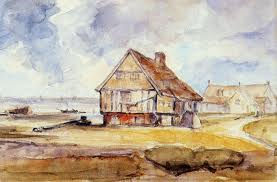
Some of the early artists were contemporaries of John Constable (see above) and they became followers of his style of painting, continuing his legacy into the late 19th century. This group of artists did not constitute a formal “school” as did the similar group of artists in Norfolk led by John Crone, who founded the Norwich Society of Artists in 1803 (the ‘Norwich School’), but they were a small group of self-taught, local artists who painted their familiar surroundings. The group of artists who are usually included in the ‘Suffolk School’ are Thomas Churchyard, Edward Smythe, Thomas Smythe, Robert Burrows, Frederick Brett Russell, John Moore, John Duval and Christopher Maskell.One of Constable’s closest followers was the Woodbridge solicitor and part-time artist Thomas Churchyard (1798-1865). Churchyard collected and copied Constable’s work and also that of Thomas Gainsborough (see above). He produced a large amount of watercolour sketches and landscape paintings of the Suffolk countryside around Woodbridge. (see above right, Churchyard's watercolour of Aldeburgh Moot Hall)

The reputation of the two Smythe brothers of Ipswich is very high in the art world for their beautifully observed dep ictions of rural and domestic Suffolk life during the second half of the 19th Century. At an auction in December 2011 two of their works sold for a total of just under £300,000. Edward Smythe (1810-1899) is famous for his painting of the Master and Hounds of the Suffolk Hunt before Euston Hall (1865), while the work of his brother, Thomas (1825-1906), became instantly recognisable when his famous “Snowball Fight” scene was widely reproduced on Christmas cards and jigsaw puzzles in the UK and America (see picture, left).
Robert Burrows (1810-1883) was another Ipswich artist, who painted scenes of the River Orwell and Suffolk landscape. John Moore (1820–1902), born in Woodbridge, preferred to paint the East coast. He became an active member of the Ipswich Art Club on its formation in 1875, where he regularly exhibited until a year before his death. Although born in Kent John Duvall (1816-1892) moved to Ipswich before 1852 where he is recorded as a “teacher of drawing”. At this time Duvall was a portrait painter but the spread of photography caused a decline in portrait commissions; consequently Duvall began to specialise in horse portraits. He was responsible for the illustrations in the Suffolk Horse Society Stud book.
Robert FitzRoy
Just to the north of Bury St Edmunds, the small village of Ampton is the birthplace of Vice Admiral Robert FitzRoy (1805 – 65), grandson of the 3rd Duke of Grafton & best known as the captain of HMS Beagle during Charles Darwin’s five year voyage to South America between 1831 & 1836. Although FitzRoy & Darwin got on well during their time at sea, FitzRoy, as a Creationist, found Darwin’s theory of evolution abhorrent &, upon their return to England, was outspoken in his condemnation of the idea that man had evolved from apes.
Prior to the journey with Darwin, FitzRoy & the Beagle had already made one surveying voyage to South America between the years 1828 & 1830, at which time he had named several islands along the pacific coast including Islas Ipswich, Islas Grafton & Isla Londonderry (Viscount Ipswich is a subsidiary title of the Dukes of Grafton. FitzRoy was related to the Marquess of Londonderry on his mother’s side). FitzRoy’s surveying work in Tierra del Fuego & along the Pacific coast of South America was to prove invaluable for navigation; the charts produced from his work being used for more than a century.
In between the two voyages, FitzRoy stood, unsuccessfully, as Tory candidate for Ipswich in the General Election in May 1831.
In 1839 Narrative of the surveying voyages of H.M.S. Adventure and Beagle was published; a four volume work to which FitzRoy contributed one volume, as did Darwin.
After a spell as governor of New Zealand from 1843 - 1845, FitzRoy returned to Britain & was made superintendent of the Royal Naval Dockyards at Woolwich, before being given his final sea command, HMS Arrogant, in 1849. In 1854 he was appointed Meteorological Statist to the Board of Trade (the forerunner of the Meteorological Office) where he was instrumental in the development of more accurate weather forecasts for shipping.

In April 1865, having suffered for several years with depression, FitzRoy commited suicide by slitting his throat. He is buried in the churchyard of All Saints Church in Upper Norwood, London.
Several places are named after him, including Mount Fitz Roy on the Argentina-Chile border, the settlement of Fitzroy in the Falkland Islands & Port Fitzroy in New Zealand. In 2002 the shipping area off the coast of Spain formerly called Finisterre was renamed FitzRoy in his honour. He also has a South American conifer; Fitzroya cupressoides, named after him, as well as Delphinus fitzroyi; a species of dolphin discovered by Darwin (now more commonly known as the Dusky Dolphin Lagenorhynchus obscurus, see photo, right) . He has also appeared on Royal Mail commemorative stamps in both the Falkland Islands & St Helena.
(See also www.planetipswich.com, Islas Ipswich page, & Viscount Ipswich section on the Ips Misc. page)
Edward FitzGerald
Best known for his translation of The Rubáiyát of Omar Khayyám, Edward Purcell was born at Bredfield near Woodbridge in March 1809. The family name change to FitzGerald was brought about in 1818, after his father John assumed the name of his wife’s family, one of the wealthiest families in England at that time, in order to inherit her father’s fortune. Upon the family’s return to England from a brief period in France, Edward went to King Edward VI Grammar School in Bury St Edmunds. In 1826 he went to Trinity College, Cambridge, where he became friends with future literary giants such as the poet Alfred Tennyson & the novelist William Makepeace Thackeray. After another stint in France from 1830, FitzGerald returned to Suffolk, where he was to spend the rest of his life; living at various times at Wherstead, Boulge & Woodbridge.
FitzGerald’s first published work was Euphranor, based on his life in Cambridge. This appeared in 1851, & the following year saw the publication of Polonius. By this time he was studying Spanish poetry &, in 1853, began studying Persian literature at Oxford.
FitzGerald first encountered the Persian philosopher & poet Omar Khayyám (1048 -1131) in 1857, after being sent some of the latter’s quatrains by his Oxford professor Edward Byles Cowell. Two years later, FitzGerald published (anonymously at first) The Rubáiyát of Omar Khayyám; a selection of translations of the poet’s ruba'i, (two-line stanzas with two parts per line). A slow seller at first, it eventually became popular after being discovered by the poets Rossetti & Swinburne. In 1868, a second edition was published, with two more editions appearing in FitzGerald’s lifetime & a fifth being published posthumously. The contents of each edition differed somewhat, & criticism has been forthcoming from some quarters that the poet’s work has been paraphrased, or even made up by FitzGerald himself. Nevertheless, the work remains popular to this day.
FitzGerald also published translations from the Persian of Jami's Salaman o Absal & Attar of Nishapur's Mantic-Uttair (the latter posthumously) & as well as plays by the Spanish writer Calderón.
In 1856 he married Lucy Barton, daughter of the Quaker poet Bernard Barton. From the 1860s onwards, FitzGerald developed an interest in the sea; keeping a yacht at Lowestoft, as well as being part owner of a herring lugger. In 1869 he published Sea Words & Phrases along the Suffolk Coast.
Edward FitzGerald died at home in 1883 & is buried in Boulge churchyard just north of Woodbridge. Legend has it that the rose bushes that grow around his grave originated from seeds taken from those at the grave of Omar Khayyám.
Benjamin Britten
Composer, conductor & pianist Edward Benjamin Britten (better known as just Benjamin Britten) was born in Lowestoft, Suffolk in November 1913. Encouraged by his mother Edith, who gave him his first piano lessons, he made his first attempts at composition at the age of five, after which he composed prolifically. He began formal piano lessons at the age of seven, & viola lessons at ten. When he was 14, he became a pupil of the composer Frank Bridge, after hearing the latter’s orchestral poem The Sea. From 1930 to 1933 he attended the Royal College of Music in London; studying composition under John Ireland & piano under Arthur Benjamin. His first compositions to attract attention were written during this period, notably Sinfonietta Op. 1, A Hymn to the Virgin (1930) & A Boy was Born (1934). After writing the film score for the documentary The King's Stamp in 1935, & collaborating with poet W H Auden, he met tenor Peter Pears, who not only became his musical collaborator, but also his life partner. In 1939 the pair moved to America; living in the village of Amityville in Suffolk County, New York, before returning to Britain in 1942; at which point, as pacifists, they applied to become conscientious objectors. During his American sojourn, Britten composed Seven Sonnets of Michelangelo, the first of many song cycles that he would write for Pears. It was also whilst in America that Britten first encountered Balinese gamelan music through Canadian composer Colin McPhee. This influence later manifested itself in such works as the ballet The Prince of the Pagodas (1957) & the opera Death in Venice (1973).
During the early 1940s, Britten wrote what was to become one of his most famous works, the opera Peter Grimes, which is based on the work of Suffolk poet George Crabbe (see above). It premiered at the Sadler’s Wells Theatre in London in 1945, & was the first in a series of English operas written over the next few years, including Billy Budd (1951), The Turn of the Screw (1954) & A Midsummer Night’s Dream (1960); the latter being based on Shakespeare’s play of the same name. In 1946 he wrote The Young Person's Guide to the Orchestra, which originally accompanied a British Government educational film entitled Instruments of the Orchestra. It would become one of his best known works. In 1962 Britten completed the War Requiem; a non-liturgical setting of the Requiem Mass, written for the consecration of the newly rebuilt Coventry Cathedral. It is widely regarded as his greatest success. This posthumously received a Grammy Hall of Fame Award in 1998.
In 1948 Britten, along with Peter Pears & librettist Eric Crozier, founded the Aldeburgh Festival in the town that the pair had made their home on the Suffolk coast. Established originally for the English Opera Group, which Britten had co-founded the previous year, the festival soon expanded to include poetry readings, literature, drama, art exhibitions, lectures & a wide range of classical music performances. Initially held in Aldeburgh Jubilee Hall, the festival soon outgrew this venue, with events taking place in the neighbouring towns of Blythburgh, Orford & Framlingham. In the 1960s, the festival acquired a new, larger concert hall with the conversion of Snape Maltings. Although extensively renovated, the venue still retains much of the original character of nineteenth century barley malthouses. The new concert hall was opened by the Queen in June 1967. Since 2007 the festival has expanded further to include electronic & experimental music events.
In 1953 Britten was appointed a Companion of Honour for his services to music. This was followed in 1965 with the appointment to the Order of Merit, & in 1976 he accepted a life peerage & became Baron Britten of Aldeburgh.
Only months later, on 4th December 1976, Benjamin Britten died of a heart attack at his Aldeburgh home. He is buried in the churchyard of St. Peter and St. Paul's Church in the town, next to Sir Peter Pears. Two years after his death, a memorial stone to him was unveiled in Westminster Abbey. The Red House, in which Britten & Pears lived for more than thirty years, is now the headquarters of the Britten-Pears Foundation; an organisation that promotes the pair’s work.
Brian Eno
Musician, composer & record producer Brian Eno was born in Woodbridge, Suffolk in May 1948. He went to St Joseph’s College in Ipswich, before studying art at Ipswich Art School & Winchester School of Art. St Joseph’s had been founded by the St John le Baptiste de la Salle order of Catholic brothers, & whilst a student there he added this to his birth-name; becoming Brian Peter George St. John le Baptiste de la Salle Eno. Despite this, he is now better known simply as Eno.
After forming & experimenting with improvisational bands at school, Eno’s first appearance on record is on The Great Learning (1971) by the experimental music ensemble Cornelius Cardew’s Scratch Orchestra. His musical career took off, however, in 1971 when he joined the band Roxy Music. Eno appeared on synthesiser & backing vocals on the band’s first two albums, Roxy Music (1972) & For Your Pleasure (1973), plus the hit singles Virginia Plain & Pyjamarama, before leaving after disagreements with the band’s frontman Bryan Ferry.
During this period, Eno was also a member of the the Portsmouth Sinfonia, a performance art-classical orchestra. He produced two of their albums, both released in 1974 (The Portsmouth Sinfonia Plays the Popular Classics & Hallellujah! The Portsmouth Sinfonia Live At The Royal Albert Hall) as well as playing clarinet on both recordings.
After leaving Roxy Music, Eno brought out four song-based albums, playing a variety of instruments & singing on Here Come the Warm Jets (1973), Taking Tiger Mountain (By Strategy) (1974), Another Green World (1975) & Before and After Science (1977). He also contributed to the June 1st 1974 live album with Kevin Ayers, John Cale & Nico, the Quiet Sun album Mainstream (1975) & the 801 Live album (1976) (The name 801 being taken from the lyrics of the song The True Wheel, which appears on the Taking Tiger Mountain (By Strategy) album).
In 1975 he also brought out Discreet Music, the first release on his own Obscure Records label. Other artists whose work later came out on the label include Michael Nyman & John Cage. From this point onwards Eno’s work has veered away from his more pop orientated earlier work to instrumental & electronic music. He is widely credited with coining the term “ambient music” to describe this mood music. Some of his many solo albums since this time include Music for Films (1978), Ambient 4: On Land (1982), Thursday Afternoon (1985) & Another Day on Earth (2005). Although proficient on a wide variety of instruments, Eno separates his role from that of the traditional instrumentalist, describing himself as a “non-musician”, and using the term “treatments” to describe his modification of the sound of musical instruments.
On some of his albums, such as Apollo (1983) & Music for Films III (1988), Brian has collaborated with his brother Roger Eno, himself a multi-instrumentalist who has brought out several solo albums of his own, beginning with Voices in 1985.
Alongside his purely solo work, Eno has also collaborated with many other artists over the years, including Robert Fripp of King Crimson, the German electronic duo Cluster & their offshoot band Harmonia, David Byrne of Talking Heads, Jon Hassell, John Cale, Peter Sinfield & Harold Budd. His most famous collaborations, however, are with David Bowie on the latter’s ‘Berlin Trilogy’ of albums, Low, “Heroes” & Lodger, which came out during the period 1977-79. His contribution to the 1974 Genesis album The Lamb Lies Down on Broadway, is credited as ‘Enossification’.
As well as a performer, Brian Eno is also a well known record producer, one of his first producing credit being for the Lucky Leif and the Longships album in 1975 by Robert Calvert of Hawkwind fame. With Daniel Lanois he co-produced several of U2’s best known albums, such as The Unforgettable Fire (1984), The Joshua Tree (1987) & Achtung Baby (1991). He has also worked with such diverse acts as Talking Heads, Devo, Ultravox, Coldplay & Grace Jones amongst others.
In 1994 Eno was approached to compose The Microsoft Sound; a piece of music lasting only six seconds to be used as the start up music-sound of the Windows 95 operating system. During the 1990s Eno also began experimenting with what he termed “generative music”; self-generating musical systems in which several independent musical tracks of varying lengths are blended together to play concurrently. When each individual track finishes, it immediately restarts again, mixing with the other ongoing tracks & creating an almost infinite combination of sounds, in which it is almost impossible to hear exactly the same music twice.
In the 1970s Eno collaborated with Peter Schmidt on Oblique Strategies, a set of printed cards, each of which offers a phrase or cryptic remark intended to be used by musicians & other artists to break a creative block or dilemma situation. Since their first appearance in 1975, various editions of Oblique Strategies have appeared over the years, with the number of cards differing from edition to edition. Many editions are now collectors’ items & change hands for considerable sums of money.
Away from music, Brian Eno has taken an active interest in politics, & is a columnist for the Sunday newspaper The Observer. He has frequently contributed to political debates, such as speaking out against Israel’s occupation of the Gaza Strip. In December 2007 he was appointed as the party’s youth affairs adviser by leader of the Liberal Democrats, Nick Clegg.
A selection of Brian Eno's recordings:
LPs:
Eno - Another Green World
Cluster & Eno
Fripp & Eno - (No Pussyfooting)
Quiet Sun - Mainstream
CDs:
Brian Eno/Peter Sinfield - In a Land of Clear Colours
Eno - Taking Tiger Mountain (By Strategy)
Harmonia 76 - Tracks & Traces
Fripp & Eno - The Equatorial Stars

Charles Dickens - The Suffolk Connection
Although world famous author Charles Dickens (1812 – 70) never lived in Suffolk, he was a frequent visitor to the county & several places in his novels are based on Suffolk towns & villages. Dickens is known to have bought a copy of the book Suffolk Words & Phrases (1823) by Edward Moor, which gave him an insight into the dialect. He may also have been acquainted with the work of the Suffolk poet George Crabbe (see above); his description of Mr Peggotty’s beach house in David Copperfield being reminiscent of Crabbe’s description of a fisherman’s shed.
It is known that Dickens visited the Lowestoft area in 1848 as part of a walking holiday, at which time he visited his friend Sir Morton Peto at Somerleyton Hall. He may also have visited Blundeston Hall. The village of Blundeston itself is thinly disguised as Blunderstone in David Copperfield (1849/50), with the birthplace of the eponymous main character, the Rookery, being based on Blundeston Rectory. The Plough Inn in the village is where David Copperfield & Barkis the Carrier are supposed to have begun their journey to London. Today, several of the streets in Blundeston are named after characters from David Copperfield, such as Barkis Meadow & Micawber Mews. There is also a Dickens Court.
Dickens first visited Bury St Edmunds in 1834 & was a frequent visitor to the town thereafter; staying at the Angel Hotel & giving readings of his work at the nearby Athenæum (see photo, left). Both the town & the hotel are featured in The Pickwick Papers, published in 1836/7:

“The coach rattled through the streets of a handsome town of thriving and cleanly appearance and stopped before a large Inn situated in a wide open street facing the old abbey. “This must be Bury St Edmunds, and this” said Mr Pickwick, looking up, “is the Angel”.”
The hotel is still in existence today, with one of the rooms being named the “Charles Dickens Room”.
Another location in Bury that Dickens used in The Pickwick Papers is South Hill House, which in the mid nineteenth century was an “Academy for Young Ladies” & was the inspiration for Westgate House girl’s school in the novel.Ipswich, which Dickens first visited in 1834, also features in The Pickwick Paper, with Mr Pickwick staying at the Great White Horse Hotel. For more details go to Planet Suffolk’s sister site www.planetipswich.com, Ipswich, England page.
A third Suffolk town that Dickens used for inspiration in The Pickwick Papers is Sudbury. Dickens was working as a journalist for the Morning Chronicle when, in 1835, he visited Sudbury to report on the General Election. In the novel, the town is disguised as Eatanswill & much of the electioneering & corruption that he witnessed is reflected in the book’s plot, albeit with a large dose of artistic license. The Peacock, at which Mr Tracy Tupman & Mr Augustus Snodgrass stay during the election, is probably based on the now demolished Swan, which once stood near to the Corn Exchange.
Sudbury based brewers Mauldons (established 1795) now produce a range of beers with a Dickensian theme, such as Micawbers Mild, Eatanswill Old, Dickens, Peggotty’s Porter & Pickwick.
Satis House in Yoxford, situated on the A12 between Saxmundham & Southwold is mentioned in the novel Great Expectations (1860/1). It may even have been here that Dickens wrote part of the novel, which was originally published in serial form in the publication All the Year Round, between December 1860 & August 1861.
When the central character Philip Pirrip or ‘Pip’ enquires about the name of the house, he is told by Estella Havisham that:
“It's Greek, Latin or Hebrew, may be all three, for enough” & that “It means that whoever lives in the house could wish for nothing more”.
At that time the house belonged to the Hulkes family, who also owned property close to Gadshill Place in London where Dickens lived from 1856 onwards, & who later attended the wedding of Dickens’ daughter. Satis House was later owned by barrister William Anthony Collins, a relative of writer Wilkie Collins (1824 - 89); the latter being a great admirer of Dickens’ work, who based part of his own novel No Name (1862) at Aldeburgh. Today the eighteenth century Satis House is a Grade II listed building & is run as a hotel & restaurant.
Dickens also has a connection with Suffolk County, Massachusetts. On his second American reading tour, which began in December 1867, Dickens stayed in Boston & was a regular visitor, along with several other famous literary figures, to The Old Corner Bookstore at the junction of Washington and School Streets. (See Freedom Trail section on the Suffolk County, Mass. Page)
Why not sign the Guestbook?


Comments